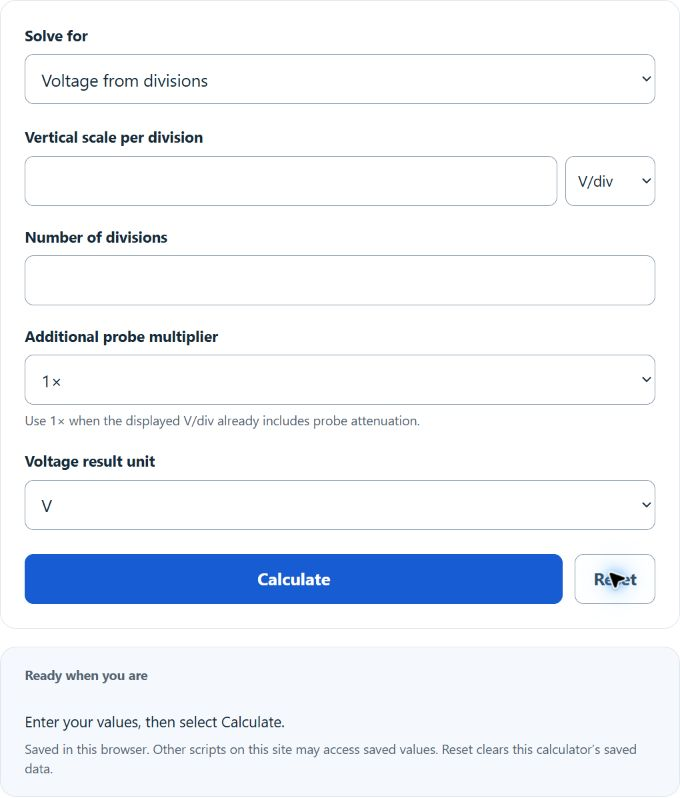
Calculate oscilloscope voltage from divisions, vertical scale, and probe attenuation, plus convert Vpp, Vrms, Vp, bandwidth, and rise time.
Related Calculators
- Capacitive Current Calculator
- Capacitor Charge Current Calculator
- Induced Voltage Calculator
- Energy Release Calculator
- All Physics Calculators
Oscilloscope Voltage Formula
The following formula is used to calculate the voltage, vertical scale per division, or the number of divisions on an oscilloscope.
Variables:
- V is the voltage
- S is the vertical scale per division (V/div)
- D is the number of divisions; P is the additional probe multiplier (1 if the displayed scale already includes attenuation)
Use V = S × D × P, S = V / (D × P), or D = V / (S × P). Set P to 1 when the displayed V/div already accounts for the probe. Voltage conversions assume a symmetric waveform centered on zero; bandwidth/rise-time estimates use the instrument’s response-dependent constant.
What is an Oscilloscope?
An oscilloscope is an electronic test instrument that graphically displays varying signal voltages, usually as a two-dimensional plot of one or more signals as a function of time. It is used to observe the change of an electrical signal over time, allowing for the measurement of various signal properties such as amplitude, frequency, and phase. Oscilloscopes are essential tools in the fields of electronics, telecommunications, and engineering for diagnosing and troubleshooting circuits and systems.
How to Calculate Oscilloscope Voltage?
The following steps outline how to calculate the voltage, vertical scale per division, or the number of divisions on an oscilloscope.
- First, determine the voltage (V) if it is not given.
- Next, determine the vertical scale per division (S) if it is not given.
- Next, determine the number of divisions (D) if it is not given.
- Choose the quantity to solve for and use V = S × D × P (P = 1 for an already compensated scale).
- After inserting the values and calculating the result, check your answer with the calculator above.
Example Problem :
Use the following variables as an example problem to test your knowledge.
Voltage (V) = 10V
Vertical Scale per Division (S) = 2V/div
Number of Divisions (D) = 5