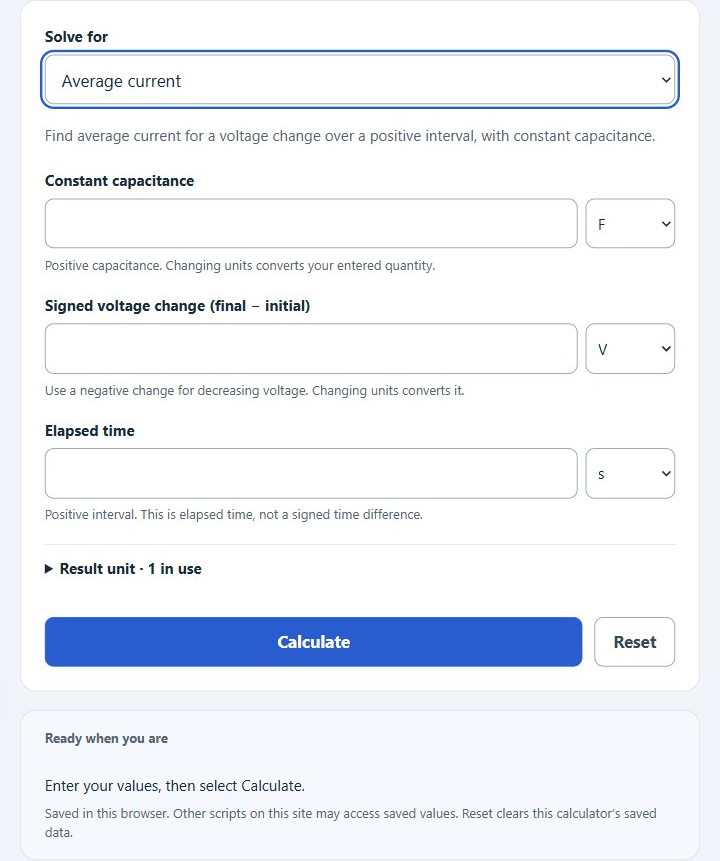
Choose average capacitive current, positive capacitance, signed voltage change or elapsed time. Enter the other three values; use Calculation details for the formula and conversions.
- All Physics Calculators
- All Electrical Calculators
- Capacitor Voltage Calculator
- Capacitor Charge Time Calculator
- Capacitor Size Calculator
- Capacitor Charge Current Calculator
Capacitive Current Formula
For an ideal constant capacitance, the finite-interval formula gives average current. It equals instantaneous current only for a constant voltage slope. The main formula is:
- I = signed average capacitive current, usually in amperes (A)
- C = total capacitance, usually in farads (F)
- ΔV = change in voltage, usually in volts (V)
- Δt = change in time, usually in seconds (s)
The calculator can also rearrange the same relationship to solve for any one missing value.
Use I = C * ΔV / Δt when capacitance, voltage change, and time change are known. Use C = I * Δt / ΔV when you need the capacitance required for a given current. Use ΔV = I * Δt / C to find how much the capacitor voltage changes. Use Δt = C * ΔV / I to find how long the voltage change takes at a given current.
All values are converted to base units before calculation: farads, volts, seconds, and amperes. Choose the result unit in the expandable Result unit section. Changing input units converts the entered physical quantity. Positive capacitance and elapsed time are required; signed current and voltage change follow the same passive sign convention.
Common Unit Conversions for Capacitive Current Calculations
These conversions are useful when checking inputs or comparing results by hand.
| Quantity | Unit | Equivalent base unit |
|---|---|---|
| Capacitance | 1 mF | 0.001 F |
| Capacitance | 1 µF | 0.000001 F |
| Capacitance | 1 nF | 0.000000001 F |
| Voltage | 1 mV | 0.001 V |
| Voltage | 1 kV | 1000 V |
| Time | 1 min | 60 s |
| Current | 1 mA | 0.001 A |
Illustrative Capacitance Ranges
These broad examples are not component selection limits; check the actual circuit and manufacturer specifications.
| Capacitor type or use | Illustrative capacitance range | Common unit |
|---|---|---|
| Small-signal or RF circuits | 1 pF to 100 nF | pF, nF |
| General electronics decoupling | 10 nF to 10 µF | nF, µF |
| Power supply filtering | 10 µF to several mF | µF, mF |
| Supercapacitor applications | 1 F and higher | F |
Example Calculations
Example 1: Calculate capacitive current
You have a 100 µF capacitor, and its voltage changes by 12 V in 0.5 s.
Convert capacitance to farads:
Substitute the values:
The average capacitive current is 0.0024 A, or 2.4 mA.
Example 2: Calculate required capacitance
You need 0.05 A of current for a 10 V voltage change over 2 s.
Substitute the values:
The required capacitance is 0.01 F, or 10 mF.
FAQs
What is capacitive current?
Capacitive current is the current associated with a changing voltage across a capacitor. A capacitor does not pass steady DC current through its dielectric, but current flows into or out of its plates when the voltage across it changes. Faster voltage change or larger capacitance produces more current.
Why does time affect capacitive current?
Time affects current because current is the rate of charge movement. For the same capacitance and voltage change, a shorter time means charge is moved faster, so the current is higher. A longer time means the same change happens more slowly, so the current is lower.
Can voltage change be zero in this calculation?
If voltage change is zero, the calculated capacitive current is zero when capacitance and time are finite. However, if you are solving for capacitance using C = I * Δt / ΔV, voltage change cannot be zero because it would require division by zero.