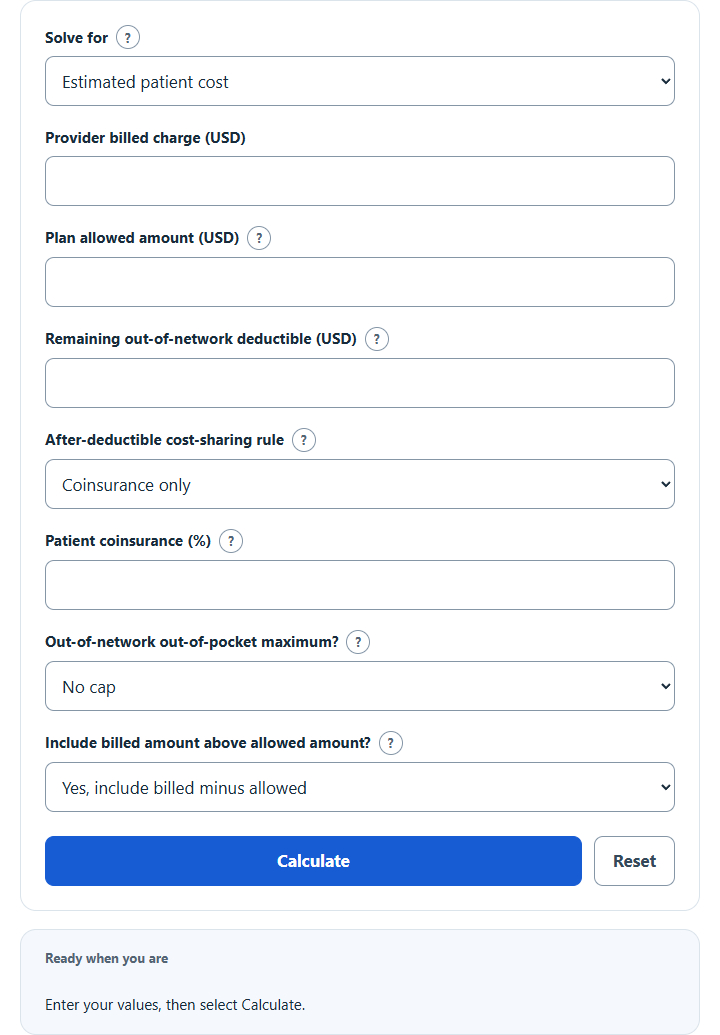
Estimate your out-of-pocket cost for out-of-network care from the billed charge, plan allowed amount, deductible and coinsurance, plus any balance bill.
Out-of-Network Cost Formula
Out-of-network cost sharing is generally calculated from the plan's allowed amount rather than the provider's billed charge:
D = min(Allowed, Remaining deductible)
P = min(Applicable copay, Allowed - D)
C = round_to_cents((Allowed - D - P) × Patient coinsurance)
Covered share before cap = D + P + C
This deductible-first model supports coinsurance only (P = 0), copay only (C = 0), or copay followed by coinsurance on the remainder. Use only a sequence confirmed by the plan. An optional confirmed out-of-network cap is applied to this covered share; 0 remaining means reached. No cap is modeled when none is selected. All modeled covered cost sharing is assumed to count toward the selected cap. The balance-bill scenario is separate:
Covered share = min(Before-cap share, Remaining cap), only if an applicable cap is selected
Balance = Billed - Allowed if included; otherwise 0
Patient cost = Covered share + Balance
Insurer payment = Allowed - Covered share
Variables:
- Billed Charge is the amount requested by the provider
- Allowed Amount is the plan's recognized amount for the service
- Deductible Applied is the smaller of the allowed amount and remaining deductible
- Coinsurance is the patient's percentage after the deductible
- Remaining OOP Max is the amount left before the applicable plan maximum
- Balance Bill is the billed amount above the allowed amount when the provider can collect it
The insurer payment is the allowed amount minus the modeled plan-counted patient share. A balance bill is outside that allowed amount.
Out-of-Network Cost Examples
The examples use coinsurance only: a 40% patient rate, a $1,000 remaining deductible, no copay, and a confirmed $6,000 remaining applicable out-of-network cap. The balance-bill choice is a hypothetical scenario, not a determination of liability.
| Billed charge | Allowed amount | Balance billing | Estimated patient cost | Estimated insurer payment |
|---|---|---|---|---|
| $5,000 | $2,500 | Yes | $4,100 | $900 |
| $5,000 | $2,500 | No | $1,600 | $900 |
| $2,000 | $1,200 | Yes | $1,880 | $120 |
| $10,000 | $4,000 | Yes | $8,200 | $1,800 |
Example Problems
Example 1: Include a balance bill.
A provider bills $5,000, the plan allows $2,500, $1,000 of deductible remains, and the patient owes 40% after the deductible.
With no copay, the covered patient share is $1,600: $1,000 deductible plus $600 coinsurance. A hypothetical $2,500 balance bill raises estimated patient cost to $4,100.
Example 2: Apply the out-of-pocket maximum.
The calculated plan cost share is $2,000, but only $500 remains to reach the applicable out-of-network maximum.
The plan-counted share is capped at $500. Any permitted balance bill is then added separately because it may not count toward the maximum.
Frequently Asked Questions
What is an allowed amount?
It is the maximum amount the plan recognizes for a covered service. Deductible and coinsurance are generally based on that amount, not necessarily the provider's full charge.
What is balance billing?
Balance billing occurs when a provider seeks the difference between the billed charge and the plan's allowed amount. Federal or state protections can prohibit it in certain situations.
Does out-of-network spending count toward my in-network maximum?
Out-of-network care and amounts above the allowed amount are generally excluded from an in-network out-of-pocket limit. Apply a separate out-of-network cap only if confirmed by the plan. Federal or state surprise-billing protections may also require in-network cost sharing; simply removing the balance bill while keeping out-of-network rates does not model those protections.