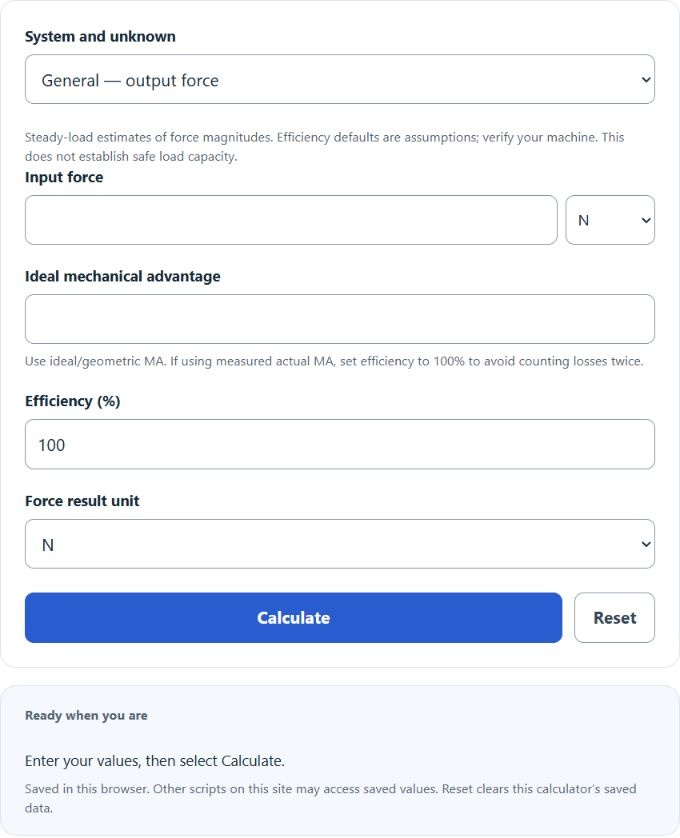
Calculate output force for mechanical advantage, levers, pulleys, hydraulic cylinders, and screw jacks from force, pressure, or torque inputs.
- All Physics Calculators
- All Force Calculators
- AMA (Actual Mechanical Advantage) Calculator
- Lever Force Calculator
- Effort Force Calculator
Output Force Formula
For a general simple machine, output force equals input force × ideal mechanical advantage × efficiency. Efficiency is a decimal fraction. If mechanical advantage is measured as the actual force ratio, it already includes losses; use 100% efficiency to avoid counting them twice.
- Where OF is the output force (N)
- IF is the input force (N)
- IMA is ideal mechanical advantage; η is efficiency as a fraction
For a lever use perpendicular moment arms. A simple pulley tackle uses its parallel supporting strand count and supplied overall efficiency. The optional equal-stage loss product is a simplified assumption, not a universal sheave/reeving model. Cylinder estimates use pressure times effective area with zero opposing gauge pressure; screw estimates use F = 2πTη / lead.
What is an Output Force?
Definition:
An output force measures the total force generated by a system with a given input force and mechanical advantage. In other words, it measures how much force a system, such as a lever, generates due to mechanical advantage.
How to Calculate Output Force?
Example Problem:
The following example outlines the steps and information needed to calculate Output Force.
First, determine the input force. In this example, the input force is found to be 100 N.
Next, use ideal mechanical advantage 4 and efficiency 100% (η = 1).
Finally, calculate the Output Force using the formula above:
OF = IF * IMA * η
OF = 100 × 4 × 1
OF = 400 N
FAQ
What is mechanical advantage and how is it calculated?
Mechanical advantage is a measure of the force amplification achieved by using a tool, mechanical device, or machine system. It is calculated by dividing the output force by the input force. For simple machines, such as levers and pulleys, the mechanical advantage can also be determined by the ratio of distances from the fulcrum or the ratio of the number of supporting ropes.
Can the output force ever be less than the input force?
Yes, the output force can be less than the input force if the mechanical advantage is less than one. This situation typically occurs in machines designed to increase speed or distance traveled rather than force, such as in the case of gears or pulleys designed to increase speed at the expense of force.
Are there any limitations to how much a mechanical advantage can increase an output force?
While theoretically, mechanical advantage can significantly increase an output force, practical limitations exist due to factors such as friction, the efficiency of the machine, and material strength. These factors can reduce the actual mechanical advantage achieved, making the real-world output force less than what pure calculations may predict.