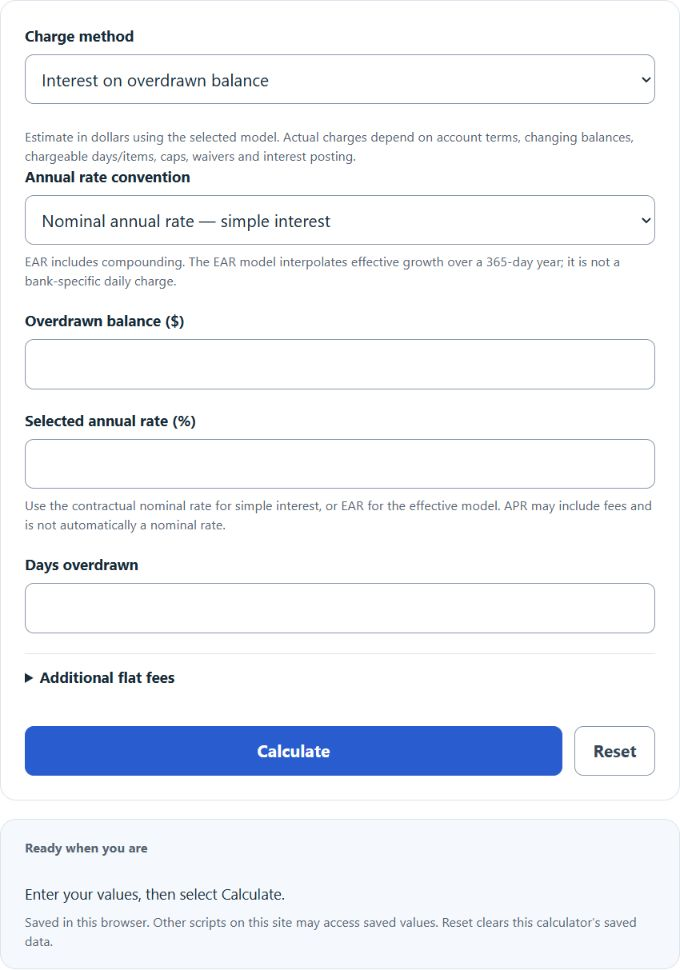
Calculate the total cost of an overdraft from interest on the overdrawn balance, a flat daily fee, or per-transaction charges, so you know what going overdrawn really costs.
Overdraft Cost Formula
The cost of an overdraft depends on how your bank charges. Use the formula that matches your account.
For a constant balance with a contractual nominal annual rate and simple interest on a 365-day basis:
OC = A * (R / 100) * (D / 365)
When the bank charges a flat daily fee:
OC = F * D
When the bank charges a fee for each eligible overdraft transaction:
OC = T * N
Where:
OC is the total overdraft cost ($). A is the overdrawn amount ($). R is the nominal annual interest rate (%) for the simple-interest formula. For the separate EAR equivalent-growth estimate, interest = A * ((1 + EAR / 100)^(D / 365) – 1); this interpolates effective growth and is not a bank-specific posting calculation. D is the number of days you stay overdrawn. F is the flat fee charged for each day overdrawn ($). T is the fee charged per-transaction ($). N is the number of chargeable overdraft transactions under the account terms. Additional flat fees are added to these formulas once.
The interest method spreads the charge across the days you are overdrawn, so paying the balance back sooner lowers the cost. The daily method applies a fixed charge for every day with a negative balance, regardless of size. The per-transaction method applies a set fee to each chargeable item; eligibility, waivers and daily caps depend on the account. If your bank combines methods, add any one-off flat fees on top using the additional fees field.
Typical Overdraft Charges by Method
The figures below are illustrative ranges, not current offers or a prediction of your charges. Use your own account terms and fee schedule, including caps and waivers.
| Charge method | Typical range | How it adds up |
|---|---|---|
| Interest / EAR | 15% to 40% EAR | Grows with balance and days |
| Flat daily fee | $0.50 to $5 per day | Grows with days only |
| Per-transaction fee | $10 to $35 each | Grows with number of items |
Example Problems
Example 1. With a constant $1,200 balance, a 39.9% nominal annual rate and 21 days, the simple-interest estimate is OC = 1200 * (39.9 / 100) * (21 / 365) = $27.55. If 39.9% instead means EAR, the equivalent-growth estimate is 1200 * ((1 + 0.399)^(21 / 365) – 1) = $23.41. Actual bank posting, changing balances and fees can differ from either estimate.
Example 2. Your bank charges a flat $35 fee for each transaction made while overdrawn, and 3 transactions cleared before you topped up the account. Using the per-transaction method, OC = 35 * 3 = $105.00.
FAQ
Is an overdraft fee the same as overdraft interest? No. A fee is a fixed charge applied per item or per day, while interest is a percentage charged on the amount you are overdrawn for the time you owe it. Some accounts use only one method and some combine both, which is why this calculator lets you pick the method and add flat fees separately.
How can I lower the cost of an overdraft? On an interest based account, paying the balance down faster reduces the number of days the rate is applied, which lowers the cost. On fee based accounts, reducing the number of overdrawn days or transactions is what cuts the charge.
What interest rate should I enter? Match the selected rate convention. Use the contractual nominal annual rate for simple interest or EAR for the equivalent-growth estimate. APR can include fees and is not automatically the nominal rate. Ask the bank for its daily rate, day-count basis and posting method when you need an account-specific charge; EAR alone is insufficient.