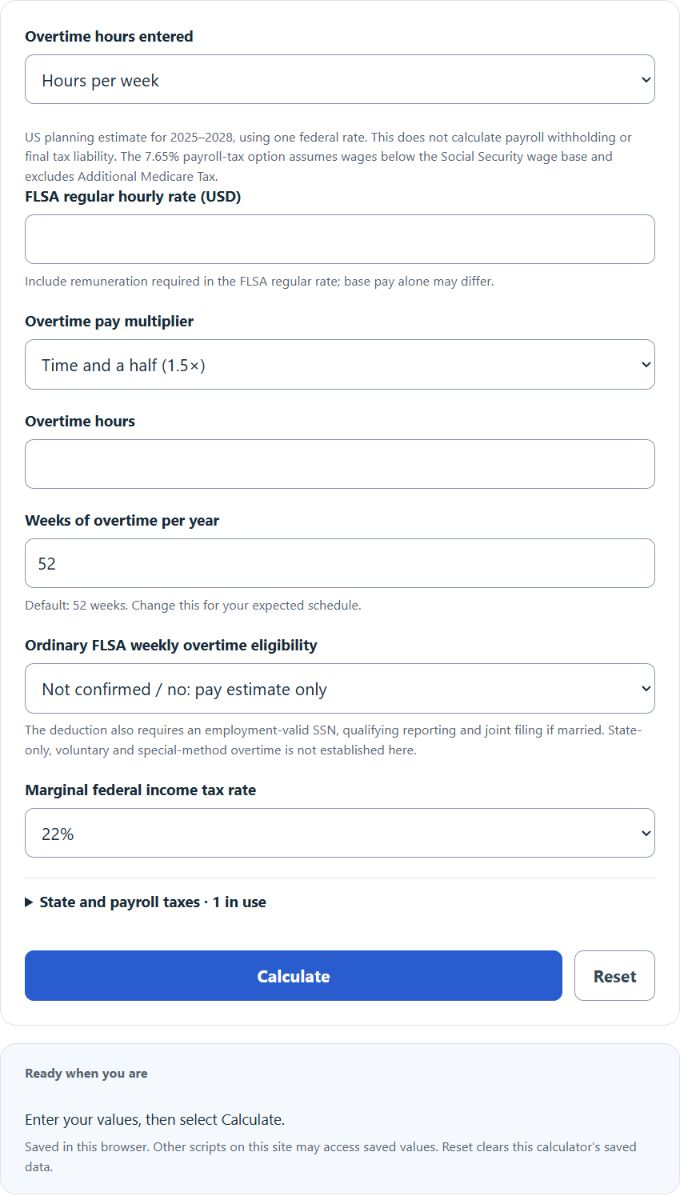
Overtime tax calculator: estimate taxes on overtime pay and your No Tax on Overtime deduction (2025-2028), including caps, income phase-outs, and estimated federal tax savings.
Overtime Tax Formula
The calculator first finds your gross overtime pay and the statutory qualifying premium for confirmed ordinary FLSA overtime:
OT = R * m * H
 P = R * 0.5 * H (ordinary qualifying FLSA weekly overtime only)
It then applies the federal No Tax on Overtime deduction (tax years 2025 through 2028) and estimates your taxes:
D = max(0, min(P, cap) - 100 * floor(max(0, MAGI - threshold) / 1000))
 Savings = D * f
Variables:
- OT is gross overtime pay and P is the qualifying extra half of the FLSA regular rate; extra voluntary premium, including the amount above time-and-a-half when paid double time, does not increase this deduction
- R is your regular hourly rate, m is the overtime multiplier (1.5 for time and a half), and H is overtime hours
- D is the qualified overtime deduction; cap is $12,500 for single filers or $25,000 for joint filers, reduced by $100 for each complete $1,000 of modified adjusted gross income above $150,000 ($300,000 joint)
- f is your marginal federal tax bracket, so Savings is the federal income tax the deduction eliminates when you file
Enter your rate, multiplier, and overtime hours, pick your filing status and bracket, and the calculator shows the gross overtime, the deduction, flat-rate estimates for federal, state, and payroll taxes, and your estimated effective tax rate on overtime after the deduction benefit. Confirm ordinary FLSA eligibility and enter MAGI to estimate a deduction; unconfirmed eligibility gives a pay-only estimate. The deduction is claimed on your tax return. For 2026, you may account for an expected deduction on a new Form W-4, step 4(b), so withholding can change during the year. This calculator does not prepare a W-4 or reproduce payroll withholding.
Overtime Deduction Value by Tax Bracket
Federal tax saved when the full overtime premium qualifies, for a worker with $10,000 of overtime premium in the year (below the caps and income thresholds).
| Marginal bracket | Qualified deduction | Federal tax saved |
|---|---|---|
| 10% | $10,000 | $1,000 |
| 12% | $10,000 | $1,200 |
| 22% | $10,000 | $2,200 |
| 24% | $10,000 | $2,400 |
| 32% | $10,000 | $3,200 |
How much overtime premium a common time-and-a-half schedule generates in a year (52 weeks):
| Hourly rate | OT hours/week | Gross OT/year | Premium (qualifies) |
|---|---|---|---|
| $20 | 5 | $7,800 | $2,600 |
| $25 | 5 | $9,750 | $3,250 |
| $25 | 10 | $19,500 | $6,500 |
| $30 | 10 | $23,400 | $7,800 |
| $35 | 12 | $32,760 | $10,920 |
| $40 | 15 | $46,800 | $15,600 |
Example Problems
Example 1: A single filer earns $25 per hour and works 10 hours of time-and-a-half overtime per week for 52 weeks, in the 22% bracket.
Gross overtime is 25 * 1.5 * 520 = $19,500. The premium portion is 25 * 0.5 * 520 = $6,500, under the $12,500 cap, so D = $6,500.
Federal tax saved is 6,500 * 0.22 = $1,430 when filing. Using flat estimates of 22% federal and 7.65% payroll tax, annual value before the deduction benefit is $13,718.25, and $15,148.25 including the $1,430 benefit. Actual payroll withholding can differ.
Example 2: A joint filer with $320,000 of MAGI and $9,000 of overtime premium.
MAGI is $20,000 over the $300,000 threshold, so the deduction is reduced by 20 * $100 = $2,000. The deduction is min(9,000, 25,000) – 2,000 = $7,000, saving 7,000 * 0.24 = $1,680 in the 24% bracket.
Frequently Asked Questions
Is overtime really tax-free now?
Not entirely. For 2025 through 2028 eligible taxpayers can deduct the qualifying premium portion of FLSA overtime, up to $12,500 ($25,000 joint). The straight-time part of an overtime hour is still fully taxable, Social Security and Medicare generally still apply, subject to their own wage-base and other rules. State treatment varies. The deduction reduces federal income tax only.
Does my paycheck get bigger right away?
It can if you submit a valid updated Form W-4 reflecting the expected deduction. Otherwise normal withholding continues, with the final benefit reconciled on your tax return. Beginning in 2026, employers report qualified overtime in W-2 box 12 using code TT; the special 2025 reporting relief does not apply to later years.
Who does not qualify?
The deduction covers overtime required by the federal FLSA, so exempt salaried employees with no FLSA overtime get nothing from it. Married taxpayers must file jointly to claim it, a valid Social Security number is required, and above $150,000 MAGI ($300,000 joint) the deduction phases out by $100 per $1,000 of extra income.
Rules reviewed October 20, 2026. The ordinary weekly method, double-time limitation, 2026 reporting and W-4 treatment follow IRS FAQ update FS-2026-13. Complete-$1,000 phaseout steps follow Schedule 1-A, Part III.