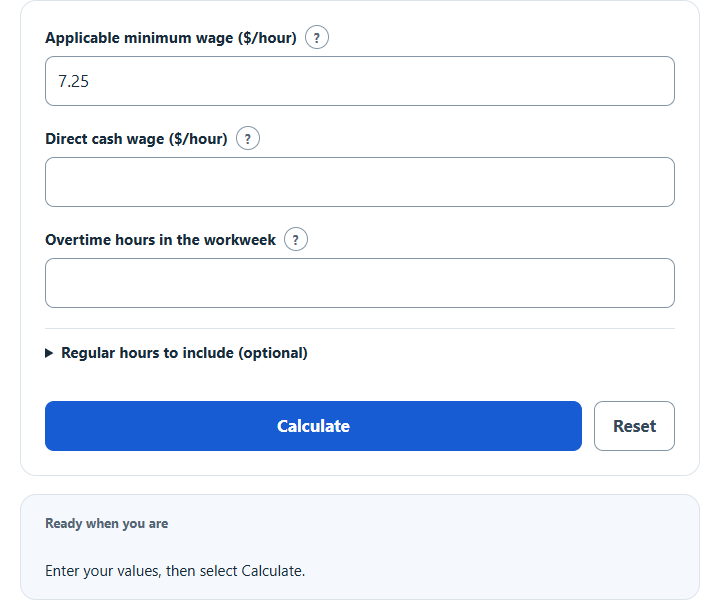
Calculate a tipped employee’s overtime rate and overtime cash pay from the minimum wage, direct cash wage and overtime hours, with the tip credit shown.
Tipped Employee Overtime Formula
Overtime generally uses the regular rate rather than only the reduced cash wage when a tip credit applies. This calculator assumes a single hourly rate with no other regular-rate pay. It uses the larger of the entered minimum and cash wage as the assumed regular rate, and subtracts an inferred credit only on the assumption that the whole credit is lawful, available, and supported by received tips:
OTcash = (R * 1.5) - TC
R is the model’s assumed regular rate. The modeled credit is the positive gap between the minimum and cash wage; it is zero when cash wage is at least the minimum. These are scenario assumptions, not an independent determination of the lawful credit or regular rate:
R = max(MW, CW)
TC = max(MW - CW, 0)
Variables:
- OTcash is the modeled direct cash rate for each entered overtime hour; tips are not added to the calculator’s cash-pay totals
- MW is the applicable minimum wage — the federal $7.25 or your higher state/local minimum
- CW is the direct cash wage per hour. The federal $2.13 floor applies only in an eligible tip-credit arrangement; higher state or local cash-wage requirements may apply.
- TC is the assumed lawful credit subtracted from the full modeled overtime rate. The calculator does not determine federal, state, or local credit eligibility or limits.
Enter the minimum wage, direct cash wage, and overtime hours for the scenario. The model accepts 0–128 overtime hours for one workweek and does not decide which hours qualify. When cash wage is below the minimum, it assumes the minimum is the regular rate and the entire inferred gap is a lawful, eligible credit. When cash wage is at least the minimum, it assumes no credit and uses 1.5 times the cash wage. Add 0–40 regular hours to see cash pay for all entered hours; blank regular hours omit that subtotal. A full-week payroll total requires all relevant hours and compensation to be included and correctly classified.
Illustrative Overtime Cash Scenarios
These are hypothetical arithmetic scenarios under the stated assumptions, not a verified list of legal wage or credit arrangements. Every inferred gap must be lawful and supported by received tips. A gap above $5.12 is not universally prohibited: DOL guidance describes additional overtime credit in certain higher-state-minimum situations when state law permits it. Hourly rates in this table are rounded to cents for comparison; the calculator displays more hourly precision and multiplies unrounded rates.
| Minimum wage | Cash wage | Tip credit | Modeled OT cash rate (rounded) | 1.5x cash wage (comparison) |
|---|---|---|---|---|
| $7.25 (federal) | $2.13 | $5.12 | $5.76 | $3.20 |
| $10.00 | $4.00 | $6.00 | $9.00 | $6.00 |
| $12.00 | $5.00 | $7.00 | $11.00 | $7.50 |
| $14.00 | $6.00 | $8.00 | $13.00 | $9.00 |
| $15.00 | $7.50 | $7.50 | $15.00 | $11.25 |
Example Problems
Example 1: Assume a covered server’s regular rate is $7.25, direct cash wage is $2.13, and a $5.12 credit is lawful, eligible, and supported by tips. There is no additional regular-rate pay. The entered week has 40 regular hours and 6 qualifying overtime hours.
TC = 7.25 – 2.13 = $5.12. The full overtime rate is 7.25 * 1.5 = $10.875, so OTcash = 10.875 – 5.12 = $5.755 per hour.
For 6 overtime hours, modeled overtime cash pay is 5.755 * 6 = $34.53, plus 40 * 2.13 = $85.20 of regular cash pay, for $119.73 of cash pay for these entered hours. Tips are not added to this total, and the model does not calculate any tip-shortfall make-up or omitted regular-rate compensation.
Example 2: In a hypothetical scenario, the minimum and assumed regular rate are $12.00, cash wage is $5.00, and 5 overtime hours are entered. This assumes the full $7.00 credit is lawful in the applicable jurisdiction, all eligibility requirements are met, tips support it, and no other regular-rate pay is present.
TC = 12.00 – 5.00 = $7.00 and OTcash = (12.00 * 1.5) – 7.00 = $11.00 per hour, so overtime cash pay is 11.00 * 5 = $55.00.
Frequently Asked Questions
Why isn’t tipped overtime just 1.5 times my cash wage?
When a lawful tip credit applies, overtime is generally based on the full regular rate before subtracting the permitted credit; multiplying only a reduced cash wage by 1.5 can understate the cash requirement. The actual regular rate can differ from the minimum because of other pay. In the calculator’s no-credit branch, 1.5 times the cash wage is used only under the assumption that this cash wage is the complete regular rate.
Do my tips count toward overtime pay?
Eligible received tips can support a lawful tip credit, so they can affect the cash amount the employer must pay. This tool shows only the modeled cash wages and does not add tips or test whether enough tips were actually received. The employer must satisfy applicable wage and overtime obligations, including any required make-up when tips are insufficient. Eligibility, notice, tip-retention requirements, and local rules must be checked separately.
What if my state does not allow a tip credit?
Where governing law does not allow a tip credit, a credit must not be subtracted. The model’s no-credit branch accepts a cash wage equal to or above the minimum and uses 1.5 times that cash wage, assuming it is the complete regular rate. If additional pay, daily overtime, multiple rates, or other rules apply, this simplified calculation is not a complete payroll determination.
Federal guidance checked October 24, 2026 against U.S. Department of Labor Fact Sheet 15 and Field Assistance Bulletin 2016-4. The federal minimum remains $7.25, with a maximum federal section 3(m) credit of $5.12 when its requirements are met; DOL also describes additional overtime credit in certain higher-state-minimum situations when state law permits it. Use applicable state or local standards. With $7.25 and $2.13 entered under the model’s assumptions, the cash overtime rate is $5.755/hour, shown directly within the calculator’s six-decimal hourly precision. Hours are multiplied by the unrounded rate before pay totals are rounded to cents. This simplified model excludes additional regular-rate items such as nondiscretionary bonuses.