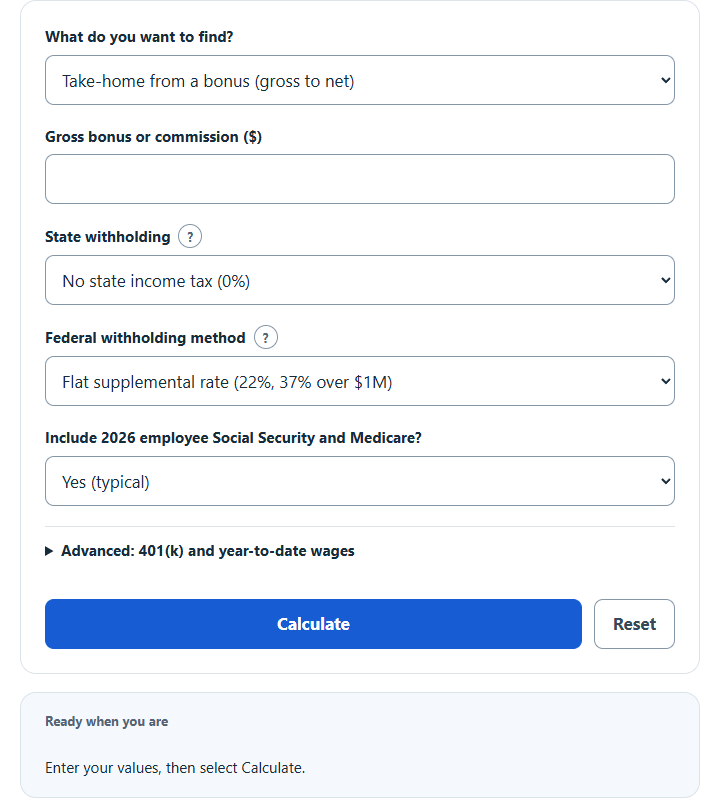
Calculate bonus tax and take-home pay from a bonus or commission with the 22% federal rate, FICA and your state, or find the gross bonus for a target net.
Bonus Tax Formula
The calculator estimates the tax withheld from a bonus using the percentage (flat rate) method that most employers apply to supplemental wages:
W = federal supplemental withholding + state withholding + Social Security + Medicare + Additional Medicare
Your take-home bonus is what remains after withholding:
N = B - W - C
Variables:
- W is the total tax withheld from the bonus
- B is the gross bonus amount
- F is the permitted optional 22% federal supplemental withholding rate up to $1,000,000 of supplemental wages for the year; the excess is subject to 37%. The entered prior supplemental wages determine the split. A custom rate below the threshold approximates employer withholding
- S is your combined state and local tax rate as a decimal
- Social Security is 6.2% of bonus wages up to the remaining 2026 $184,500 wage base; Medicare is 1.45% of all bonus wages, plus employer withholding of 0.9% above $200,000 of Medicare wages. Prior wages entered are used to split a bonus at those thresholds
- N is the net (take-home) bonus and C is any 401(k) contribution taken from the bonus
Choose what you want to solve for at the top. In gross-to-net mode you enter the bonus from your offer or payout notice and the tool shows the estimated deposit. In net-to-gross mode you enter the take-home you want and the tool works backward to the gross bonus your employer would need to pay, which is useful for negotiating a relocation payment or a make-whole bonus. A traditional 401(k) contribution entered under Advanced reduces federal and state withholding but not Social Security or Medicare.
2026 Aggregate Federal Withholding
Select Aggregate federal (2026) to estimate the extra federal income tax withheld when one bonus is combined with regular taxable pay. Enter federal taxable pay after eligible pre-tax deductions, your payroll frequency and the entries from your 2020-or-later Form W-4. This mode covers the first bonus in a payroll period and annual supplemental wages of at most $1 million; it is for standard resident wages, not exempt withholding, special nonresident rules or IRS lock-in arrangements.
Bonus federal withholding = W(regular taxable pay + taxable bonus) − W(regular taxable pay), with each period’s withholding rounded to cents. W follows the 2026 IRS Publication 15-T Worksheet 1A and annual percentage-method tables: annualize pay; add W-4 Step 4(a); subtract Step 4(b) and the worksheet adjustment; apply the filing-status and Step 2(c) schedule; divide annual tax minus Step 3 credits by the number of pay periods, with a zero floor; then add Step 4(c). The same extra withholding appears once in each total and cancels from the bonus difference.
For example, $3,000 of monthly regular taxable pay and a $1,000 taxable bonus, with a single-filer W-4 and no Step 2, 3 or 4 adjustments, give regular-only federal withholding of $178.33 and combined withholding of $298.33. The estimated bonus increment is $120.00. This is federal income tax withholding only: it is not take-home pay and excludes state/local withholding, Social Security and Medicare. Actual payroll can differ if regular withholding uses another allowed method, different rounding or earlier supplemental payments in the same payroll period. See Publication 15, section 7 for the aggregation and mandatory 37% rules.
Bonus Withholding by State Tax Rate
This table shows the estimated take-home from a $5,000 bonus using the 22% flat federal rate plus 7.65% FICA at different state tax rates.
| State rate | Total withholding | Take-home bonus | Effective rate |
|---|---|---|---|
| 0% | $1,482.50 | $3,517.50 | 29.65% |
| 3% | $1,632.50 | $3,367.50 | 32.65% |
| 5% | $1,732.50 | $3,267.50 | 34.65% |
| 7% | $1,832.50 | $3,167.50 | 36.65% |
| 9% | $1,932.50 | $3,067.50 | 38.65% |
| 11% | $2,032.50 | $2,967.50 | 40.65% |
Common gross bonuses and their approximate take-home with no state tax:
| Gross bonus | Federal (22%) | FICA (7.65%) | Take-home |
|---|---|---|---|
| $1,000 | $220.00 | $76.50 | $703.50 |
| $2,500 | $550.00 | $191.25 | $1,758.75 |
| $5,000 | $1,100.00 | $382.50 | $3,517.50 |
| $10,000 | $2,200.00 | $765.00 | $7,035.00 |
| $25,000 | $5,500.00 | $1,912.50 | $17,587.50 |
| $50,000 | $11,000.00 | $3,825.00 | $35,175.00 |
Example Problems
Example 1: Take-home from a $5,000 bonus in a state with a 5% income tax.
Federal withholding is 5,000 * 0.22 = $1,100. State withholding is 5,000 * 0.05 = $250. Social Security and Medicare take 5,000 * 0.0765 = $382.50.
N = 5,000 – 1,100 – 250 – 382.50 = $3,267.50, an effective withholding rate of about 34.7%.
Example 2: Gross bonus needed to take home $10,000 with no state tax.
The combined withholding rate is 0.22 + 0.0765 = 0.2965, so the net factor is 1 – 0.2965 = 0.7035.
B = 10,000 / 0.7035 = $14,214.64. Checking forward: 14,214.64 minus 22% federal and 7.65% FICA leaves $10,000.
Frequently Asked Questions
Are bonuses really taxed at a higher rate?
Not necessarily. The optional flat federal withholding rate is 22% when its conditions apply, while the aggregate method uses your regular-pay withholding calculation. Supplemental wages above $1 million in the year generally require 37% withholding on the excess. When you file, bonus income is included with your other taxable income; a refund or balance due depends on your whole return and total prepayments.
What is the aggregate method?
Under the aggregate method, the employer combines regular and supplemental wages for a payroll period, figures federal income tax withholding on the total, and subtracts the tax on regular wages. It can apply to separately identified bonus payments as well as a combined paycheck. Select Aggregate federal (2026) for the supported W-4-based estimate. Withholding can be higher or lower than 22%; it is a prepayment of your annual tax, not a separate final bonus tax.
Why is my bonus check missing more than 22%?
Because federal income tax is only one piece. Social Security (6.2%) and Medicare (1.45%) come out of a bonus just like regular wages, plus any state and local income tax and any 401(k) percentage you have set to apply to bonuses. Together these commonly push total withholding to 30% to 40%.
Rules reviewed October 20, 2026. 2026 payroll limits and supplemental-wage methods follow IRS Publication 15, sections 7 and 9. Social Security and Medicare wage histories may differ. This tool estimates one employer payment and does not determine final Additional Medicare liability or enforce retirement-plan contribution limits.