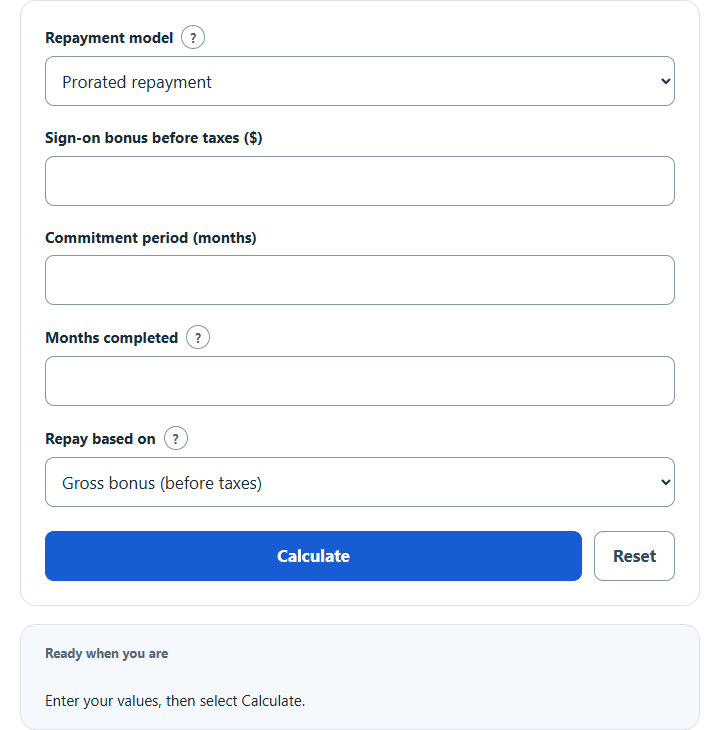
Calculate how much of a sign-on bonus you must pay back if you leave early from the bonus, commitment period and months worked, prorated or full repayment.
Sign-On Bonus Payback Formula
For the selected linear prorated model, estimated repayment is the chosen bonus basis multiplied by the uncompleted share of the commitment. Repayment is zero at or beyond completion:
Owed = B * max(0, T - t) / T
For the selected full-repayment cliff model, the entire chosen basis remains repayable before completion and none is repayable at or after completion. This model has no gradual monthly release:
Owed = B (if t < T), 0 (if t >= T)
Variables:
- Owed is the estimated repayment under the selected model and inputs, not a determination of the amount legally due.
- B is the repayment basis specified by the agreement: select the gross bonus or enter the net amount only when that is the applicable basis. Tax withholding alone does not choose the basis.
- T is the positive commitment period in months, as defined by the agreement.
- t is the nonnegative completed time in months. Fractional months assume linear proration; this tool does not calculate calendar dates, completed-month rules or day-based proration.
Enter the gross bonus, commitment period and completed months, then choose prorated or cliff terms and the applicable gross or net basis. The retained amount is B minus estimated repayment. A prorated model releases B/T per additional month until completion; a cliff releases the full basis only at completion. Confirm the trigger, service-counting convention, exceptions and repayment basis in the actual agreement. Interest, fees, taxes and legal enforceability are not calculated.
Prorated Payback on a $10,000 Sign-On Bonus
Illustrative amounts for a $10,000 repayment basis under linear monthly proration with 12-month and 24-month commitments. These are example terms, not a claim about the most common agreements.
| Months completed | 12-month agreement | 24-month agreement |
|---|---|---|
| 3 | $7,500.00 | $8,750.00 |
| 6 | $5,000.00 | $7,500.00 |
| 9 | $2,500.00 | $6,250.00 |
| 12 | $0.00 | $5,000.00 |
| 18 | $0.00 | $2,500.00 |
| 24 | $0.00 | $0.00 |
Example Problems
Example 1: A $10,000 sign-on bonus with a 12-month prorated clawback, leaving after 7 months.
Owed = 10,000 * (12 - 7) / 12 = 10,000 * 5/12 ≈ $4,166.67. The fraction is not rounded before calculating dollars.
Under this prorated model, $5,833.33 is retained and the monthly release is approximately $833.33 until completion. This is not the monthly release under a cliff model.
Example 2: The same bonus with a cliff clause, leaving after 11 months.
Under this illustrative full-repayment cliff, leaving after 11 of 12 months produces a $10,000 estimate; at 12 completed months the model produces $0. Actual service dates, repayment triggers and exceptions must be interpreted under the agreement rather than inferred from this example.
Frequently Asked Questions
Do I repay the gross bonus or what I actually received?
Use the repayment basis required by the agreement and applicable law; the amount withheld for tax does not by itself reduce the contract balance. U.S. same-year and later-year repayments can have different payroll and tax treatment. IRS Publication 15 discusses wage repayment timing, while Publication 525 describes conditional deduction or credit rules for some earlier-year repayments. Not every clawback qualifies. Resolve the payroll process and tax treatment separately; this calculator includes no tax refund or credit.
Can my employer take the repayment out of my final paycheck?
A repayment agreement does not by itself establish that a deduction from final wages is lawful. Applicable wage law and the specific authorization matter; for example, California's labor agency describes restrictions on deductions even with written authorization. Check the relevant labor agency or obtain advice on the particular agreement. This calculator does not authorize a payroll deduction or decide enforceability.
Can I negotiate the clawback before signing?
You can ask for written terms addressing proration instead of a cliff, a shorter commitment, and exceptions for specified termination circumstances. Whether a change is accepted or enforceable depends on the agreement and applicable law. Have the final terms documented; this simple calculator does not apply an exception automatically.