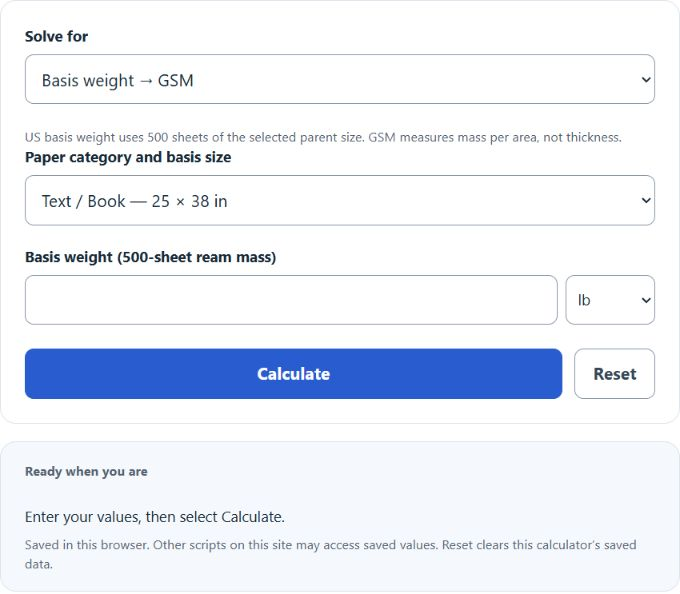
Select a conversion direction and paper category to convert between US 500-sheet basis weight in lb or kg and grammage in g/m² (GSM).
- All Unit Converters
- GSM (Grams Per Square Meter) Calculator
- MSI Calculator
- Roll Length Calculator
- Printing Cost Per Page Calculator
Paper Weight Conversion Formula
The paper weight conversion calculator converts between US basis weight and GSM using a 500-sheet ream. Basis weight depends on the paper category because each category uses a different standard sheet size.
Convert basis weight in pounds to GSM:
Convert GSM to basis weight in pounds:
Convert basis weight in kilograms to pounds before calculating GSM:
Convert calculated basis weight in pounds to kilograms:
- GSM = grams per square meter
- BW_lb = basis weight in pounds
- BW_kg = basis weight in kilograms
- F = category conversion factor, in GSM per pound of basis weight
- 0.45359237 = exact kilograms per pound
If you enter a basis weight, the calculator converts it to pounds if needed, then multiplies by the selected paper category factor to find GSM.
If you enter GSM, the calculator divides by the selected paper category factor to find the basis weight in pounds. If you selected kilograms, it then converts the result from pounds to kilograms.
Paper Category Conversion Factors
The selected paper category changes the conversion because US basis weight here is based on 500 sheets at a category-specific parent sheet size. The factors below are derived from 1 in = 0.0254 m and 1 lb = 0.45359237 kg; the calculator uses full precision. A kg input or result is the mass of that same basis ream.
| Paper category | US basis size | Factor used | Formula to GSM |
|---|---|---|---|
| Text / Book | 25 × 38 in | 1.480146 | GSM = lb × 1.480146 |
| Cover | 20 × 26 in | 2.704114 | GSM = lb × 2.704114 |
Common Paper Weight Comparisons
| Basis weight | Text / Book GSM | Cover GSM |
|---|---|---|
| 60 lb | 88.8088 GSM | 162.2468 GSM |
| 80 lb | 118.4117 GSM | 216.3291 GSM |
| 100 lb | 148.0146 GSM | 270.4114 GSM |
Paper Weight Conversion Examples
Example 1: Convert 80 lb text paper to GSM
You select Text / Book, which uses a factor of 1.480146.
So, 80 lb text paper is 118.4117 GSM.
Example 2: Convert 270.5 GSM cover paper to basis weight
You select Cover, which uses a factor of 2.704114.
So, 270.5 GSM cover paper is 100.0328 lb cover.
Paper Weight Conversion FAQ
Why does the same pound weight give different GSM values?
US basis weight is not based on one universal sheet size. Text paper and cover paper use different parent sheet sizes. Because of that, 80 lb text and 80 lb cover do not have the same mass per area. Thickness also depends on the paper density and finish. GSM is based on one square meter, so it is easier to compare across paper types.
What is the difference between basis weight and GSM?
Basis weight is the weight of a standard ream of paper in a specific category, usually stated in pounds in the US. GSM means grams per square meter. GSM measures weight per area, so it is more direct for comparing paper across categories.
Can you compare text weight directly to cover weight?
Not by the pound number alone. You should convert both to GSM first. For example, 80 lb text is about 118.4117 GSM, while 80 lb cover is about 216.3291 GSM. The cover stock is much heavier per square meter.