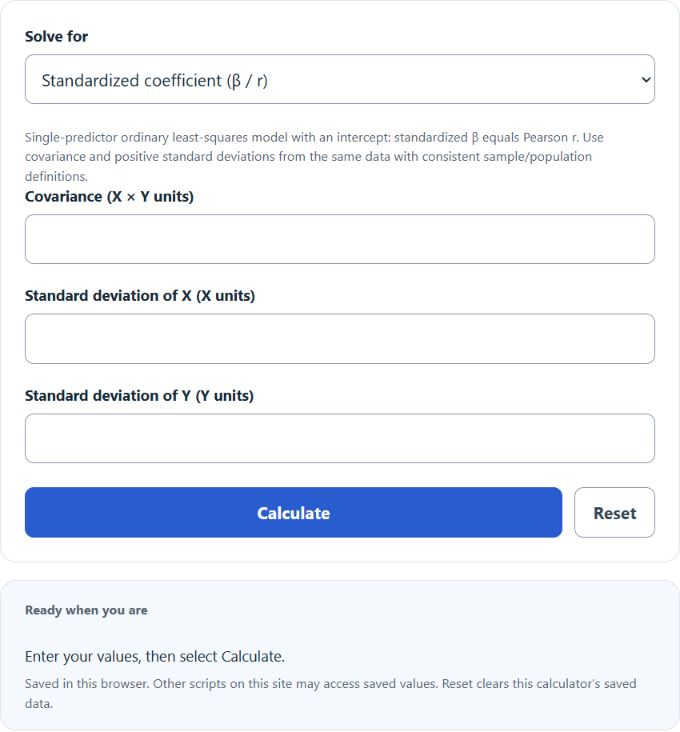
Choose a solve mode for standardized coefficient, covariance, or either standard deviation. This calculator covers a single-predictor ordinary least-squares model with an intercept; use statistics from the same dataset with consistent definitions.
Related Calculators
- Partial Correlation Calculator
- Cronbach Alpha Calculator
- Squared Error Calculator
- Outlier Calculator
- All Statistics Calculators
Path Coefficient Formula
The following formula calculates the standardized path coefficient for a single-predictor model. In this special case, it is numerically equal to the Pearson correlation coefficient between X and Y.
Variables:
- P is the standardized path coefficient (dimensionless); for one predictor, P = r (the Pearson correlation coefficient)
- C is the covariance between the independent variable and the dependent variable
- σx is the standard deviation of the independent variable
- σy is the standard deviation of the dependent variable
To calculate this standardized coefficient, divide the covariance between the independent variable and the dependent variable by the product of their standard deviations (all computed from the same dataset and using consistent definitions).
What is a Path Coefficient?
A path coefficient is a standardized regression coefficient that represents the direct effect of one variable on another in a path analysis model. It quantifies the strength and direction of the relationship between an independent variable and a dependent variable, taking into account the influence of other variables in the model. Path coefficients are used in structural equation modeling (SEM) to assess the direct, indirect, and total effects of variables within a network of relationships. Causal interpretations require defensible model assumptions and study design; an observed association alone does not establish causation.
Note: For ordinary least-squares regression with an intercept and one independent variable predicting one dependent variable (no other predictors/controls), the standardized regression coefficient equals the Pearson correlation, which is why it can be computed using covariance and standard deviations as shown above. For models with multiple predictors, the path coefficient generally requires regression/SEM estimation and cannot be determined from only Cov(X,Y), σx, and σy.
How to Calculate Path Coefficient (Single Predictor)?
The following steps outline how to calculate the standardized Path Coefficient for a single-predictor model.
- First, determine the covariance between the independent variable and the dependent variable (C).
- Next, determine the standard deviation of the independent variable (σx).
- Next, determine the standard deviation of the dependent variable (σy).
- Finally, calculate the standardized path coefficient using the formula P = C / (σx * σy).
- After inserting the values and calculating the result, check your answer with the calculator above.
Example Problem :
Use the following variables as an example problem to test your knowledge.
Covariance between Independent Variable and Dependent Variable (C) = 0.5
Standard Deviation of Independent Variable (σx) = 2
Standard Deviation of Dependent Variable (σy) = 3
Then P = 0.5 / (2 × 3) = 0.0833 (rounded to 4 decimals).