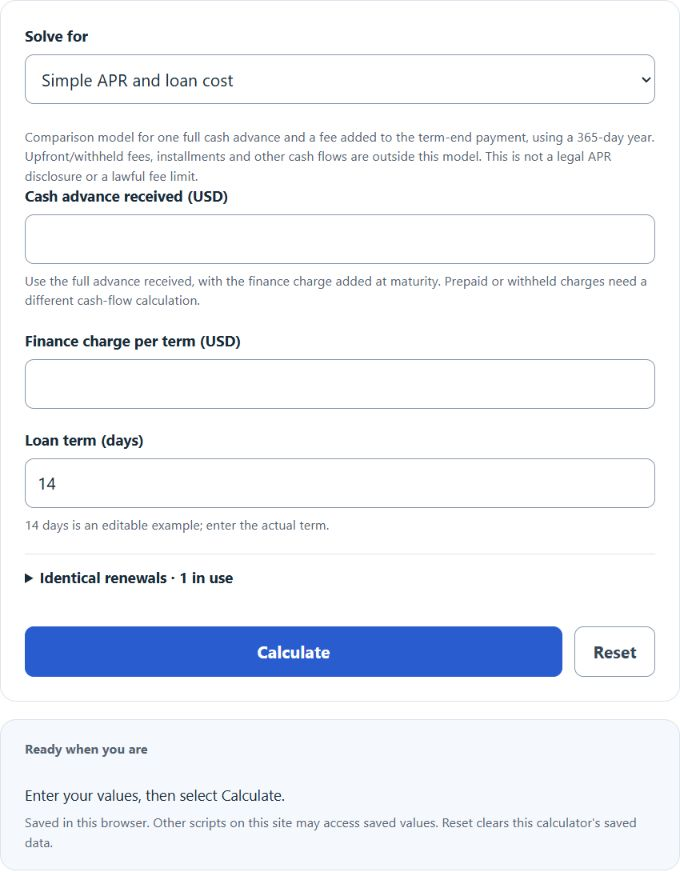
Use this payday loan APR calculator for a simple annualized comparison of a full cash advance and an added term-end finance charge. It separates hypothetical renewal fees already paid from the final payoff and cumulative cash outlay, and finds a whole-cent fee within a mathematical APR target. It does not determine lawful fees or produce a legal APR disclosure.
Payday Loan APR Formula
For this single-advance, single-payment comparison model, simple APR uses a 365-day year. It assumes the full advance is received and the finance charge is added at maturity. Prepaid or withheld charges, multiple advances, installments and other payment schedules require a different cash-flow calculation. The formula is:
APR = (F / P) * (365 / d) * 100
For identical renewals, total fees are:
F_total = F * (R + 1)
Variables:
- F is the included finance charge for one term, added to the maturity payment
- P is the full cash advance received under this added-at-maturity fee model
- d is the term in days
- R is the number of renewals or rollovers
- APR is the simple annualized percentage rate
Because the term is short, a modest fee can produce a high simple annualized comparison. In the renewal model, each earlier fee is paid separately to extend the term while principal remains unchanged. Target mode rearranges the formula to find a mathematical fee threshold, then floors it to whole cents so the modeled rate does not exceed the selected target. It is not a legal maximum or permission to charge that fee. Days and renewals must be whole numbers.
Payday Loan Fee and APR Reference
This table shows why the fee per $100 and the number of days are both important. The examples use a 14-day term.
| Fee per $100 | 14-day finance charge on $300 | Simple APR | Amount due on $300 |
|---|---|---|---|
| $10 | $30 | 260.7% | $330 |
| $15 | $45 | 391.1% | $345 |
| $20 | $60 | 521.4% | $360 |
| $30 | $90 | 782.1% | $390 |
Example Problems
Example 1: Calculate a two-week loan APR.
You borrow $300 and pay a $45 finance charge after 14 days. APR = ($45 ÷ $300) × (365 ÷ 14) × 100, or about 391%. The amount due after one term is $345.
Example 2: Include two rollovers.
The original term plus two renewals gives three 14-day terms, or 42 days. Two renewal fees of $45 have already been paid, totaling $90. The final payoff is $300 principal plus the last $45 fee, or $345. Lifetime finance charges are $135, and cumulative cash outlay including the final payoff is $435. The simple APR for each identical term remains about 391%; this does not calculate a legal APR for the complete multi-payment sequence.
Frequently Asked Questions
Why is the APR so much higher than the fee percentage?
The fee is charged for only a few days. APR annualizes that short-period cost over 365 days, making it easier to compare with longer-term credit.
Does a rollover reduce the principal?
In the calculator’s rollover model, it does not. The borrower pays another fee to extend the due date and still owes the original principal. Actual state rules and loan terms vary.
Is the compounded annual equivalent a likely one-year cost?
It is a mathematical comparison showing repeated compounding at the same short-term rate. It is not a prediction that the loan will legally or practically renew for an entire year.