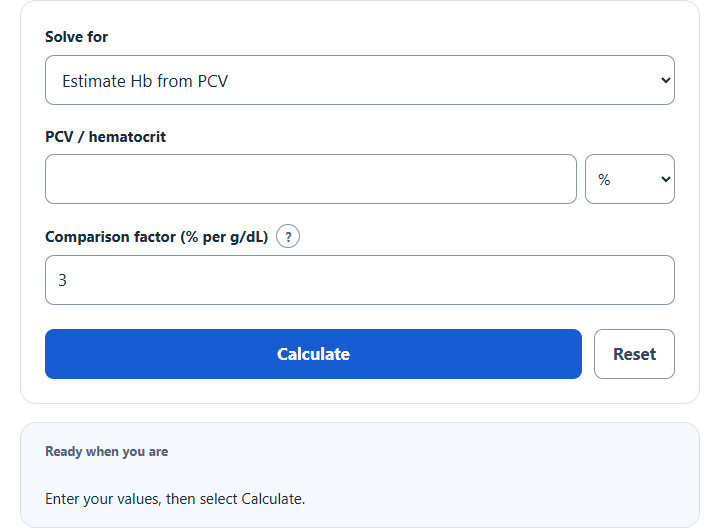
Convert PCV to Hb or Hb to PCV with the rule of three (PCV ≈ 3 × Hb), in % or L/L and g/dL or g/L, or compare a measured PCV and hemoglobin.
Medical disclaimer: This calculator provides a rough estimate for educational purposes only and does not diagnose anemia, polycythemia, or any condition. For interpretation of CBC/hematology results (or if you have concerning symptoms such as chest pain, shortness of breath, fainting, severe fatigue, or heavy bleeding), consult a licensed clinician or seek urgent care.
- All Health and Medical Calculators
- HbA1c To Percentage Calculator
- Ganzoni Formula Calculator
- Absolute Lymphocyte Count
PCV to Hb Ratio Formula
The following empirical relationship estimates packed cell volume (PCV) from hemoglobin (Hb) using a selected comparison factor. Use the specified units and measured laboratory results for clinical interpretation.
Variables:
- PCV is packed cell volume (hematocrit), expressed as a percentage in this formula; multiply L/L by 100.
- Hb is hemoglobin in g/dL; divide g/L by 10.
- R is the comparison factor in % per g/dL, often approximated as 3 in the common “rule of 3”. A custom factor is a user-selected scenario, not a validated patient-specific calibration.
To estimate the packed cell volume (PCV), multiply the hemoglobin (Hb) level by the ratio (R). Many references teach a rough “rule of 3” (PCV ≈ 3 × Hb when Hb is in g/dL and PCV is in %), but the relationship is not exact and can vary between individuals and situations.
What is the PCV to Hb Ratio?
The PCV to Hb ratio describes the relationship between packed cell volume (PCV/hematocrit) and hemoglobin (Hb). A commonly taught approximation is that PCV (as a %) is about three times the Hb value (in g/dL). This is best thought of as a rough consistency check or quick estimate—not a diagnostic or monitoring tool—and lab results should be interpreted in clinical context.
Limitations of the “PCV ≈ 3 × Hb” Rule
This approximation may be inaccurate in many common situations. Examples include:
- iron deficiency or other causes of microcytosis
- macrocytosis (for example, B12/folate deficiency)
- dehydration or overhydration
- pregnancy
- hemoglobinopathies (such as sickle cell disease or thalassemia)
- recent bleeding, transfusion, or rapidly changing blood counts
- differences in lab methods and reporting units (g/dL vs g/L; % vs L/L)
How to Calculate PCV to Hb Ratio?
The following steps outline the empirical estimate. In measured-comparison mode, discrepancy is measured PCV (%) minus factor × measured Hb (g/dL), expressed in percentage points. Relative discrepancy divides that difference by the factor-based PCV estimate, then multiplies by 100. It is undefined when that estimate is zero; the observed PCV-to-Hb quotient is undefined when Hb is zero, including a 0/0 input. Zero is a mathematical boundary, not a clinically normal result.
- First, determine the hemoglobin (Hb) level (confirm the unit, such as g/dL).
- Next, determine the packed cell volume (PCV/hematocrit) (confirm the unit, such as %).
- If estimating PCV from Hb, use PCV = Hb × R (often R ≈ 3).
- If estimating Hb from PCV, use Hb = PCV ÷ R.
- After inserting the values and calculating the result, check your answer with the calculator above.
Example Problem :
Use the following variables as an example problem to test your knowledge.
Hemoglobin (Hb) level = 12 g/dL
Ratio (R) = 3
Using the formula PCV = Hb * R, the packed cell volume (PCV) would be 12 * 3 = 36%.