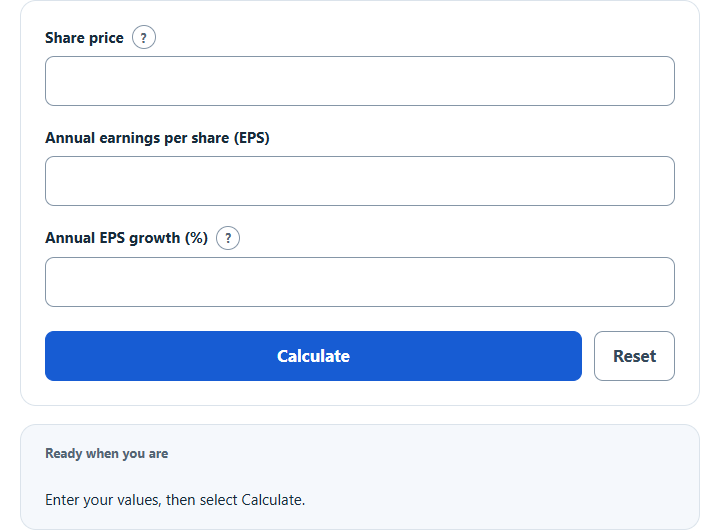
Calculate the PEG ratio from share price, earnings per share (EPS) and annual EPS growth, with the P/E ratio shown alongside the result.
- Growth Rate Calculator
- Dividend Growth Calculator
- All Business Calculators
- Diluted Earnings Per Share Calculator (w/ Formula)
PEG Ratio Formula
The following formula is used to calculate the price-earnings to growth rate ratio.
- Where PEG is the price-earnings to growth rate ratio
- P:E is the price-earnings ratio
- EPSG is annual earnings per share growth expressed as a percentage number, such as 10 for 10%
P/E = share price ÷ annual EPS. PEG = P/E ÷ annual EPS growth (%). For example, price 50, EPS 2.50 and growth 10% give P/E 20 and PEG 2. This positive-growth screening model requires positive price, EPS and growth.
PEG Ratio Definition
PEG compares a price-to-earnings multiple with an annual EPS growth assumption. A lower PEG can reflect a lower P/E, higher assumed growth, or both. Different earnings definitions and forecast horizons affect comparisons. A value below one does not prove undervaluation, and a value above one does not prove overvaluation.
PEG Ratio Example
How to calculate PEG ratio?
- First, determine the price to earnings ratio.
Calculate the price to earnings ratio. Visit the calculator linked above if you need help with this.
- Next, determine the earnings per share growth rate.
Calculate the growth rate of the EPS.
- Finally, calculate the PEG ratio.
Calculate the price to earnings growth ratio using the formula above.
FAQ
A PEG ratio is a ratio of the price to earnings ratio to the earnings per share growth rate.