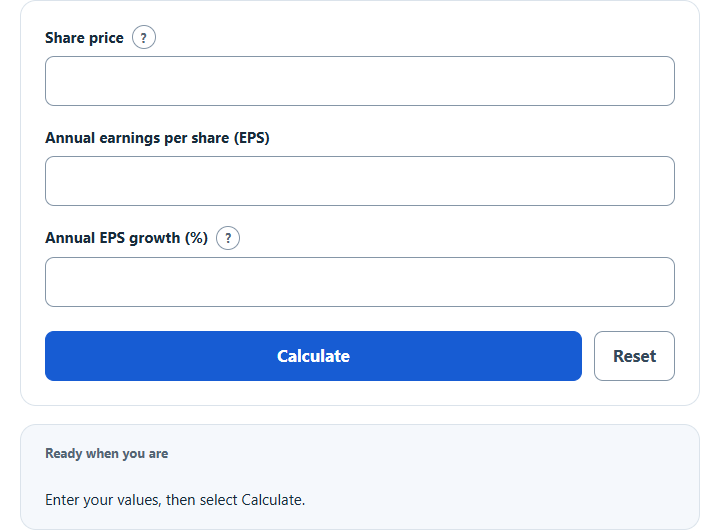
Calculate the PEG ratio from share price, earnings per share (EPS) and annual EPS growth, with the P/E ratio shown alongside the result.
Calculator Functions
| Function | What it does | What it requires |
|---|---|---|
| PEG ratio | Finds a stock’s price/earnings to growth ratio | Requires the share price, the annual earnings per share and the annual EPS growth in percent |
The result also shows the price to earnings ratio and whether the PEG ratio is below 1, equal to 1 or above 1. The share price and the earnings per share must be in the same currency.
PEG Ratio Formulas
| PEG | Price/earnings to growth ratio |
| P | Share price |
| EPS | Annual earnings per share |
| G | Annual EPS growth as a percentage number, such as 10 for 10% |
P ÷ EPS is the price to earnings ratio, so the PEG ratio is the P/E divided by the growth rate [1]. A share priced at 50 with earnings of 2.50 per share has a P/E of 20. With 10% annual growth, the PEG ratio is 20 ÷ 10 = 2. A share at 30 with earnings of 2 and 20% growth has a P/E of 15 and a PEG ratio of 0.75.
Growth goes in as 10, not 0.10. The ratio rests on the rule of thumb that a fair P/E equals the growth rate, which makes a fair PEG ratio 1. Under that rule a value above 1 reads as relatively expensive and a value below 1 as below fair value [1].
Limits of This Estimate
- The PEG ratio is a guideline, not a verdict. It does not say how long the growth will last, and it tends to undervalue companies growing faster than 100% a year [1].
- A study of S&P 500 data from 1985 to 2020 found that buying below a PEG of 1 and selling above it worked in some periods and not in others [2].
- The growth rate is usually a forecast, and trailing and forward earnings give different ratios. Compare stocks only on the same earnings definition and growth period.
- The calculator needs a positive price, positive earnings and positive growth. A company with losses or shrinking earnings has no meaningful PEG ratio. The result is a screening number, not advice to buy or sell.
Sources
- CFA Institute, Is It Overvalued? Look at the PEG Ratio: PEG formula, how it is read and its limits
- CFA Institute, Is the PEG Ratio a Reliable Market-Timing Tool?: how reliable the PEG ratio has been