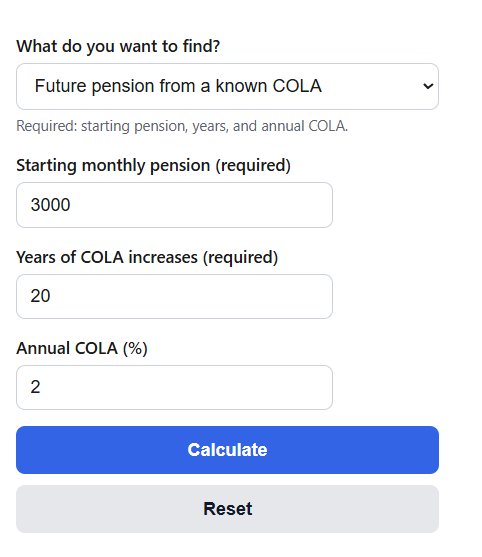
Calculate a pension after compound COLA increases, total nominal payments, or the annual COLA needed to reach a target monthly benefit over a selected period.
Pension COLA Formula
A compound cost-of-living adjustment raises the pension by a percentage of the prior year's payment.
Future payment:
Future\ Pension=Starting\ Pension*(1+COLA)^n
Required COLA:
COLA=(Target/Starting)^{1/n}-1
Nominal payments:
Total=12P*((1+COLA)^n-1)/COLA
Variables:
- P is starting monthly pension
- COLA is annual compound adjustment
- n is annual increases
- Target is the desired future monthly pension
Future-payment mode calculates the payment and total benefits from a known COLA. COLA-needed mode reverses the formula.
The first year uses the starting payment, followed by one adjustment per year.
A pension can rise nominally while losing purchasing power when its COLA trails inflation.
Growth of a $3,000 Monthly Pension
Twenty annual compound increases produce the following amounts.
| Annual COLA | Monthly pension after 20 years | Increase |
|---|---|---|
| 0% | $3,000 | 0% |
| 1% | $3,661 | 22% |
| 2% | $4,458 | 49% |
| 2.5% | $4,916 | 64% |
| 3% | $5,418 | 81% |
Example Problems
Example 1: Project a pension.
A $3,000 pension with a 2 percent COLA grows to about $4,458 after 20 increases.
Example 2: Solve for COLA.
To grow $3,000 to $4,500 in 20 years, take the twentieth root of the ratio and subtract one.
Frequently Asked Questions
Does every pension have a COLA?
No. Some plans have no adjustment, a cap, or discretionary increases.
What is a simple COLA?
A simple adjustment repeatedly uses the original base rather than the prior year's increased amount.
Does 2 percent preserve purchasing power?
Only when inflation averages approximately 2 percent over the same period.