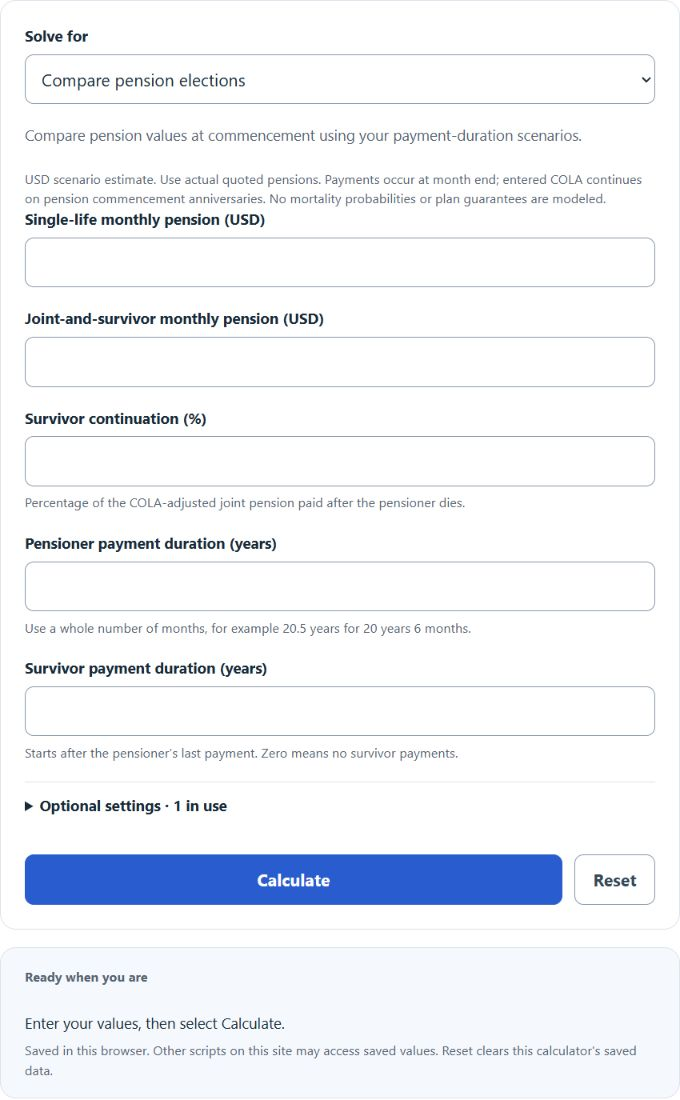
Compare single-life and joint-and-survivor pension values under supplied longevity scenarios, or find the first survivor payment month at which the joint option catches up. Values are measured at pension commencement.
Pension Survivor Benefit Formula
A joint-and-survivor pension trades a smaller payment while the pensioner is alive for continued income to a survivor.
Default monthly model: S and J are the quoted initial single-life and joint monthly payments. C(m) is the annual COLA factor and D(m) discounts month m to commencement. Single-life value:
PVsingle = sum of S*C(m)*D(m)
for months m = 1 to R
Joint-and-survivor value:
PVjoint = sum of J*C(m)*D(m)
for m = 1 to R
+ sum of J*q*C(m)*D(m)
for m = R+1 to R+T
The COLA, discount and survivor-share factors are:
C(m) = (1+g)^floor((m-1)/12)
D(m) = (1+r)^(-m/12)
q = SurvivorPercent/100
Variables:
- r is the annual effective discount rate as a decimal
- g is annual COLA as a decimal
- R is the whole number of pensioner payment months
- T is the whole number of survivor payment months
Comparison mode values both streams under entered payment durations. Break-even mode searches up to 100 survivor years and returns the first qualifying month. The optional annual approximation groups 12 payments at year end, requires whole payment years and searches in whole survivor years.
The first pensioner payment is one month after commencement. Survivor payments begin in the month after the last pensioner payment; COLA anniversaries continue from commencement without restarting at death.
Present value is only one consideration; guaranteed lifetime income and household risk tolerance also matter.
Common Survivor Election Structures
Plans may offer several continuance percentages with different initial pension reductions.
| Election | Payment while pensioner lives | Payment after pensioner’s death |
|---|---|---|
| Single life | Quoted single-life amount | Usually none, subject to guarantees |
| 100% joint and survivor | Plan-specific reduction | 100% of the applicable joint payment |
| 75% joint and survivor | Plan-specific reduction | 75% of the applicable joint payment |
| 50% joint and survivor | Plan-specific reduction | 50% of the applicable joint payment |
Example Problems
Example 1: Compare two elections.
Compare $4,200 single life with $3,700 joint and survivor, 75% continuation, 20 pensioner years, 10 survivor years, 2% annual COLA and a 5% annual effective discount rate. The month-end model gives $755,925.58 single-life value and $825,919.75 joint value, a $69,994.17 difference.
Example 2: Find survivor break-even.
For the same assumptions, joint value is $755,714.56 after 63 survivor months and $757,037.29 after 64. Break-even is therefore the 64th payment: 5 years 4 months. A positive shortfall with 0% continuation cannot catch up; other searches report explicitly if not reached within 100 survivor years.
Frequently Asked Questions
Is the survivor payment based on the original or current pension?
This model applies the entered COLA on each pension commencement anniversary and continues that schedule during survivor payments; confirm your plan’s rules. It does not supply a plan-specific COLA or reduction factor.
What if the survivor dies first?
Some plans have a pop-up provision that raises the pensioner’s payment; this calculator does not model that feature.
Does the higher present value identify the best election?
No. The joint option can provide valuable longevity protection even when this finite scenario produces a lower present value. The calculation is not mortality-weighted and does not determine the best election.