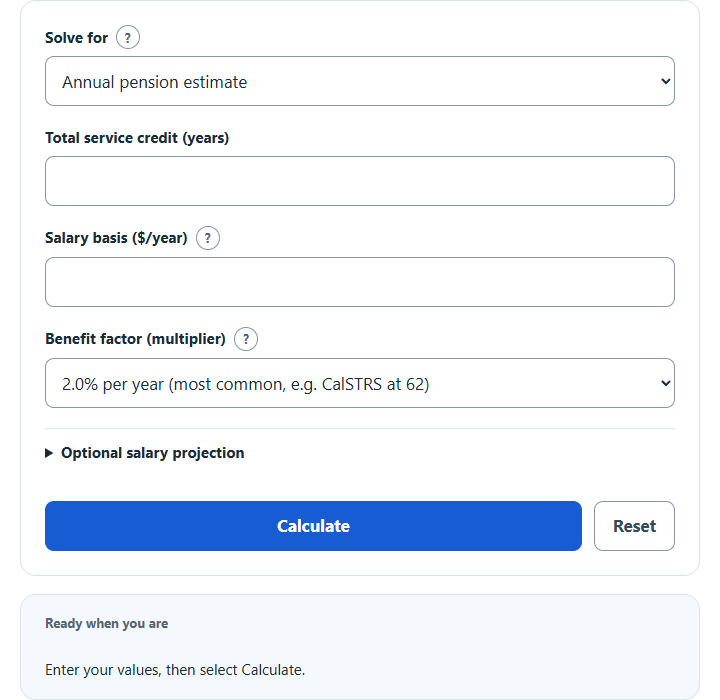
Estimate a teacher pension from years of service, average salary and benefit multiplier (default 2% per year), or solve for the service or salary you need.
Teacher Retirement Formula
The following generic defined-benefit equation estimates an annual pension. It is not a determination of benefits under every teacher retirement plan.
- Where TR is the teacher retirement ($/year)
- YS is the years of service
- AS is the average salary
- BF is the benefit factor
Multiply total credited service by the plan-defined annual compensation basis and the applicable benefit factor. Pick a typical factor such as 2%, or choose Custom and enter 2 for 2%. Optional salary growth compounds over a separate future projection horizon; it does not determine final-average compensation under a plan.
What is a Teacher Retirement?
Definition:
Teacher retirement refers to the financial benefit educators receive upon retiring, typically based on factors like years of service, average salary, and a set benefit multiplier. This retirement package may also include pension plans, annuities, or health benefits specific to the teaching profession.
How to Calculate Teacher Retirement?
Example Problem:
The following example outlines the steps and information needed to calculate the Teacher Retirement.
First, determine the years of service. In this example, a teacher has 30 years of service.
Next, determine the average salary. Assume this teacher has an average salary of $50,000 annually.
Then, determine the benefit factor. In this example, the benefit factor is 0.02 (or 2%).
Finally, calculate the retirement using the formula above:
TR = 30 × $50,000 × 0.02
TR = $30,000/year
FAQ
What factors can affect a teacher’s retirement amount?
Several key factors influence a teacher’s retirement amount, including years of service, final average salary, and the specific benefit multiplier outlined by the pension system. Additional contributions to supplementary retirement accounts and variations in state or district policies can also impact the final sum.
How can a teacher maximize their retirement benefits?
Benefits depend on plan-specific service, compensation, age, eligibility and payout rules. Consult the retirement system’s official estimate before making retirement decisions; supplemental savings and other income are outside this calculator.
Are teacher retirement benefits different from those in other professions?
Teacher retirement systems often have unique structures compared to private sector 401(k) plans. Many teachers participate in defined benefit pensions that offer a steady income stream in retirement, whereas other professions might rely solely on defined contribution plans. Requirements and benefit formulas can vary significantly by state or district.