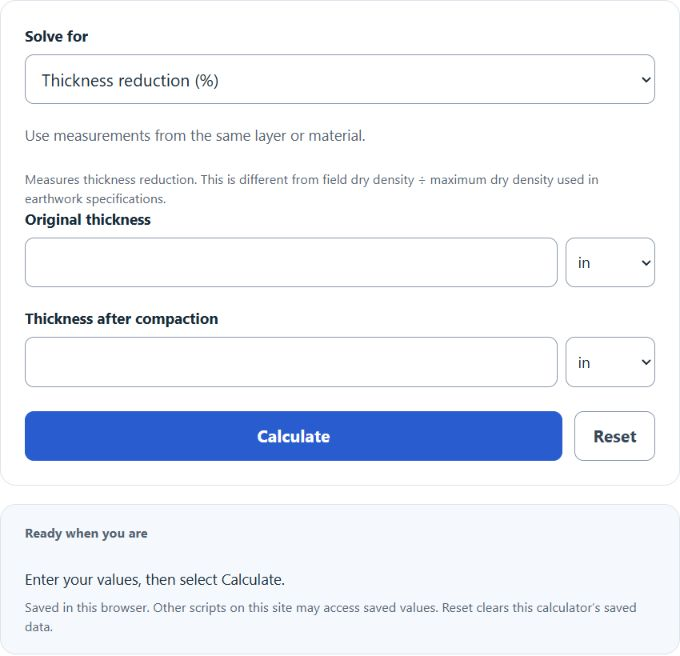
Calculate percent thickness reduction from original and compacted thickness, or solve for either thickness using inches, feet, cm, mm, or meters.
Understanding Percent Compaction
The percent compaction calculator on this page measures how much a layer has decreased in thickness after compaction. It compares the original thickness to the compacted thickness and expresses that reduction as a percentage of the starting value. This is a simple and useful way to quantify compression in materials where thickness change is the main concern.
This approach is commonly used when reviewing compacted lifts, pads, fill layers, asphalt sections, foam products, textiles, insulation, packaging, and other materials that lose thickness under pressure.
Percent Compaction Formula
- PC = percent compaction
- OT = original thickness
- TC = thickness after compaction
The formula finds the thickness lost during compaction, divides that loss by the original thickness, and converts the result to a percentage.
Rearranged Equations
If you know any two values, you can solve for the third.
| Unknown Value | Formula |
|---|---|
| Percent Compaction | PC = (OT - TC) / (OT) × 100 |
| Thickness After Compaction | TC = OT(1 - (PC) / (100)) |
| Original Thickness | OT = (TC) / (1 - (PC) / (100)) |
How to Interpret the Result
A larger percentage means a greater reduction in thickness.
So if the percent compaction is 18%, the compacted layer still retains 82% of its original thickness. A result of 0% means no thickness change. A negative result means the final thickness is greater than the original thickness, which usually indicates swelling, heave, rebound, or a measurement/input issue rather than true compaction.
| Percent Compaction | What It Means |
|---|---|
| 0% | No thickness reduction |
| 10% | Final thickness is 90% of the original |
| 25% | Final thickness is 75% of the original |
| 50% | Final thickness is half of the original |
| 75% | Only 25% of the original thickness remains |
Example
If the original thickness is 30 in and the thickness after compaction is 20 in, the percent compaction is:
This means 33.33% of the original thickness was reduced during compaction, and 66.67% of the original thickness remains.
How to Use the Calculator
- Measure the original thickness before compaction.
- Measure the thickness after compaction.
- Select the correct unit for each measurement.
- Choose the value to solve for, then enter the two known values.
- Read the computed percent compaction or the missing thickness value.
Because the calculation is ratio-based, inches, feet, centimeters, millimeters, and meters all work correctly; the calculator converts the selected units before comparing thicknesses.
When This Calculator Is Most Useful
- Checking how much a layer compressed after rolling, pressing, tamping, or loading
- Comparing pre-compaction and post-compaction material thickness
- Estimating remaining layer depth after a known percent reduction
- Reviewing compression performance for manufactured or installed materials
- Confirming whether a process is producing a consistent thickness change
Thickness Reduction vs. Density-Based Compaction
This calculator uses a thickness-reduction definition of percent compaction. In earthwork and geotechnical specifications, “percent compaction” may also refer to the ratio of field dry density to maximum dry density. That is a different calculation and should not be confused with thickness loss.
If your project references Proctor testing, field density, or maximum dry density requirements, the density-based equation is the appropriate method. If your goal is to measure how much thinner a layer became, the thickness-based calculator on this page is the correct one.
Common Mistakes to Avoid
- Mixing units: using a unit label that does not match its measurement will give the wrong result.
- Reversing the values: the original thickness should be larger than the compacted thickness in a normal compaction scenario.
- Confusing compaction with remaining thickness: 20% compaction does not mean 20% remains; it means 80% remains.
- Using the wrong definition: thickness reduction and density compaction are not interchangeable.
- Ignoring field conditions: moisture changes, rebound, swelling, or uneven surfaces can affect measurements.
FAQ
Can percent compaction be greater than 100%?
No. In this thickness-based model, 100% would mean the final thickness is zero. Real values should normally be between 0% and less than 100%.
What does a negative result mean?
A negative value means the measured final thickness is greater than the original thickness. That usually suggests expansion, measurement error, or that the material was not actually compacted.
Do the units matter?
Select the correct unit for each measurement. The calculator converts inches, feet, centimeters, millimeters and meters, so the two selected units may differ.
Why is this calculation helpful?
It provides a fast, direct way to describe compression performance. Instead of only saying that a layer went from one thickness to another, you can express the change as a normalized percentage that is easier to compare across jobs, materials, or test conditions.