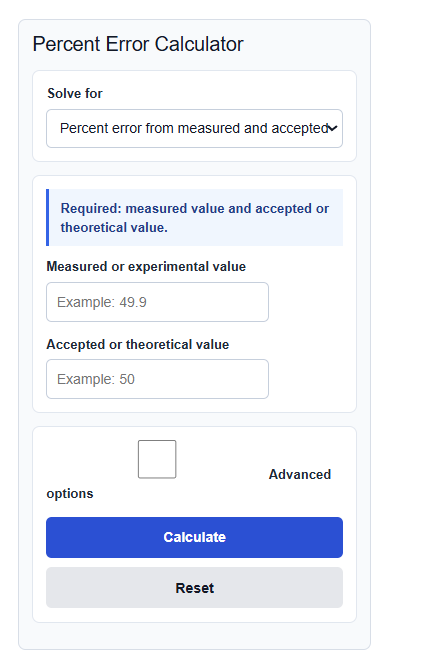
Calculate percent error from a measured value and an accepted value.
Percent Error Formula
The calculator uses a different formula for each mode you select.
Absolute percent error (magnitude only):
PE = |measured - accepted| / |accepted| * 100
Signed percent error (keeps direction):
PE = (measured - accepted) / |accepted| * 100
Percent difference (two measured values, no accepted reference):
PD = |A - B| / ((A + B) / 2) * 100
Solve for the measured value (rearranged from signed percent error):
measured = accepted * (1 + PE / 100)
- PE = percent error, expressed as a percentage
- PD = percent difference, expressed as a percentage
- measured = the experimental value you obtained
- accepted = the true, theoretical, or reference value
- A, B = the two values being compared in percent difference mode
In absolute mode the result is always zero or positive, since you take the absolute value of the difference. Use it when you only care how far off the measurement is. Signed mode drops the absolute value on the top, so a positive result means the measurement was above the accepted value and a negative result means it was below. Percent difference mode compares two values when neither is treated as correct, dividing by their average instead of by a reference. The solve-for-measured mode reverses the signed formula: give it the accepted value, the percent error, and the direction (high or low), and it returns the measured value that would produce that error.
How to Read Your Percent Error
The table below gives rough guidance for interpreting a result in a typical lab or homework setting. Acceptable error depends on the field, the instrument, and the assignment, so treat these as general ranges.
| Percent error | General interpretation |
|---|---|
| 0% to 2% | Very close agreement, strong result |
| 2% to 5% | Good agreement for most student labs |
| 5% to 10% | Acceptable, but worth checking technique |
| Over 10% | Large error, review method or measurements |
The next table shows which mode fits the situation you are in.
| Situation | Mode to use |
|---|---|
| You have a known true value | Absolute or signed percent error |
| You need to know if you over or under measured | Signed percent error |
| You compare two measurements, neither is correct | Percent difference |
| You know the target error and want the measured value | Solve for measured |
Example Problems
Example 1. You measure the density of a metal as 8.92 g/cm3. The accepted value is 8.96 g/cm3. Using absolute percent error: |8.92 - 8.96| / |8.96| * 100 = 0.04 / 8.96 * 100 = 0.45%. The measurement is very close to the accepted value.
Example 2. Two students measure the same resistor and get 100 ohms and 104 ohms. Neither value is the accepted reference, so use percent difference: |100 - 104| / ((100 + 104) / 2) * 100 = 4 / 102 * 100 = 3.92%.
Frequently Asked Questions
Can percent error be negative? In absolute mode it cannot, because the absolute value forces the result to zero or higher. In signed mode it can: a negative value means your measured value was lower than the accepted value, and a positive value means it was higher.
What is the difference between percent error and percent difference? Percent error compares a measured value to an accepted or true value and divides by that reference. Percent difference compares two values when neither is treated as correct and divides by their average. Use percent error when you have a known correct value and percent difference when you do not.
Why is my percent error so large? A large percent error usually points to a measurement mistake, a faulty instrument, or using the wrong accepted value. Check that your measured and accepted values are in the same units and that you entered the accepted value, not another measurement, in the reference field.