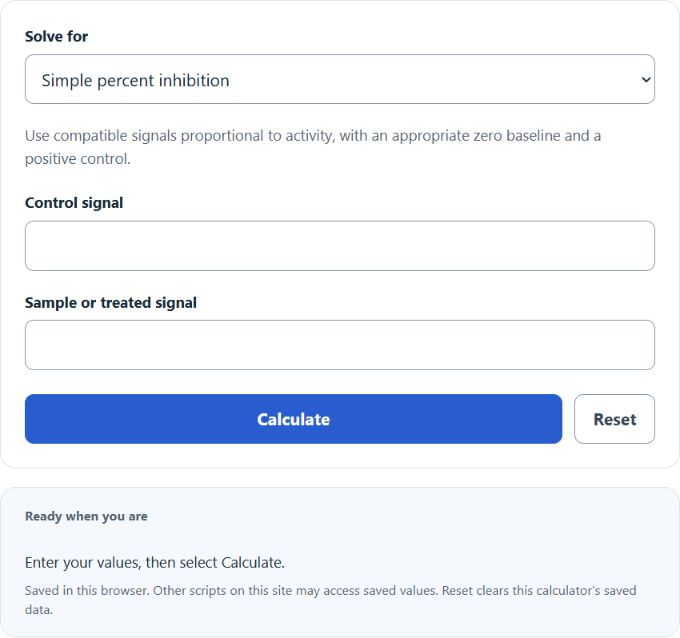
Calculate simple or blank-corrected percent inhibition and activity, or solve the sample signal needed for a target inhibition.
Percent Inhibition Formula
The following formula applies to comparable control and sample signals that are proportional to activity, with appropriate background correction. A nonlinear or inverse-response readout requires the assay protocol’s calibration or normalization.
Variables:
- %I is the percent inhibition
- C is the control activity
- S is the sample activity
To calculate percent inhibition, subtract sample activity from control activity, divide by the positive control activity, and multiply by 100. In blank-corrected mode, Cc = C − control blank and Sc = S − sample blank, then inhibition = (Cc − Sc) ÷ Cc × 100 and activity = Sc ÷ Cc × 100. Blanks must match the corresponding assay conditions; separate blanks are useful when backgrounds differ, and do not automatically remove all interference. The target-signal mode rearranges this as raw sample = Cc × (1 − target/100) + sample blank. This gives a model-required signal, not an inhibitor concentration. A control near its blank amplifies measurement uncertainty. Results are not clamped: negative inhibition means corrected sample exceeds control; over100% means corrected sample is below zero and needs review of blanks, noise or interference. Values within0–100% alone do not establish assay quality.
What is Percent Inhibition?
Percent inhibition is a measure used in various scientific fields, particularly in biochemistry and pharmacology, to quantify the extent to which a substance (such as a drug or inhibitor) reduces the activity of a particular enzyme or biological process. It is expressed as a percentage and indicates how much the activity is reduced compared to a control (untreated) sample. A single percent-inhibition result describes response at the tested concentration, time and conditions. It does not by itself determine IC50, mechanism, comparative potency or therapeutic efficacy. Those conclusions require appropriate concentration-response experiments and controls.
How to Calculate Percent Inhibition?
The following steps outline how to calculate the Percent Inhibition.
- First, determine the control activity (C).
- Next, determine the sample activity (S).
- Next, calculate the percent inhibition using the formula %I = ((C – S) / C) * 100.
- Finally, calculate the Percent Inhibition.
- After inserting the values and calculating the result, check your answer with the calculator above.
Example Problem :
Use the following variables as an example problem to test your knowledge.
Control Activity (C) = 100 units
Sample Activity (S) = 70 units
Percent inhibition = (100 − 70) ÷ 100 × 100 = 30%; activity remaining relative to control is 70%.