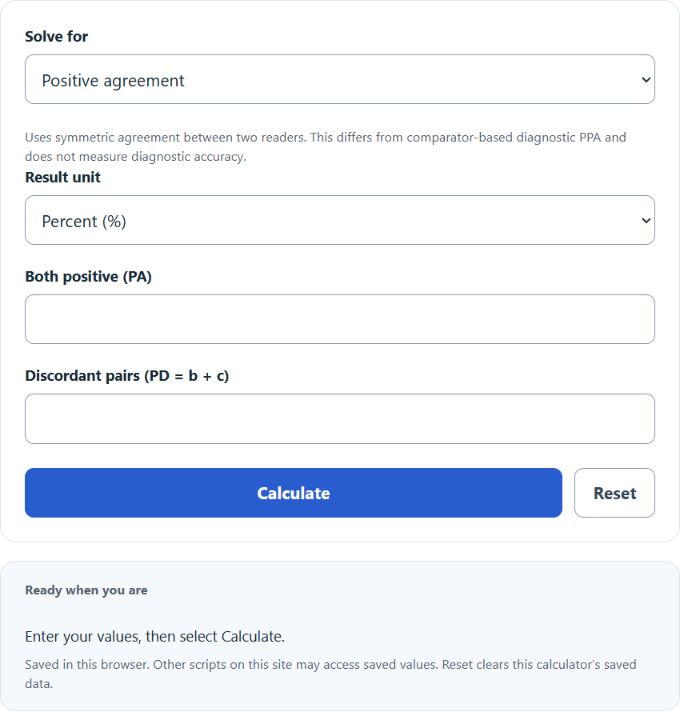
Calculate percent positive agreement from positive agreements and discordant pairs, or find PPA, NPA, and OPA from a 2×2 table.
Percent Positive Agreement Formula
The following formula calculates symmetric percent positive agreement, giving both readers equal weight, from positive agreements and discordant pairs.
Variables:
- PPA is the symmetric percent positive agreement used on this page
- PA is the number of positive agreements (both tests/raters are positive)
- PD is the number of positive disagreements (discordant pairs where one is positive and the other is negative; PD = b + c in a 2×2 table)
To calculate percent positive agreement, multiply the number of positive agreements by 2, divide by (2 times positive agreements plus positive disagreements), then multiply the result by 100 to get the percentage.
What is Percent Positive Agreement?
Percent Positive Agreement (PPA) is a measure of how often two tests or raters agree on positive classifications. Using paired results, it is commonly calculated as 2a / (2a + b + c) (× 100%), where a is the number of pairs where both are positive and b and c are the discordant pairs (one positive and the other negative). Higher values indicate stronger symmetric agreement on positives. This differs from comparator-based diagnostic PPA, a / (a + c) when reader B is the comparator, and does not by itself establish diagnostic accuracy.
How to Calculate Percent Positive Agreement?
The following steps outline how to calculate the Percent Positive Agreement.
- First, determine the number of positive agreements (PA).
- Next, determine the number of positive disagreements (PD).
- Next, calculate the percent positive agreement using the formula PPA = (2PA / (2PA + PD)) * 100.
- Finally, calculate the Percent Positive Agreement.
- After inserting the values and calculating the result, check your answer with the calculator above.
Example Problem :
Use the following variables as an example problem to test your knowledge.
Number of positive agreements (PA) = 80
Number of positive disagreements (PD) = 20