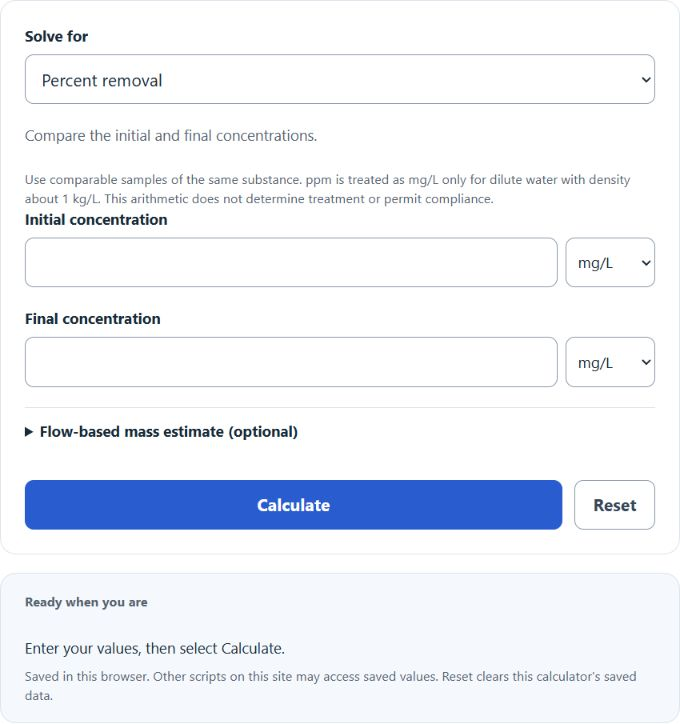
Calculate percent removal, final or initial concentration, or log reduction with concentration units, reduction factor, flow-based mass removal, and sensitivity.
Related Calculators
- Collection Percentage Calculator
- Success Percentage Calculator
- Percentage Distance Calculator
- Relative Error Calculator
- All Math and Numbers Calculators
Percent Removal Formula
The following formula is used to calculate the percent removal for a given initial and final concentration.
Variables:
- P is the percent removal (%)
- Ci is the initial (influent) concentration
- Cf is the final (effluent) concentration
Both concentrations must be in the same units (mg/L, ppm, ppb, etc.) before applying the formula. The calculator above handles unit conversions automatically if mixed units are selected.
What is Percent Removal?
Percent removal measures the concentration decrease relative to the initial concentration: (Ci − Cf) / Ci × 100. It is 0% when concentrations are equal and 100% when the final concentration is zero; a negative value means concentration increased. A concentration percentage also represents a mass-load percentage only when initial and final flows use the same representative basis.
For conventional secondary treatment, 40 CFR 133.102 generally requires BOD5 and suspended-solids concentrations of no more than 30 mg/L as a 30-day average and 45 mg/L as a 7-day average, plus at least 85% removal as a 30-day average. All applicable requirements must be met. Authorized special considerations and treatment-equivalent provisions appear in 133.103 and 133.105; the actual discharge permit controls.
Typical Removal Efficiencies by Wastewater Treatment Stage
Treatment-stage performance depends on the wastewater, process and operating conditions. The table is explanatory, not a set of regulatory or design guarantees. The approximate primary-treatment values come from an EPA municipal-wastewater overview; use plant-specific measurements and applicable permit conditions for other stages. Stage percentages cannot simply be added.
| Treatment Stage | BOD Removal | TSS Removal | Nutrient Removal (N/P) |
|---|---|---|---|
| Preliminary (screening, grit removal) | Site-specific | Site-specific | Site-specific |
| Primary (sedimentation) | About 35% (illustrative municipal value) | About 60% (illustrative municipal value) | Site-specific |
| Secondary (activated sludge, trickling filter) | Process-specific; check the permit | Process-specific; check the permit | Process-specific |
| Tertiary (filtration, nutrient removal) | Process-specific | Process-specific | Process-specific |
Air Pollution Control Device Removal Efficiencies
Air-control performance depends on pollutant basis, particle-size distribution, device design and operation. These EPA-CICA fact-sheet examples use different stated bases and are not guarantees or hard particle-size cutoffs. Concentration-only removal equals mass-rate removal only when inlet and outlet gas flows are equal or appropriately normalized.
| Control Device / Source | PM Collection Efficiency (stated basis) | Particle-Size Qualification |
|---|---|---|
| Baghouse (pulse-jet fabric filter) | 99 to 99.9% typical new design; older operation 95 to 99.9% | Coarse and fine PM; depends on media and dust |
| Dry wire-plate ESP | 99 to 99.9% typical new design; older operation 90 to 99.9% | Depends on particle size and dust/gas properties |
| Venturi scrubber | 70 to greater than 99%, application-dependent | Often higher collection for approximately 0.5 to 5 microns |
| Spray-tower scrubber | 70 to greater than 99% for PM, application-dependent | Fine-PM applications require high liquid-to-gas ratios |
| Conventional single cyclone | 70 to 90% total PM; finer-PM efficiency is lower | Commonly used for particles above 10 microns; no hard cutoff |
| Settling chamber | Typically less than 10% for PM10; larger-particle efficiency varies | Most designs mainly collect particles above about 50 microns |
Percent Removal vs. Log Reduction
For microbiological contaminants in drinking water treatment, regulators often use log reduction values (LRV) instead of percent removal. Log reduction is a logarithmic scale that better expresses the multiple orders of magnitude required for pathogen inactivation. The relationship between the two is: LRV = log10(Ci / Cf).
| Log Reduction | Percent Removal | Factor Reduction |
|---|---|---|
| 1-log | 90% | 10x |
| 2-log | 99% | 100x |
| 3-log | 99.9% | 1,000x |
| 4-log | 99.99% | 10,000x |
| 5-log | 99.999% | 100,000x |
| 6-log | 99.9999% | 1,000,000x |
For public water systems using surface water or ground water under its direct influence, 40 CFR 141.70 specifies at least 3-log (99.9%) removal/inactivation of Giardia and 4-log (99.99%) removal/inactivation of viruses. Cryptosporidium requirements depend on the applicable filtration/treatment category and source-water monitoring. A concentration ratio by itself does not demonstrate credited treatment or regulatory compliance.
Heavy Metal Removal Efficiencies by Adsorbent
Adsorption performance depends on the adsorbent, metal species, pH, dose, contact time and water composition. Reported laboratory results apply to the tested conditions and do not establish a universal optimized percentage. For chromium, distinguish Cr(III) from Cr(VI); their chemistry and treatment behavior differ.
| Heavy Metal | Removal Efficiency | Evidence Needed |
|---|---|---|
| Lead (Pb2+) | Depends on adsorbent and test conditions | Use a cited study or measured system data |
| Copper (Cu2+) | Depends on adsorbent and test conditions | Use a cited study or measured system data |
| Cadmium (Cd2+) | Depends on adsorbent and test conditions | Use a cited study or measured system data |
| Nickel (Ni2+) | Depends on adsorbent and test conditions | Use a cited study or measured system data |
| Zinc (Zn2+) | Depends on adsorbent and test conditions | Use a cited study or measured system data |
| Chromium (specify Cr(III) or Cr(VI)) | Depends on adsorbent and test conditions | Use a cited study or measured system data |
Limitations of Percent Removal
Percent removal depends on influent concentration: for the same positive effluent concentration, a higher influent concentration gives a higher removal percentage. Dilute influent can make a percentage requirement more demanding than a concentration limit. 40 CFR 133.103 provides case-specific wet-weather combined-sewer considerations and authorized alternative requirements for qualifying less-concentrated influent; dilution does not automatically waive a permit limit.
At low influent concentrations, measurement uncertainty can materially affect the ratio. An uncertainty of 2 mg/L in a 20 mg/L influent result is 10% of that input, but its effect on percent removal also depends on the final concentration. Where a permit contains concentration and percentage-removal limits, meet both unless the permitting authority has established an applicable authorized adjustment; meeting either one alone is not sufficient.
In microbiological applications, percent removal breaks down at high efficiencies because the difference between 99.9% and 99.99% removal (1-log difference) appears trivial as a percentage but represents a tenfold difference in pathogen concentration. This is why log reduction values are preferred for disinfection performance.
Common Parameters Measured by Percent Removal
Percent removal is applied to a wide range of parameters across environmental and industrial engineering. In wastewater treatment, the primary parameters include BOD5 (the oxygen consumed by microorganisms in five days of decomposition), TSS (the dry mass of solids retained on the specified filter per volume), COD (chemical oxygen demand, measuring total oxidizable material), total nitrogen, and total phosphorus. Industrial applications extend to oil and grease, heavy metals, volatile organic compounds (VOCs), and specific regulated pollutants identified in facility discharge permits.
In air pollution control, percent removal is applied to particulate matter (PM10 and PM2.5), sulfur dioxide (SO2), nitrogen oxides (NOx), and hazardous air pollutants (HAPs). In soil and groundwater remediation, the metric tracks removal of contaminants like BTEX compounds (benzene, toluene, ethylbenzene, xylenes), chlorinated solvents, and PFAS (per- and polyfluoroalkyl substances).