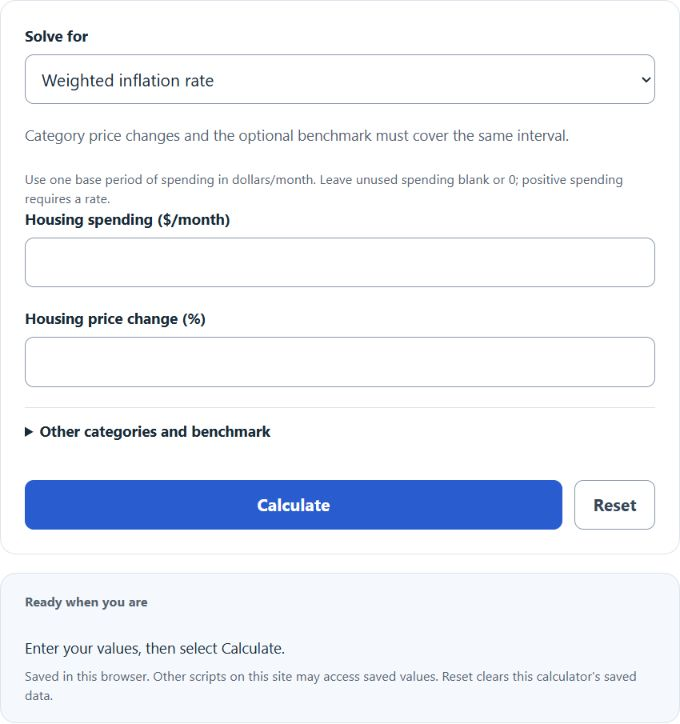
Use the Personal Inflation Rate Calculator to weight price changes by your own spending, compare with a benchmark, and project a future household budget.
Personal Inflation Rate Formula
This personal inflation estimate is a spending-weighted average of the price changes in your included budget categories. Use spending from one base period in dollars per month, with unchanged quantities; spending changes caused by buying more or different items are not price inflation. The calculator divides each category’s base spending by total included base spending to find its weight:
w_i = E_i / ΣE_i
It then multiplies each category weight by that category’s inflation rate and adds the contributions:
PI (%) = 100 * Σ(w_i * r_i)
For a multi-year budget projection, each category compounds at its own constant annual rate, assuming unchanged quantities:
B_n = Σ[E_i * (1 + r_i)^n]
Variables:
- PI is the weighted personal inflation rate expressed as a percentage
- E_i is base-period spending in category i, in dollars per month
- w_i is category i’s share of total spending
- r_i is the inflation rate for category i, written as a decimal
- B_n is the projected total budget after n years
- n is the number of years in the projection
Enter spending only for categories that apply to your household. The calculator automatically gives larger categories more influence, so a sharp increase in a small expense does not distort the result as much as the same increase in housing or groceries. An optional comparison rate lets you see whether your personal result is above or below a published inflation measure.
Personal Inflation Rate Example by Spending Category
This illustrative budget produces a 3.70 percent personal inflation rate. The contribution column equals the category weight multiplied by its inflation rate.
| Category | Budget weight | Category inflation | Weighted contribution |
|---|---|---|---|
| Housing | 35% | 4.0% | 1.40 percentage points |
| Groceries | 15% | 6.0% | 0.90 percentage points |
| Transportation | 15% | 2.0% | 0.30 percentage points |
| Healthcare | 10% | 5.0% | 0.50 percentage points |
| Utilities | 10% | 3.0% | 0.30 percentage points |
| Other spending | 15% | 2.0% | 0.30 percentage points |
| Total | 100% | — | 3.70% personal inflation |
Example Problems
Example 1: Calculate a weighted personal inflation rate.
A household spends $500 per month in a category rising 3 percent, $300 in a category rising 8 percent, and $200 in a category falling 1 percent. Total spending is $1,000. The weighted result is:
PI = (500 / 1,000 * 3%) + (300 / 1,000 * 8%) + (200 / 1,000 * -1%) = 3.70%.
Example 2: Project a personal budget.
A current monthly budget is $3,000 and every included category grows at a constant 4 percent annual rate. With unchanged quantities, after five years the comparable budget is approximately $3,000 * 1.04^5 = $3,649.96 per month. When category rates differ, the calculator compounds each category separately; the initial weighted average generally cannot be compounded as one constant rate.
Frequently Asked Questions
Why can my personal inflation rate differ from CPI?
An official consumer price index represents a broad population using a standardized market basket. Your budget may put more weight on housing, food, transportation, healthcare, or another category whose price movement differs from the overall index. A personal rate answers how your own mix of expenses changed, not how prices changed for the average household.
Which time period should I use?
Use spending from one common monthly base period and price changes for one matching comparison interval. For a historical fixed-quantity comparison, use spending weights from the beginning of that interval. The weighted-rate mode may use annual, quarterly, monthly or other interval rates, with a benchmark covering the same interval; it does not annualize them. The projection mode requires annual category rates, assumes they remain constant, and treats the result as a scenario rather than a forecast.
Can a category have a negative inflation rate?
Yes. A negative category rate represents a price decline. It offsets positive contributions from other categories according to its share of your spending. The overall personal inflation rate can still be positive even when one or more categories become cheaper.