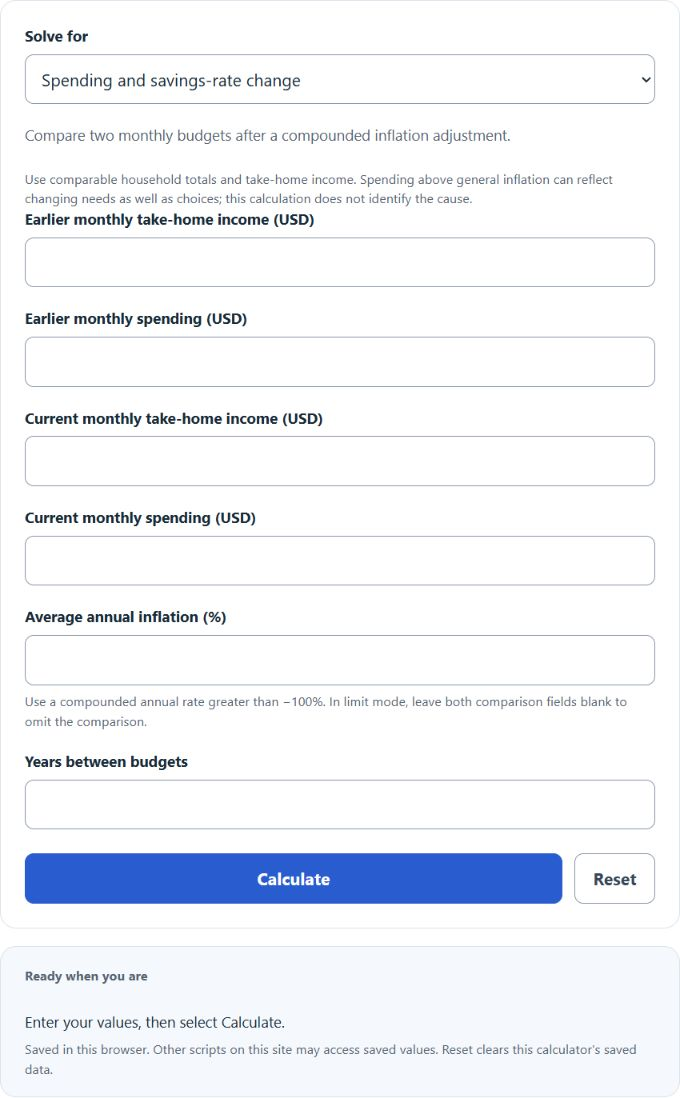
Use the Lifestyle Inflation Calculator to separate spending growth from general inflation, compare savings rates, and set a spending limit after a raise.
Lifestyle Inflation Formula
Lifestyle inflation is the increase in spending beyond what general price inflation alone would explain. First bring earlier spending into current dollars:
S_adjusted = S_0 * (1 + i)^n
Compare current spending with that inflation-adjusted baseline:
Lifestyle inflation = (S_1 / S_adjusted - 1) * 100%
The earlier and current savings rates are:
SR_0 = (I_0 - S_0) / I_0
 SR_1 = (I_1 - S_1) / I_1
To preserve the earlier savings rate after income changes, the current spending limit is:
Spending limit = I_1 * (1 - SR_0)
Variables:
- S_0 is earlier monthly spending
- S_1 is current monthly spending
- S_adjusted is earlier spending expressed in current dollars
- I_0 and I_1 are earlier and current monthly income
- i is the average annual inflation rate, written as a decimal
- n is the number of years between the two periods
- SR_0 and SR_1 are the earlier and current savings rates
The analysis mode compares spending with a compounded inflation-adjusted baseline; changes in household needs can also explain the difference. When earlier spending is zero, percentage growth is undefined and the calculator reports the absolute monthly change. The spending-limit mode needs only earlier income, earlier spending and current income. Enter both inflation and elapsed years for an optional comparison, or leave both blank to omit it. A negative earlier savings rate describes a deficit, not positive saving.
Lifestyle Inflation Examples
The table uses monthly income and spending. A positive lifestyle-inflation result means spending rose faster than general prices. The savings-rate change is shown in percentage points.
| Earlier monthly income / spending | Current income / spending | Inflation and time | Lifestyle inflation above general inflation | Savings-rate change |
|---|---|---|---|---|
| $5,000 / $3,500 | $7,000 / $4,900 | 3% for 5 years | +20.77% | 0.00 points |
| $5,000 / $3,500 | $7,000 / $4,500 | 3% for 5 years | +10.91% | +5.71 points |
| $4,000 / $3,200 | $5,000 / $4,200 | 2.5% for 4 years | +18.91% | -4.00 points |
| $6,000 / $4,200 | $8,000 / $5,600 | 4% for 3 years | +18.53% | 0.00 points |
Example Problems
Example 1: Measure lifestyle inflation.
Earlier monthly spending was $3,500. Five years later, current spending is $4,900, and general inflation averaged 3 percent. The inflation-adjusted earlier spending is $3,500 * 1.03^5 = approximately $4,057.46. Lifestyle inflation above general inflation is ($4,900 / $4,057.46 - 1) * 100% = approximately 20.77 percent.
Example 2: Preserve an earlier savings rate.
Earlier monthly income was $5,000 and spending was $3,500, so the savings rate was 30 percent. Current income is $7,000. To keep saving 30 percent, current spending must stay at or below $7,000 * 70% = $4,900 per month, leaving $2,100 per month for savings.
Frequently Asked Questions
Is every increase in spending lifestyle inflation?
No. Part of a spending increase may simply reflect higher prices. The calculator first adjusts the earlier spending level for general inflation, then labels only the remaining increase as lifestyle inflation. A larger household, medical needs, debt payments, taxes, or another major life change may also explain the difference.
Can lifestyle inflation be negative?
Yes. A negative result means current spending is below the inflation-adjusted earlier level. That may result from deliberate cost cutting, lower housing or transportation costs, debt payoff, a smaller household, or a change in consumption rather than falling prices alone.
Why compare savings rates as well as spending?
Income and spending often rise together. The savings rate shows whether a larger income produced proportionally more saving or whether additional spending absorbed the gain. Preserving the earlier savings rate is one practical benchmark, though a household may intentionally choose a different target.