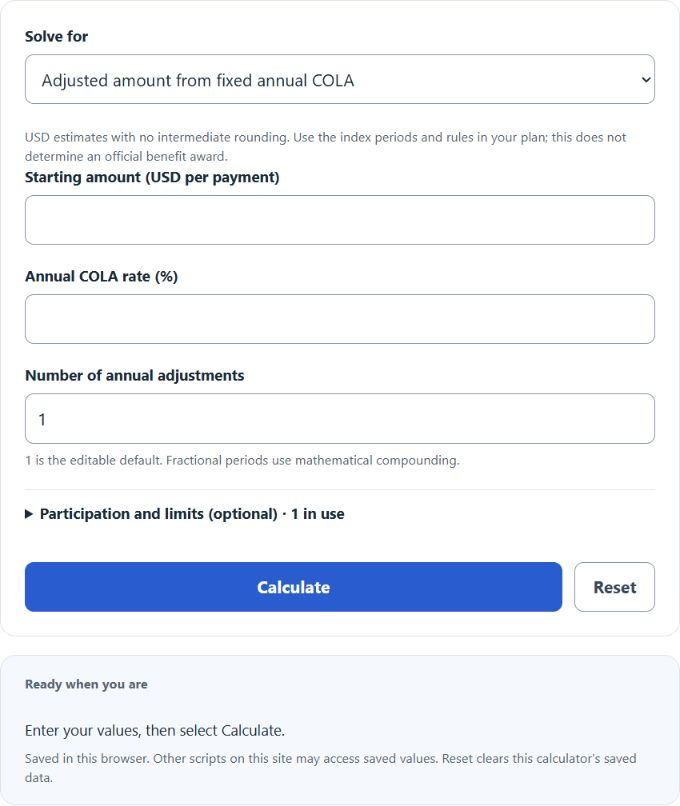
Use the COLA Calculator to apply fixed or index-based adjustments, participation rates, floors, and caps, or reverse-calculate an equivalent annual COLA.
COLA Formula
A fixed annual cost-of-living adjustment compounds the current payment, wage, benefit, or allowance by the selected COLA rate:
A_n = A_0 * (1 + c)^n
For an index-based adjustment, first calculate the percentage change in the index. Then apply any participation percentage, floor, and cap specified by the plan. This calculator applies the index change once and keeps full precision until the final display:
c_raw = I_1 / I_0 - 1
 c_pre = c_raw * p
 c_applied = min(max(c_pre, floor), cap)
When the old and new amounts are known, the equivalent annual COLA is:
c = (A_n / A_0)^(1/n) - 1
Variables:
- A_0 is the current or starting amount
- A_n is the amount after n annual adjustments
- c is a fixed or equivalent annual COLA rate, expressed as a decimal in these formulas
- I_0 and I_1 are the base and current index values
- p is the index participation rate, written as a decimal
- c_applied is the rate after participation, floor, and cap rules
- n is the number of annual adjustment periods; fractional values use mathematical compounding
Select a fixed COLA when the adjustment percentage is already known. Select index-based COLA when the governing rule starts with two index values. Participation below 100 percent provides only part of the index change, while a floor sets a minimum and a cap sets a maximum.
COLA Calculation Examples
These examples illustrate common fixed and index-based adjustment structures. Actual plans can use different measurement periods, rounding rules, delays, and eligibility provisions.
| COLA method | Starting amount | Rule | Adjusted amount |
|---|---|---|---|
| Fixed | $2,000 | 3% for 1 adjustment | $2,060.00 |
| Fixed | $2,000 | 3% for 5 adjustments | $2,318.55 |
| Index-based | $2,000 | 4% index change, full participation | $2,080.00 |
| Index-based | $2,000 | 6% index change, 75% participation | $2,090.00 |
| Index-based | $2,000 | 8% index change, 3% cap | $2,060.00 |
| Index-based | $2,000 | -1% index change, 0% floor | $2,000.00 |
Example Problems
Example 1: Apply a fixed COLA for several years.
A monthly payment is $2,500 and receives a 2.5 percent annual COLA for four adjustments. The future amount is $2,500 * 1.025^4 = approximately $2,759.53 per month.
Example 2: Apply participation and a cap.
A base index rises from 300 to 318, a 6 percent increase. The plan provides 75 percent participation and caps the adjustment at 4 percent. Before the cap, the adjustment is 6% * 75% = 4.5%. The applied rate is therefore 4 percent. A $2,000 payment becomes $2,080.
Frequently Asked Questions
What is a cost-of-living adjustment?
A cost-of-living adjustment changes a payment or compensation amount to address changes in prices. It may be a fixed percentage or may be tied to a published index. The exact index, comparison months, participation rate, cap, floor, and rounding method depend on the plan or contract.
Is a COLA always equal to inflation?
No. Some adjustments match an index change, but others use only part of it, impose a maximum or minimum, use a delayed measurement period, or specify a fixed rate unrelated to current inflation. Compare the governing terms with the calculator settings before relying on the result.
What is the difference between a COLA cap and floor?
A cap limits how high the applied adjustment can be, even when the measured index change is larger. A floor sets the minimum applied adjustment. For example, a zero-percent floor prevents a negative index change from reducing the payment, while a three-percent cap limits a larger positive adjustment.