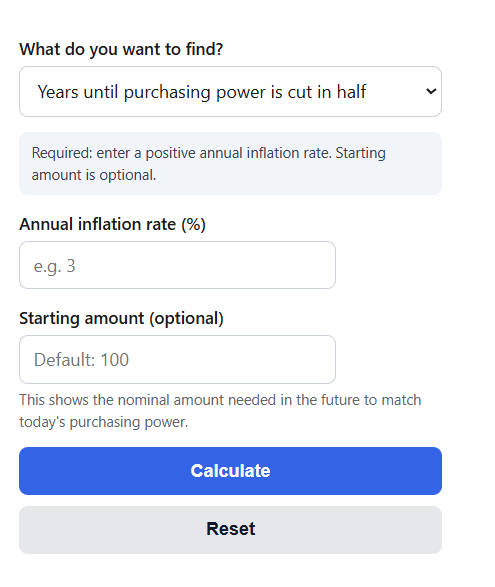
Use the Purchasing Power Half-Life Calculator to find when inflation cuts buying power in half or the annual rate that doubles prices over a chosen period.
Purchasing Power Half-Life Formula
The purchasing-power half-life is the time required for a constant inflation rate to double the general price level. When prices double, a fixed amount of money buys half as much. Solve the compound inflation equation for time:
t_50 = ln(2) / ln(1 + i)
To solve for the annual inflation rate that produces a selected half-life:
i = 2^(1 / t_50) - 1
The time needed to lose any selected share L of purchasing power is:
t_L = ln[1 / (1 - L)] / ln(1 + i)
Variables:
- t_50 is the number of years until purchasing power falls by 50 percent
- t_L is the time until the selected purchasing-power loss
- i is the annual inflation rate, written as a decimal
- L is the share of purchasing power lost, written as a decimal
- ln is the natural logarithm
The optional starting amount does not change the half-life. It shows the nominal amount that would be required at the end to match the starting purchasing power. At the half-life, that required nominal amount is exactly twice the starting amount under the constant-rate assumption.
Purchasing Power Half-Life by Inflation Rate
The Rule of 72 estimates doubling time by dividing 72 by the percentage rate. The calculator uses the exact logarithmic formula and displays the Rule of 72 result only as a comparison.
| Annual inflation rate | Exact purchasing-power half-life | Rule of 72 estimate |
|---|---|---|
| 2% | 35.00 years | 36.00 years |
| 3% | 23.45 years | 24.00 years |
| 4% | 17.67 years | 18.00 years |
| 5% | 14.21 years | 14.40 years |
| 8% | 9.01 years | 9.00 years |
| 10% | 7.27 years | 7.20 years |
Example Problems
Example 1: Find the half-life at 3 percent inflation.
Use t_50 = ln(2) / ln(1.03). The result is approximately 23.45 years. At that point, $100 would have the purchasing power of about $50 in starting-year goods, and approximately $200 would be needed to buy what $100 bought at the beginning.
Example 2: Find the inflation rate for a 20-year half-life.
Use i = 2^(1/20) – 1. The result is approximately 0.035265, or 3.5265 percent per year. A constant annual inflation rate near 3.53 percent doubles prices over 20 years.
Frequently Asked Questions
Is purchasing-power half-life the same as money losing half its face value?
No. The number printed on the currency does not change. Half-life refers to real purchasing power: the amount of goods and services a fixed nominal sum can buy. When the price level doubles, the same dollars buy approximately half of the original basket.
What happens when inflation is zero or negative?
At zero inflation, purchasing power does not have a finite half-life under this model. With sustained deflation, a fixed amount gains rather than loses purchasing power. The half-life calculation therefore requires a positive inflation rate.
How accurate is the Rule of 72?
The Rule of 72 is a convenient approximation for moderate rates. The exact logarithmic formula is more precise and works consistently across the supported range. Actual future purchasing power will differ when inflation varies over time, which is better modeled with a variable inflation calculation.