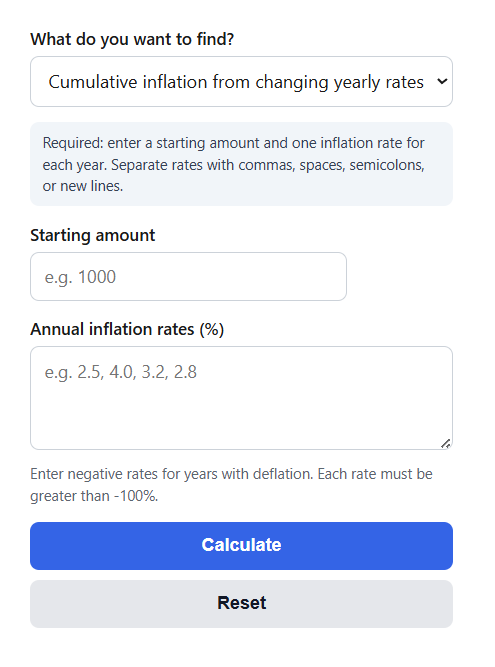
Use the Variable Inflation Calculator to compound changing annual rates, find cumulative inflation, future cost, and the purchasing power of a fixed amount.
Variable Inflation Formula
When inflation changes from year to year, the rates compound rather than add. Convert each annual percentage to a decimal and multiply its growth factor:
F = Π(1 + r_t)
The cumulative inflation rate, future cost of a starting basket, and remaining purchasing power of a fixed amount are:
Cumulative inflation = (F - 1) * 100%
 Future cost = A * F
 Fixed-amount purchasing power = A / F
An equivalent constant annual inflation rate summarizes the entire sequence:
r_eq = F^(1/n) - 1
Variables:
- F is the total compounded inflation factor
- r_t is the inflation rate in year t, written as a decimal
- A is the starting amount or basket cost
- r_eq is the equivalent compound annual inflation rate
- n is the number of annual rates entered
Enter the rates in chronological order, separated by commas, spaces, semicolons, or new lines. A negative rate represents deflation for that year. The year-by-year output shows how the cumulative factor, comparable basket cost, and purchasing power change after each entry.
Variable Inflation Examples
The table demonstrates why adding rates or taking a simple arithmetic average is not enough. Each year’s rate applies to the price level created by all preceding years.
| Yearly inflation sequence | Cumulative inflation | Equivalent annual rate | $100 future cost |
|---|---|---|---|
| 3%, 3%, 3% | 9.27% | 3.00% | $109.27 |
| 2%, 5%, 1% | 8.17% | 2.65% | $108.17 |
| 8%, 4%, 2% | 14.57% | 4.64% | $114.57 |
| -1%, 4%, 3% | 6.05% | 1.98% | $106.05 |
| 6%, 6%, 6%, 6% | 26.25% | 6.00% | $126.25 |
Example Problems
Example 1: Calculate cumulative inflation from changing yearly rates.
A $1,000 basket experiences inflation of 2 percent, 5 percent, and 1 percent over three years. The compounded factor is 1.02 * 1.05 * 1.01 = 1.08171. Cumulative inflation is 8.171 percent and the future basket cost is $1,081.71. The equivalent annual rate is approximately 2.65 percent.
Example 2: Include a deflation year.
Annual rates are -1 percent, 4 percent, and 3 percent. The factor is 0.99 * 1.04 * 1.03 = 1.060488. Cumulative inflation is approximately 6.05 percent. A fixed $100 at the end has purchasing power equivalent to about $94.30 in starting-year goods.
Frequently Asked Questions
Can I add annual inflation rates together?
Adding is only an approximation. Exact cumulative inflation multiplies the annual growth factors because each year’s price change applies to the new price level. The difference grows as the rates, volatility, or number of years increase.
What does a negative annual rate mean?
A negative rate represents deflation, meaning the general price level falls during that year. Enter it with a minus sign. It reduces the cumulative factor but does not erase the compounding from other years unless the full sequence brings the factor back to one.
Why is remaining purchasing power calculated by division?
If prices rise by a factor F, each fixed dollar buys 1/F as much of the original basket. For example, a 1.25 price factor means a basket costs 25 percent more, while a fixed amount retains 1/1.25 = 80 percent of its original purchasing power.