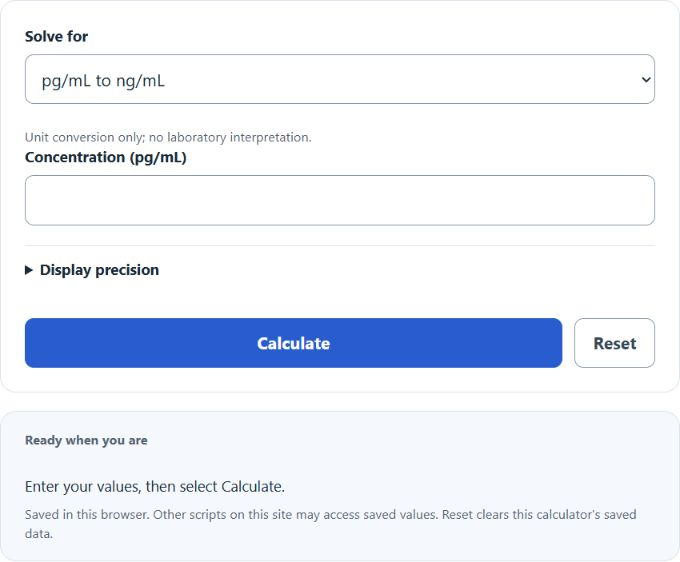
Convert concentrations between pg/mL and ng/mL, with reverse conversion and µg/mL results for blood or lab concentration values instantly.
- mg Per mL Calculator
- mg/m3 to ppm Converter
- ppm to mg/m3 Converter
- ug/m3 to ppm Converter
- All Unit Converters
pg/mL to ng/mL Formula
The following formula is used to convert a concentration from picograms per milliliter to nanograms per milliliter.
Reverse formula:
Variables:
- ng/mL is the concentration in nanograms per milliliter
- pg/mL is the concentration in picograms per milliliter
To convert pg/mL to ng/mL, divide the concentration in picograms per milliliter by 1000. Because the volume unit stays the same, only the mass unit changes.
What is pg/mL to ng/mL?
Picograms per milliliter and nanograms per milliliter are concentration units commonly used in laboratory testing, hormone panels, cytokine measurements, and other low-level analyte reporting. A nanogram is 1000 times larger than a picogram, which means any value reported in pg/mL can be converted to ng/mL by dividing by 1000.
For example, 1000 pg/mL equals 1 ng/mL, 250 pg/mL equals 0.25 ng/mL, and 42 pg/mL equals 0.042 ng/mL. This makes it easy to compare results when different laboratories or references use different concentration units.
How to Convert pg/mL to ng/mL?
The following steps outline how to convert pg/mL to ng/mL.
- First, determine the concentration in picograms per milliliter (pg/mL).
- Next, divide that value by 1000.
- The result is the equivalent concentration in nanograms per milliliter (ng/mL).
- After calculating the result, verify your answer with the calculator above.
Example Problem:
Use the following values as an example problem to test your knowledge.
Concentration = 2500 pg/mL
Converted Concentration = 2.5 ng/mL
pg/mL to ng/mL Conversion Table
The table below lists several example concentrations in pg/mL and their equivalents in ng/mL using the rule ng/mL = pg/mL ÷ 1000.
| Value in pg/mL | Equivalent in ng/mL | Comment |
|---|---|---|
| 10 pg/mL | 0.01 ng/mL | 10 ÷ 1000 |
| 25 pg/mL | 0.025 ng/mL | 25 ÷ 1000 |
| 50 pg/mL | 0.05 ng/mL | 50 ÷ 1000 |
| 100 pg/mL | 0.1 ng/mL | 100 ÷ 1000 |
| 250 pg/mL | 0.25 ng/mL | Quarter of a ng/mL |
| 1000 pg/mL | 1 ng/mL | Exact 1:1000 conversion |
| 5000 pg/mL | 5 ng/mL | Higher-range value |
Different laboratories may report the same test in pg/mL or ng/mL. Since the units differ only by a factor of 1000, converting between them is straightforward and expresses concentrations in consistent units; unit conversion alone does not interpret the test result.