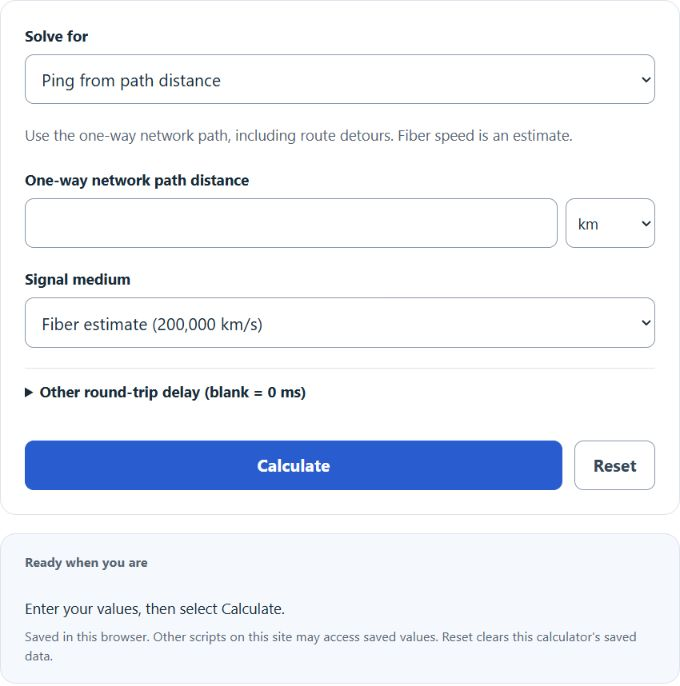
Estimate ping from path distance, infer distance or effective signal speed, or estimate one-way delay from RTT. Propagation modes support fiber, free-space, custom speed and additional round-trip overhead.
Related Calculators
- Upload Time Calculator
- Frame Rate Calculator
- GPU Hours Calculator
- Ohms To Distance Calculator
- All Unit Converters
One-way Latency (Approx.) Formula
The following formula approximates total one-way delay from a measured ping (RTT) when forward and return delays are roughly equal. It does not isolate propagation delay or measure either direction.
Variables:
- L is the estimated one-way latency in milliseconds (ms)
- RTT is the round-trip time (ping) in milliseconds (ms)
To estimate total one-way delay, divide RTT by 2. The separate propagation modes use RTT = 2000 × D / v + overhead, where D is one-way path distance in km, v is propagation speed in km/s, and RTT and overhead are in ms. These modes assume equal outward and return path lengths and speeds; fiber speed is approximate.
What is Ping (RTT)?
Ping (as reported by common tools like ping) is the round-trip time (RTT): the time it takes for a probe packet to go from your device to a destination and for the reply to come back. It is usually measured in milliseconds (ms). A lower RTT generally indicates a more responsive connection, which is important for real-time applications such as online gaming, video conferencing, and VoIP calls. High RTT can result in lag and delays, affecting performance and user experience.
How to Estimate One-way Latency
The following steps outline how to estimate one-way latency from ping (RTT).
- First, measure the ping (RTT) of a destination in milliseconds (ms) using a tool such as
ping. - Next, if you need an estimate of one-way latency, use the approximation L ≈ RTT / 2 (this assumes roughly symmetric delay).
- Finally, choose One-way delay from ping in the calculator above and enter the measured RTT. Use the other modes only when the required path, speed and overhead assumptions are available.
Example Problem :
Use the following variables as an example problem to test your knowledge.
Ping / Round Trip Time (RTT) = 100 ms
Estimated One-way Latency (L) ≈ RTT / 2 = 100 / 2 = 50 ms