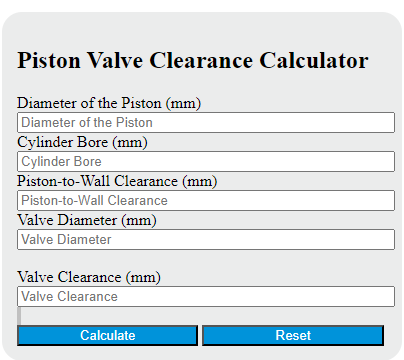
Enter the deck clearance, compressed head gasket thickness, valve pocket (relief) depth, and valve lift (at the crank position you’re checking—often TDC on overlap) into the calculator to estimate piston-to-valve clearance at that position.
Piston-to-Valve Clearance (Estimated) Formula
The piston-to-valve clearance calculator estimates the gap between the piston crown and the valve at a specific crankshaft position. In most engine mock-up checks, this position is near top dead center during overlap, but the tightest point may occur slightly before or after that depending on cam timing, rocker ratio, and valve motion.
VC = D + C + P - V
This relationship adds the available distance above the piston and the valve relief depth, then subtracts the valve lift present at the exact crank angle being checked.
| Symbol | Meaning | Practical note |
|---|---|---|
| VC | Piston-to-valve clearance | The estimated remaining gap at the checked crank position. |
| D | Deck clearance | Use a positive value when the piston is below the deck. If the piston protrudes above the deck, enter it as a negative value. |
| C | Compressed head gasket thickness | Use the installed, compressed thickness rather than the uncompressed catalog thickness. |
| P | Valve pocket depth | This is the depth of the valve relief in the piston crown. |
| V | Valve lift at the checked crank position | Use actual valve lift at that crank angle, not peak lift unless that is the exact point being checked. |
Rearranged Equations
Because the calculator can solve for any one missing value, the same equation can be rearranged as follows:
D = VC - C - P + V
C = VC - D - P + V
P = VC - D - C + V
V = D + C + P - VC
How to Use the Calculator
- Measure the piston deck clearance relative to the block deck.
- Enter the compressed thickness of the head gasket you are actually using.
- Measure the valve pocket depth in the piston.
- Determine valve lift at the exact crank position being checked.
- Review the calculated clearance value for that specific position.
If you are checking an interference engine build, it is best to evaluate more than one crank angle because the minimum clearance is not always exactly at top dead center.
Result Interpretation
- Positive clearance: There is still estimated space between the valve and piston at that crank angle.
- Zero clearance: The parts are theoretically just touching.
- Negative clearance: The estimate indicates interference, meaning the valve would try to occupy the same space as the piston.
Example
Suppose the piston is 0.50 mm below deck, the compressed gasket thickness is 1.00 mm, the valve pocket depth is 2.50 mm, and valve lift at the checked crank position is 1.20 mm.
VC = 0.50 + 1.00 + 2.50 - 1.20 = 2.80\ \text{mm}The estimated piston-to-valve clearance at that crank angle is 2.80 mm.
Piston-to-Valve Clearance vs. Valve Lash
Piston-to-valve clearance and valve lash are not the same thing. Piston-to-valve clearance is the physical distance between the piston and the valve during engine rotation. Valve lash is the small designed running clearance within the valvetrain itself. Correct lash does not guarantee safe piston-to-valve clearance, and safe piston-to-valve clearance does not automatically mean lash is correct.
What Affects Piston-to-Valve Clearance?
- Cam timing: Advancing or retarding the cam changes when the valve opens and closes relative to piston position.
- Valve lift curve: Clearance depends on lift at the checked crank angle, not just advertised peak lift.
- Rocker ratio: A ratio change alters actual valve motion.
- Head gasket thickness: A thinner compressed gasket reduces available clearance.
- Deck height changes: Block decking or piston height changes move the piston closer to or farther from the valve.
- Piston design: Valve relief depth and piston crown shape directly affect the available pocket space.
- Machining changes: Milled heads, sunk seats, or changed installed heights can alter real geometry.
- Valvetrain dynamics: At operating speed, deflection, stretch, or float can reduce actual running clearance compared with a static estimate.
Important Limitations
This calculator provides a simplified geometric estimate. It is most useful as a planning and comparison tool during engine assembly, cam swaps, piston selection, and mock-up work. Real engines are three-dimensional systems, and actual minimum clearance can be influenced by valve angle, piston rock, rod stretch, timing set variation, lifter behavior, and machining tolerances.
- Check intake and exhaust valves separately if their timing events differ.
- Use actual net valve lift at the measured crank angle whenever possible.
- Re-check clearance after changing the camshaft, rocker ratio, head gasket, piston, head milling, block decking, or valve timing.
- For tight builds, physical verification with a mock-up method is strongly recommended before final assembly.