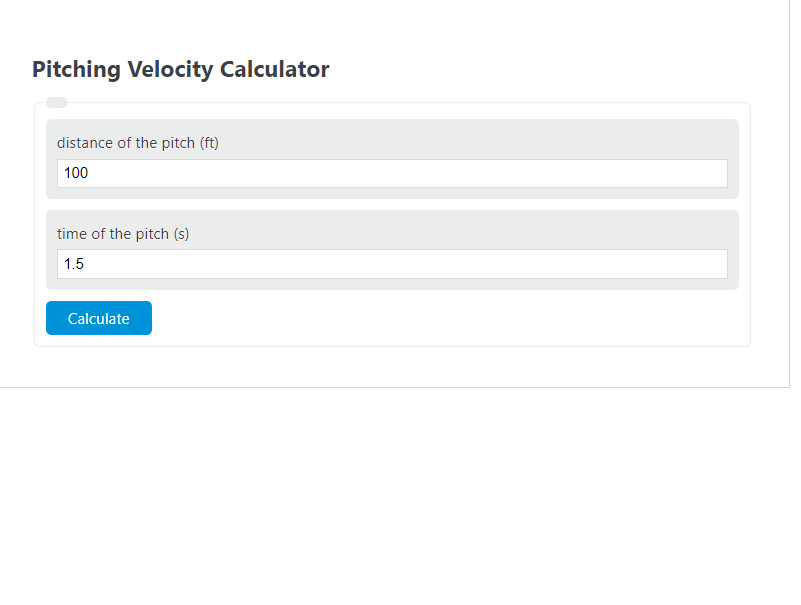
Calculate pitching velocity, pitch time, or distance from any two values, and estimate reaction time plus MLB-equivalent speed for baseball or softball.
Pitching Velocity Formula
The following equation is used to calculate the Pitching Velocity.
- Where PV is the pitching velocity (MPH)
- D is the distance of the pitch (ft)
- T is the time of the pitch (s)
The constant 1.467 converts feet per second into miles per hour (5,280 ft/mile divided by 3,600 s/hour). When you divide distance in feet by time in seconds, you get feet per second. Dividing again by 1.467 converts that result into MPH.
Average Pitching Velocity by Age
Pitching velocity benchmarks vary significantly across age groups. These ranges represent the average fastball velocity for each level, with elite pitchers typically falling at or above the top end.
| Age/Level | Mound Distance | Average Velocity (MPH) | Elite Velocity (MPH) |
|---|---|---|---|
| 9-10 (10U) | 35-46 ft | 40-50 | 55+ |
| 11-12 (Little League) | 46 ft | 50-60 | 65-70 |
| 13-14 (Middle School) | 50-54 ft | 60-70 | 75+ |
| 15-16 (JV/Varsity) | 60.5 ft | 70-80 | 82-85 |
| 17-18 (Varsity) | 60.5 ft | 78-85 | 88-92 |
| College (D1) | 60.5 ft | 88-92 | 94-97 |
| MLB | 60.5 ft | 93-94 | 98-105+ |
One important nuance this table reveals: a 12-year-old throwing 60 mph from 46 feet delivers the ball to home plate in about 0.52 seconds. An MLB pitcher throwing 94 mph from 60.5 feet delivers it in about 0.44 seconds. The youth pitcher's pitch actually gives the batter less than 0.1 additional seconds to react, which is why youth baseball can feel deceptively fast relative to the raw speed numbers.
Pitching Mound Distance by League
Different leagues and age groups use different pitching distances, which directly affects both perceived velocity and time to plate. Use the calculator's Reaction Time tab to compare how a pitch at one distance feels at another.
| League/Level | Age Group | Mound Distance (ft) | Basepath (ft) |
|---|---|---|---|
| T-Ball / Coach Pitch | 4-7 | 35-38 | 50 |
| Little League (Minors) | 7-11 | 46 | 60 |
| Little League (Majors) | 10-12 | 46 | 60 |
| PONY Bronco / Cal Ripken | 11-12 | 50 | 70 |
| PONY Pony / Babe Ruth | 13-14 | 54 | 80 |
| High School / College / MLB | 15+ | 60.5 (60 ft 6 in) | 90 |
| Softball (Fastpitch) | 14+ | 43 | 60 |
The 60-foot-6-inch distance used from high school through MLB was established in 1893. Before that, pitchers threw from 50 feet, but the offensive explosion at that distance prompted the rule change. This distance has remained unchanged for over 130 years.
Average MLB Pitch Velocity by Pitch Type
Pitching velocity is not uniform across pitch types. Each pitch serves a different purpose in a pitcher's arsenal, and speed differentials are what make them effective. Below are average MLB velocities by pitch type as of the 2025 season.
| Pitch Type | Avg. MLB Velocity (MPH) | Typical Speed Differential vs. Fastball |
|---|---|---|
| 4-Seam Fastball | 94.0 | Baseline |
| Sinker (2-Seam) | 92.5 | 1-3 mph slower |
| Cutter | 88-95 | 2-6 mph slower (varies widely) |
| Changeup | 85.9 | 8-10 mph slower |
| Slider | 84-88 | 6-12 mph slower |
| Curveball | 80.5 | 12-16 mph slower |
| Splitter | 85-88 | 6-10 mph slower |
The average MLB four-seam fastball has increased from 89.0 mph in 2002 to 94.0 mph in 2025, a 5.6% increase over 23 years. Meanwhile, four-seam usage has dropped from 64.4% to 47.9% over that same period, as pitchers increasingly rely on sliders (now 22.4% usage, up from 12.1% in 2002) and other breaking pitches. This shift reflects a broader strategic evolution toward tunneling and speed differential rather than pure velocity.
Biomechanics of Pitching Velocity
Pitching velocity is produced through a kinetic chain that transfers energy from the ground, through the legs and hips, into the trunk, through the shoulder and arm, and out through the hand. Research has identified several measurable factors that correlate with higher velocity.
Stride Length: Studies of collegiate pitchers show that stride length is positively correlated with ball velocity. The target is roughly 85% of the pitcher's height, with the lead foot landing in a slightly closed position. Hip abduction flexibility in the stride leg has a significant positive correlation with achievable stride length.
Hip-to-Shoulder Separation: High-velocity pitchers open their hips earlier and at a faster angular rate than low-velocity pitchers. The pelvis reaches rotational velocities of 400 to 700 degrees per second during the delivery. This creates a stretch across the core that stores elastic energy before the trunk fires. Greater separation between hip and shoulder rotation produces more rotational force.
Shoulder Internal Rotation: At peak, shoulder internal rotation reaches 7,000 to 9,000 degrees per second, making it the fastest measured human movement. This is the final link in the kinetic chain before ball release.
Ground Reaction Forces: Research indicates that ground reaction forces can explain up to 61% of the variance in throwing velocity. Pitchers who generate more force into the rubber and through the stride leg into landing tend to throw harder. This is why lower body strength training (deadlifts, single-leg exercises, plyometrics) is a core part of modern velocity development programs.
Reaction Time and Perceived Velocity
Raw pitch speed only tells part of the story. What matters to a batter is how long they have to identify and react to the pitch. This is where pitching distance becomes critical. A 70 mph pitch from 46 feet (Little League) reaches the plate in about 0.45 seconds, while a 94 mph pitch from 60.5 feet (MLB) takes about 0.44 seconds. These two pitches, despite a 24 mph speed gap, give batters nearly identical reaction windows.
| Scenario | Distance (ft) | Speed (MPH) | Time to Plate (s) | MLB-Equivalent (MPH) |
|---|---|---|---|---|
| Youth 46 ft, 55 mph | 46 | 55 | 0.570 | 72.3 |
| Youth 46 ft, 65 mph | 46 | 65 | 0.483 | 85.5 |
| Youth 50 ft, 70 mph | 50 | 70 | 0.487 | 84.7 |
| HS 60.5 ft, 85 mph | 60.5 | 85 | 0.485 | 85.0 |
| College 60.5 ft, 92 mph | 60.5 | 92 | 0.448 | 92.0 |
| MLB 60.5 ft, 100 mph | 60.5 | 100 | 0.412 | 100.0 |
| Softball 43 ft, 65 mph | 43 | 65 | 0.451 | 91.5 |
This table demonstrates why a 65 mph fastpitch softball pitch from 43 feet is comparable to a 91+ mph fastball in MLB: the batter has essentially the same reaction window. Coaches transitioning players between leagues can use the calculator's Reaction Time tab to understand these equivalencies.
Fastest Pitches Ever Recorded
The Statcast era (2015-present) provides precise tracking data for every MLB pitch. Below are the top recorded pitch speeds in MLB history.
| Pitcher | Speed (MPH) | Date |
|---|---|---|
| Aroldis Chapman | 105.8 | Sept. 24, 2010 |
| Aroldis Chapman | 105.7 | July 18, 2016 |
| Ben Joyce | 105.5 | Sept. 3, 2024 |
| Aroldis Chapman | 105.4 | July 18, 2016 |
| Aroldis Chapman | 105.2 | July 22, 2016 |
A 105.8 mph pitch from 60.5 feet reaches the plate in approximately 0.39 seconds. Subtracting roughly 0.15-0.20 seconds for the swing itself, the batter has under 0.2 seconds to identify pitch type and location and decide whether to swing. For comparison, the average human blink takes about 0.15-0.40 seconds.
How Pitching Velocity Is Measured
There are several methods used to measure pitch speed, each with different accuracy and accessibility.
Radar Gun: The traditional tool, used by scouts since the 1970s. Measures the peak speed of the ball, typically captured near the pitcher's release point. Consumer-grade units (Pocket Radar, Stalker) cost $100-$400 and are accurate within 0.5-1 mph. Professional units used in stadiums are accurate within 0.1 mph.
Statcast (Hawk-Eye): MLB's optical tracking system captures full pitch trajectory using 12 high-resolution cameras per stadium. It reports both release speed and plate speed. The typical speed drop from release to plate is 8-10% due to air drag, so a 95 mph fastball at release crosses the plate around 86-87 mph.
Stopwatch Method: The most accessible approach, and what this calculator is built for. By timing a pitch from release to plate, you can back-calculate velocity using V = D / T / 1.467. Accuracy depends on reaction time of the person operating the stopwatch (typically adds 0.1-0.3 seconds of error, which at MLB distances translates to 10-25 mph of potential error). Video analysis at 120+ fps provides much better accuracy with this method.
Video Analysis (Dartfish, Kinovea): Free and paid software tools let you mark the release frame and plate-arrival frame in slow-motion video. At 240 fps, each frame spans about 0.004 seconds, making this method accurate to roughly 1-2 mph when the distance is known.