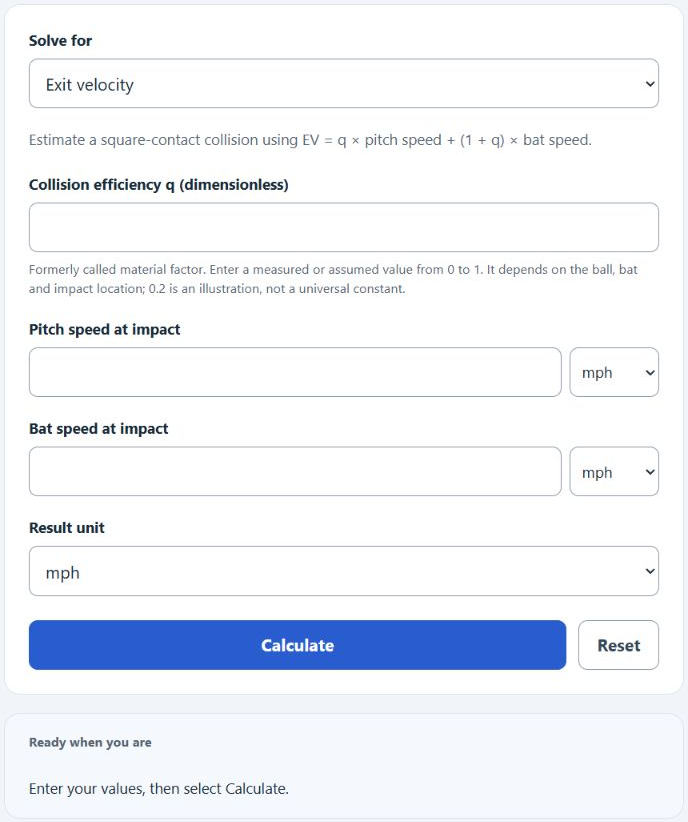
Select exit velocity, bat speed, pitch speed or collision efficiency, then enter the other three values. This square-contact model uses collision efficiency rather than a universal material constant.
Bat Speed to Exit Velocity Formula
The following equation is used to calculate the Bat Speed to Exit Velocity.
- Where Ve is the exit velocity (mph)
- MF is collision efficiency q (dimensionless), which depends on the ball, bat and impact location; 0.2 is an illustrative assumption
- PS is the pitch speed (mph)
- BS is the bat speed (mph)
| Bat Speed (mph) | Exit Velocity (mph) |
|---|---|
| 30 | 54.0 |
| 35 | 60.0 |
| 40 | 66.0 |
| 45 | 72.0 |
| 50 | 78.0 |
| 55 | 84.0 |
| 60 | 90.0 |
| 65 | 96.0 |
| 68 | 99.6 |
| 70 | 102.0 |
| 72 | 104.4 |
| 75 | 108.0 |
| 78 | 111.6 |
| 80 | 114.0 |
| 82 | 116.4 |
| 85 | 120.0 |
| 88 | 123.6 |
| 90 | 126.0 |
| 92 | 128.4 |
| 95 | 132.0 |
| Illustrative fixed pitch speed and collision efficiency q. Formula: Exit Velocity = q × Pitch Speed + (1 + q) × Bat Speed. | |
How are Bat Speed and Exit Velocity Related?
In this simplified model, exit velocity is described by three quantities:
- The speed of the pitch
- The speed of the bat
- Collision efficiency, including ball and bat properties and impact location
At fixed positive collision efficiency, increasing bat or pitch speed increases the predicted exit velocity. The model does not describe every contact.
How to Calculate Exit Velocity From Bat Speed?
Example Problem:
The following example outlines the steps and information needed to calculate Exit Velocity From Bat Speed.
First, select Exit velocity and assume collision efficiency MF = 0.2 for this example; this is not a fixed value for all wooden bats.
Next, determine the pitch speed. For this problem, the pitch speed is found to be 95 mph.
Next, determine the bat speed. In this case, the bat speed is measured to be 75 mph.
Finally, calculate the exit velocity using the formula above:
Ve = MF * (PS) + (1+MF)*BS
Ve = .2* (95) + (1+.2)*75
Ve = 109 mph