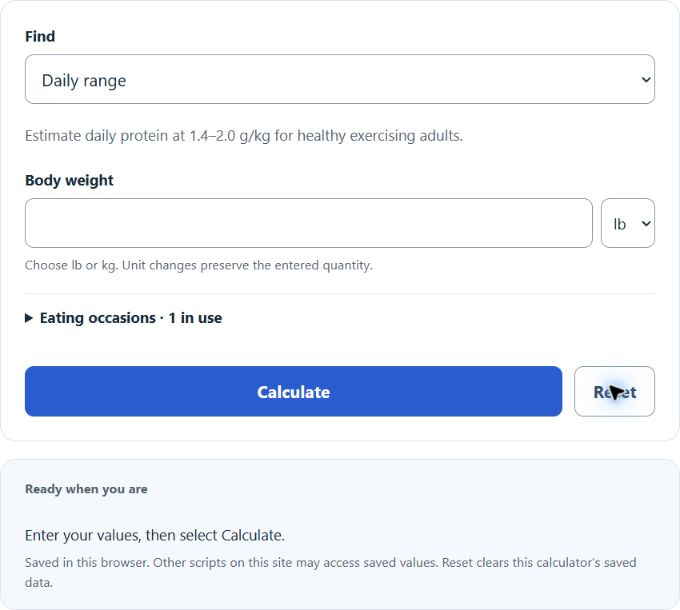
Estimate an athlete protein target from pounds or kilograms using 1.4–2.0 grams per kilogram for healthy exercising adults, or a custom factor.
Pounds To Protein Formula
The following formula could be used to estimate protein intake based on body weight and an intake factor.
Variables:
- PI is the protein intake (grams)
- BW is the body weight (pounds)
- r is the protein intake factor per pound of body weight (grams/pound)
To calculate the protein intake, multiply the body weight by the protein intake factor per pound of body weight. The result is an estimated daily protein intake in grams for the chosen factor.
| g/kg | g/lb |
|---|---|
| 0.5 | 0.227 |
| 0.6 | 0.272 |
| 0.7 | 0.318 |
| 0.8 | 0.363 |
| 0.9 | 0.408 |
| 1.0 | 0.454 |
| 1.1 | 0.499 |
| 1.2 | 0.544 |
| 1.3 | 0.590 |
| 1.4 | 0.635 |
| 1.5 | 0.680 |
| 1.6 | 0.726 |
| 1.7 | 0.771 |
| 1.8 | 0.816 |
| 1.9 | 0.862 |
| 2.0 | 0.907 |
| 2.2 | 0.998 |
| 2.4 | 1.089 |
| 2.6 | 1.179 |
| 3.0 | 1.361 |
| Exact conversion: g/lb = g/kg × 0.45359237; g/kg = g/lb ÷ 0.45359237. Table values round to three decimal places. The general-adult 0.8 g/kg/day reference is approximately 0.36 g/lb/day and is separate from the exercising-adult range. | |
What is Pounds To Protein?
This page calculates daily protein from body weight in pounds or kilograms, or calculates a mathematically matching weight from a daily protein target. Daily range uses 1.4–2.0 g/kg/day for healthy exercising adults, based on the ISSN position stand on protein and exercise. Daily custom and Weight custom use a positive factor you supply. The reverse calculation is arithmetic and does not recommend a body weight. An even split across 3, 4 or 5 eating occasions is an arithmetic summary, not a prescribed serving size.
How to Calculate Pounds To Protein?
The following steps outline how to calculate the Pounds To Protein using the formula: PI = BW * r.
- First, choose Daily range or Daily custom and enter body weight in lb or kg. Unit changes preserve the entered quantity.
- For Daily custom, enter a positive factor in g/lb or g/kg; match the factor to the body-weight unit for a manual calculation. Daily range uses the stated 1.4–2.0 g/kg/day interval.
- Next, gather the formula from above: PI = BW * r.
- Finally, calculate the estimated protein intake (PI).
- Check both daily endpoints for a range. To work backward, choose Matching weight range or Weight custom and enter a daily protein target. Divide the target by the larger factor for the lower weight and by the smaller factor for the higher weight; select lb or kg for the output.
Example Problem :
Use the following variables as an example problem to test your knowledge.
body weight (BW) in pounds = 150
example custom protein factor (r) = 0.36 g/lb/day, approximately the 0.8 g/kg/day general-adult reference. This rounded factor is separate from the default exercising-adult range.
PI = 150 × 0.36 = 54 g/day. In Daily custom, enter 150 lb and 0.36 g/lb. An even split across four occasions is 13.5 g each; protein-only energy is about 216 kcal/day using 4 kcal/g, as described in the FDA protein handout. This is not total dietary energy.
Using the exact 0.8 g/kg/day factor instead gives 150 × 0.45359237 × 0.8 = 54.4310844 g/day. Using Daily range at the same weight gives approximately 95.25–136.08 g/day.