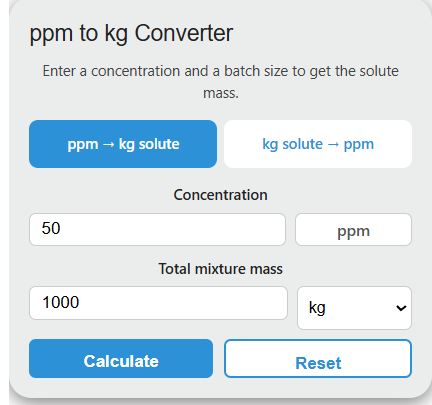
Convert ppm to kilograms, grams, or milligrams of solute for a known mixture mass, or calculate ppm from solute mass using mass-based concentration.
Quick Overview: ppm to kg
For many environmental, laboratory, and engineering calculations, ppm expresses how many milligrams of solute are present per kilogram of mixture.
Basic relationship: 1 ppm ≈ 1 mg/kg
- 10 ppm in 1 kg = 0.00001 kg of solute
- 50 ppm in 10 kg = 0.0005 kg of solute
- 100 ppm in 100 kg = 0.01 kg of solute
- 250 ppm in 1000 kg = 0.25 kg of solute
The calculator uses this relationship automatically once you enter the ppm level and select the total mass of material.
- ppm to ug/l Converter
- ec to ppm Converter
- Ratio To Volume Calculator
- kg Per Hectare Calculator
- All Unit Converters
ppm to kg Formula
The following formula is used to convert a concentration in parts per million into the mass of solute in kilograms for a known total mass of mixture.
Variables:
- kg is the mass of solute in kilograms
- ppm is the concentration in parts per million
- M is the total mass of the mixture in kilograms
For dilute mixtures, ppm is commonly interpreted as milligrams of solute per kilogram of mixture. To calculate the solute mass in kilograms, multiply the ppm value by the total mass in kilograms and divide by 1,000,000.
You can also rearrange the relationship as follows:
- 1 ppm ≈ 1 mg solute / 1 kg mixture
- Mass of solute (kg) = ppm × total mass (kg) ÷ 1,000,000
- ppm = (mass of solute (kg) ÷ total mass (kg)) × 1,000,000
What is ppm to kg Conversion?
ppm to kg conversion is the process of turning a very small concentration value into an actual mass amount. Since ppm represents a mass fraction, it tells you how much solute exists relative to the total mass of material. Once the overall mass of the mixture is known, you can estimate how many kilograms of the substance are present.
This type of conversion is common in environmental science, water treatment, agriculture, laboratory work, and process engineering. It helps with dosing, reporting contamination levels, tracking chemical inventory, and comparing concentrations across different sample sizes.
For example, 50 ppm in 1,000 kg of material corresponds to 50 × 1000 ÷ 1,000,000 = 0.05 kg of solute. The same 50 ppm in only 10 kg of material would correspond to just 0.0005 kg of solute.
ppm to kg Conversion Table
The table below lists example conversions for several ppm values and total masses using the formula mass (kg) = ppm × total mass (kg) ÷ 1,000,000.
| Concentration (ppm) | Total Mass of Mixture (kg) | Solute Mass (kg) |
|---|---|---|
| 10 ppm | 1 kg | 0.00001 kg |
| 50 ppm | 1 kg | 0.00005 kg |
| 100 ppm | 10 kg | 0.001 kg |
| 250 ppm | 100 kg | 0.025 kg |
| 500 ppm | 1000 kg | 0.5 kg |
| 800 ppm | 5000 kg | 4 kg |
| 1000 ppm | 10000 kg | 10 kg |
How to Calculate ppm to kg?
The following steps outline how to convert ppm into kilograms of solute.
- First, determine the concentration in parts per million (ppm).
- Next, determine the total mass of the mixture in kilograms.
- Then, multiply the ppm value by the total mass in kilograms.
- Finally, divide the result by 1,000,000 to calculate the solute mass in kilograms.
- After inserting the values and calculating the result, check your answer with the calculator above.
Example Problem:
Use the following variables as an example problem to test your knowledge.
Concentration (ppm) = 50
Total Mass of Mixture (M) = 1000 kg
Solute Mass (kg) = 50 × 1000 ÷ 1,000,000 = 0.05 kg