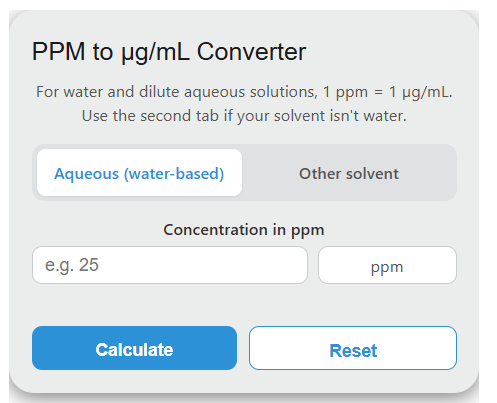
Convert ppm to micrograms per milliliter (µg/mL) or reverse the calculation for water or other liquids using solution-density correction.
Quick Overview: In most dilute aqueous samples, 1 ppm is effectively equal to 1 µg/mL because 1 ppm means 1 mg of solute per kg of solution, and 1 liter of water weighs about 1 kg.
- Water: 10 ppm ≈ 10.0 µg/mL
- Seawater: 10 ppm ≈ 10.25 µg/mL
- Ethanol: 10 ppm ≈ 7.9 µg/mL
- Glycerol: 10 ppm ≈ 12.6 µg/mL
The calculator applies the selected liquid density so the ppm to µg/mL conversion is more accurate for non-water media.
- All Unit Converters
- nm to ug/ml Converter
- mg/m3 to ppm Converter
- mEq/L To mg/dL Calculator
- ng/mL To nmol/L Calculator
PPM to µg/mL Formula
The following formula is used to convert ppm into micrograms per milliliter when the density of the liquid is known.
Variables:
- µg/mL is the concentration in micrograms per milliliter
- ppm is the concentration in parts per million
- ρ is the density of the liquid in kg/L (numerically the same as g/mL)
To calculate the concentration in µg/mL, multiply the ppm value by the density of the solution. For water and most dilute aqueous solutions, the density is close to 1.00, so ppm and µg/mL are nearly equal.
What is PPM to µg/mL Conversion?
PPM to µg/mL conversion is used to express the same concentration in two different ways. PPM is a mass-based concentration unit, meaning parts of solute per million parts of solution by mass. Micrograms per milliliter is a volume-based concentration unit. When the density of the liquid is known, you can convert between them accurately. This is especially useful in chemistry, environmental testing, laboratory analysis, water treatment, and pharmaceutical work.
For dilute water-based samples, the conversion is simple because 1 ppm is almost the same as 1 mg/L, and 1 mg/L equals 1 µg/mL. However, if the liquid is denser or lighter than water, such as glycerol or ethanol, the converted value changes slightly.
How to Convert PPM to µg/mL?
The following steps outline how to convert ppm to µg/mL.
- First, determine the concentration in ppm.
- Next, determine the density of the solution in kg/L or g/mL.
- Multiply the ppm value by the density using the formula µg/mL = ppm × ρ.
- Check your answer with the calculator above.
Example Problem:
Use the following variables as an example problem to test your knowledge.
PPM = 10
Density (ρ) = 1.025 kg/L
µg/mL = 10 × 1.025 = 10.25
PPM to µg/mL Conversion Table
The table below shows example conversions for a 10 ppm solution in several common liquids.
| Medium | Approx. Density (ρ) kg/L | 10 ppm in µg/mL |
|---|---|---|
| Pure Water | 1.00 | 10.0 µg/mL |
| Seawater | 1.025 | 10.25 µg/mL |
| Blood Plasma | 1.025 | 10.25 µg/mL |
| Ethanol | 0.79 | 7.9 µg/mL |
| Vegetable Oil | 0.92 | 9.2 µg/mL |
| Glycerol | 1.26 | 12.6 µg/mL |
| Other Dilute Aqueous Solution | 1.00 | 10.0 µg/mL |
In environmental and laboratory work, ppm values in water are often treated directly as µg/mL. For liquids with densities that differ noticeably from water, using the density-based conversion gives a more precise result.