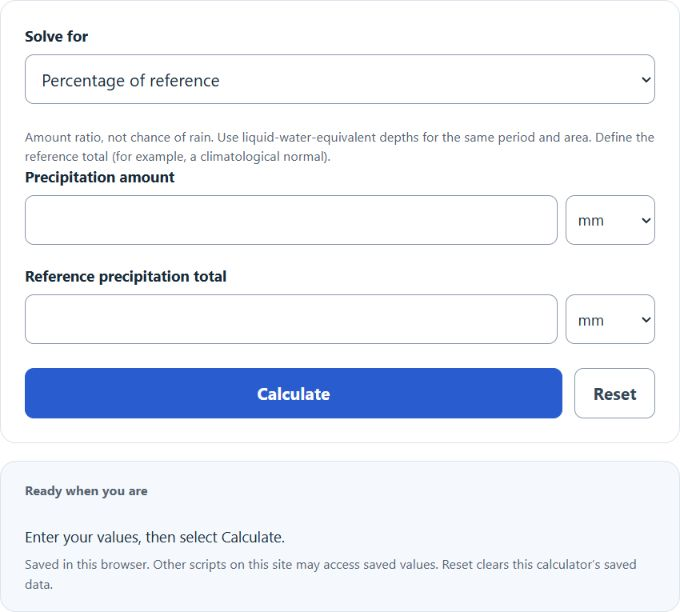
Calculate precipitation as a percentage of a defined reference total, or solve for either depth, using mm, cm, inches or meters. This amount ratio is not the forecast chance of rain.
Related Calculators
- Excess Reagent Calculator
- Ionic Concentration Calculator
- Mass Percent Calculator
- Normality To Percent Calculator
- All Chemistry Calculators
Precipitation Percentage Formula
The following formula expresses a precipitation amount as a percentage of a specified positive reference total for the same period and area.
Variables:
- P is the precipitation percentage
- A is the amount of precipitation
- T is the specified positive reference precipitation total, in the same depth units as A
To calculate the precipitation percentage, divide the amount of precipitation by the total possible precipitation. Multiply the result by 100 to convert it to a percentage.
What is Precipitation Percentage?
Here, precipitation percentage means an amount divided by a defined reference total, multiplied by 100. The reference may be a normal or another stated benchmark; it is not a universal “total possible” amount. A percentage of normal may exceed 100%. This ratio differs from probability of precipitation, which expresses the chance of measurable precipitation at a location during a stated forecast period. Use liquid-water-equivalent depths when comparing rain with snow or ice.
How to Calculate Precipitation Percentage?
The following steps outline how to calculate the Precipitation Percentage.
- First, determine the amount of precipitation (A).
- Next, determine the total possible precipitation (T).
- Next, calculate the precipitation percentage using the formula P = (A / T) * 100.
- Finally, calculate the Precipitation Percentage.
- After inserting the values and calculating the result, check your answer with the calculator above.
Example Problem :
Use the following variables as an example problem to test your knowledge.
Amount of precipitation (A) = 50 mm
Reference precipitation total (T) = 200 mm; P = (50/200) × 100 = 25%.