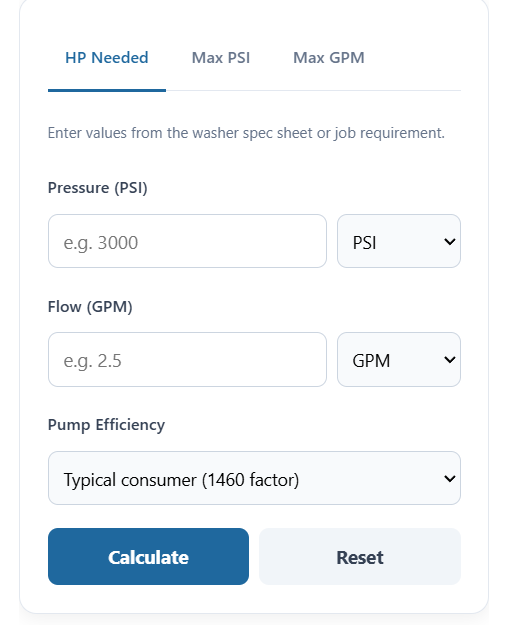
Enter the pressure (PSI) and flow rate (GPM) of a pressure washer to estimate the horsepower required to drive the pump — or switch modes to solve for maximum PSI or GPM from a known motor size.
Related Calculators
- All Automotive Calculators
- Pressure Washer Horsepower Calculator
- Horsepower To GPM Calculator
- Pump Brake Horsepower Calculator
Formula
HP = (PSI × GPM) ÷ C
where HP = required horsepower, PSI = pump outlet pressure, GPM = flow rate in gallons per minute, C = efficiency constant (1460 typical consumer, 1100 commercial/high-load, 1714 ideal hydraulic).
PSI = (HP × C) ÷ GPM
GPM = (HP × C) ÷ PSI
Interpretation
The result is the shaft horsepower the engine or motor must deliver to produce the given pressure and flow at the nozzle. The PSI × GPM product is also called Cleaning Units (CU) — the single best proxy for how fast a washer strips dirt. Use these ranges to judge the result:
- Under 3 HP: light-duty electric washers (~1,500–2,000 PSI, 1.4 GPM).
- 3–7 HP: residential gas washers (2,500–3,200 PSI, 2.3–2.8 GPM).
- 7–13 HP: prosumer / heavy residential (3,300–4,000 PSI, 3.0–4.0 GPM).
- 13–20 HP: commercial-duty units (4,000+ PSI, 4–5 GPM).
- Over 20 HP: industrial and fleet washing equipment.
If your calculated HP is higher than the horsepower of the engine installed on a washer you're comparing, the spec sheet is either using the 1714 ideal constant or overstating pump output.
Efficiency Constant Reference
| Constant | Implied Efficiency | Use When |
|---|---|---|
| 1714 | 100% (ideal hydraulic) | Theoretical / textbook calculations only. |
| 1460 | ~85% | Typical consumer axial or wobble-plate pumps. |
| 1100 | ~64% | Commercial triplex pumps under sustained load or when sizing a new build with headroom. |
FAQ
Should I use rated pressure or unloader bypass pressure?
Use the rated working pressure at the nozzle (what the machine produces during spray), not the higher bypass/peak pressure listed in marketing copy. Peak ratings can overstate HP needs by 10–15%.
Why do manufacturer specs sometimes show less HP than this calculator?
Consumer washers often quote peak horsepower — a short-duration rating — while this calculator gives the sustained HP required at the pump shaft. Peak HP is typically 1.5–2× the continuous rating.
Does hose length, nozzle size, or elevation change the HP required?
Not at the pump. The pump still delivers the same PSI × GPM, so HP is unchanged. Nozzle size and hose restrictions affect what reaches the surface, but not the horsepower drawn from the engine.
Can I use this for an electric pressure washer?
Yes — convert the motor's kW rating to HP (the calculator does this automatically) and use the 1460 constant. Remember electric motors are rated in true continuous watts, not peak, so results tend to match real-world performance closely.