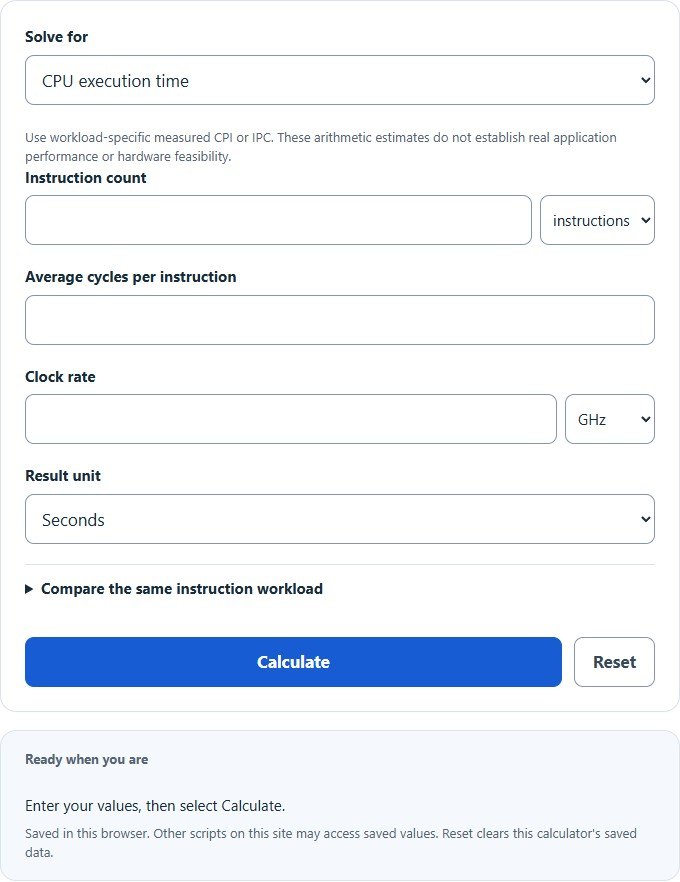
Calculate workload CPU time, instruction throughput with IPC and cores, or required clock rate while keeping frequency, CPI, parallelism, and utilization distinct.
Related Calculators
- Bits per Second to Hertz Calculator
- Cycles to Seconds Calculator
- Clock Cycles Per Instruction Calculator
- Floating Point Operations Per Second Calculator
- MIPS Calculator
- All Unit Converters
Instruction Throughput Formula
The identity below defines average instruction throughput in instructions per second. The CPU-time mode above uses CPU time = instruction count × average CPI / clock frequency in Hz; required clock frequency rearranges this equation.
Variables:
- P is the average instruction throughput (Instructions/Second, IPS)
- I is the number of instructions
- T is the time in seconds
Divide completed instructions by the matching measured time to obtain average instruction throughput. For a single workload, estimated CPU time is I × CPI / f. The instruction-throughput mode estimates independent-work aggregate IPS = f × measured IPC × identical active cores × utilization/100. Optional Amdahl speedup is a separate fixed-workload estimate: 1 / [(1 − p) + p/N], where p is the fraction of single-core runtime that can scale ideally. It is not multiplied into aggregate IPS.
What is Processor Speed?
The term processor speed is often used in two different ways. Clock speed (also called clock frequency) is measured in hertz (Hz) and indicates how many clock cycles occur per second (modern CPUs are often in the gigahertz, GHz, range). Separately, the rate at which work is completed can be expressed as instruction throughput (instructions per second, IPS) or, for floating‑point workloads, FLOPS. Instruction throughput is not the same as clock speed—it depends on the workload and microarchitecture (for example IPC/CPI, stalls, branch behavior), and can also scale with the number of cores for parallel workloads. Higher clock speeds can increase potential performance, but real-world performance and efficiency depend on many other factors.
How to Calculate Processor Speed?
Use the three modes to estimate CPU execution time, independent-work instruction capacity, or the clock rate required for a target CPU time. Use measured workload-specific CPI/IPC and consistent units; clock rate alone is not a benchmark.
- First, determine the number of instructions (I) that need to be executed.
- Next, determine the time (T) taken to execute those instructions.
- Finally, calculate the instruction throughput (P) using the formula P = I / T.
- For CPU execution time use T = I × CPI / f, with f in Hz. For required clock rate use f = I × CPI / target CPU time.
- The instruction-throughput mode uses measured IPC, identical active cores and an independent utilization adjustment. IPC and utilization must use compatible measurement definitions to avoid counting idle time twice. Amdahl speedup applies to a fixed workload with no overhead; memory and shared-resource limits can reduce real scaling.
Example Problem :
Use the following variables as an example problem to test your knowledge.
Number of instructions (I) = 5000
Time (T) = 2 seconds
Average instruction throughput = 5,000 / 2 = 2,500 IPS. This measured rate does not determine a unique GHz clock frequency without CPI/IPC. For example, 1 billion instructions at CPI 1.5 and 3 GHz require 0.5 seconds of CPU time.