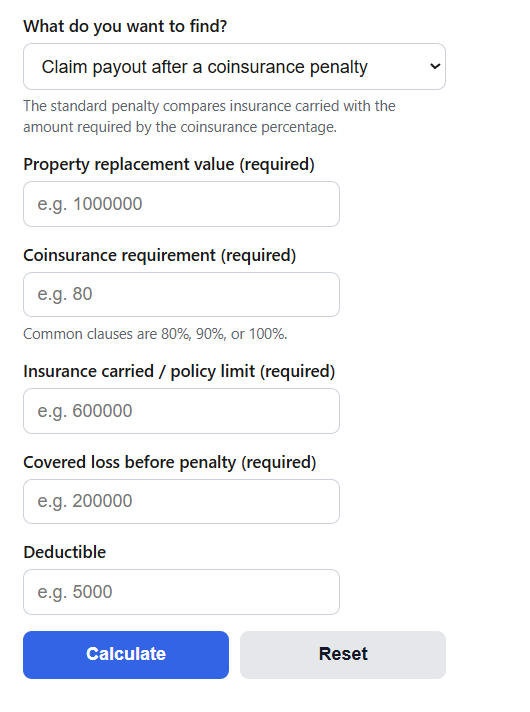
Online property insurance coinsurance penalty calculator to estimate claim payout, required insurance, and added limit needed to satisfy the policy clause.
Property Insurance Coinsurance Penalty Formula
A property coinsurance clause first determines how much insurance should have been carried:
Required Insurance = Property Value * Coinsurance Percentage
When insurance carried is below that amount, a proportional penalty can reduce a partial-loss payment:
Payout = min(Insurance Carried, Loss * (Insurance Carried / Required Insurance) - Deductible)
Variables:
- Property Value is the replacement value used by the policy for the coinsurance test
- Coinsurance Percentage is the required insured percentage, such as 80%
- Insurance Carried is the applicable limit at the time of loss
- Loss is the covered amount before the coinsurance adjustment
- Deductible is subtracted after the proportional adjustment in this model
The ratio is capped at 1, so carrying more than the required amount does not create a payout above the covered loss or policy limit.
Coinsurance Penalty Reference
The table assumes a $1,000,000 property value, an 80% coinsurance clause, a $200,000 covered loss, and a $5,000 deductible.
| Insurance carried | Required insurance | Coinsurance ratio | Estimated payout |
|---|---|---|---|
| $800,000 | $800,000 | 100% | $195,000 |
| $700,000 | $800,000 | 87.5% | $170,000 |
| $600,000 | $800,000 | 75% | $145,000 |
| $400,000 | $800,000 | 50% | $95,000 |
Example Problems
Example 1: Calculate a coinsurance penalty.
A building is worth $1,000,000, the policy requires 80% insurance, and only $600,000 is carried. A covered loss is $200,000 with a $5,000 deductible.
Required insurance is $800,000, so the coinsurance ratio is 75%. The modeled payout is $200,000 × 75% − $5,000 = $145,000.
Example 2: Find the limit needed to avoid the penalty.
A property has a $750,000 replacement value and a 90% coinsurance clause.
The required insurance is $750,000 × 90% = $675,000. Carrying at least that amount satisfies this simplified test.
Frequently Asked Questions
What does an 80% coinsurance clause mean?
It generally means the property should be insured to at least 80% of the value defined by the policy. Falling below that threshold can reduce payment on a partial loss.
Does the penalty apply to a total loss?
The proportional formula is most important for partial losses. A total loss is still constrained by the policy limit, exclusions, valuation terms, and applicable law.
How can a coinsurance penalty be avoided?
Keep reported values and limits current, review inflation and improvements, and ask whether agreed-value, blanket, or reporting-form provisions suspend or change the clause.