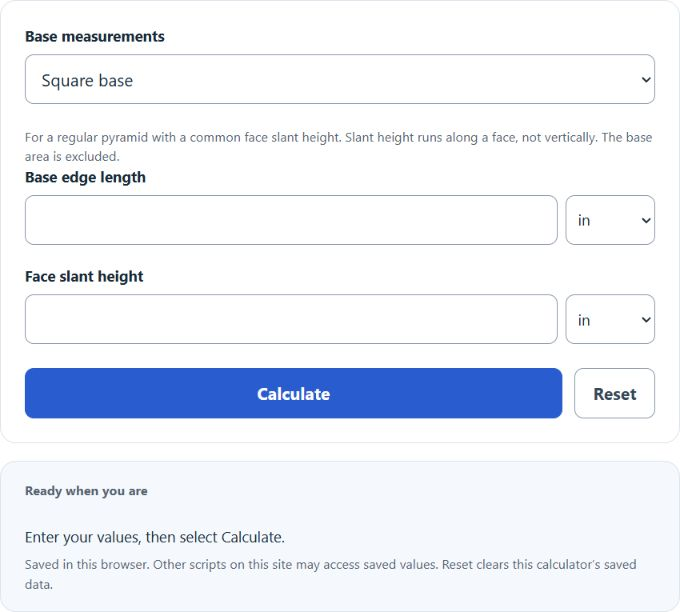
Calculate a pyramid’s lateral surface area from base edge or perimeter inputs and slant height in inches, feet, centimeters, or meters.
- All Math and Numbers Calculators
- Pentagon Calculator
- Octagon Calculator
- Slant Height Calculator
- Ramp Slope Calculator
- L Shape Area Calculator
Pyramid Lateral Area Formula
The lateral area of a regular pyramid is the combined area of all of its triangular side faces and does not include the base. This calculator is intended for a regular pyramid, meaning the base is a regular polygon and every side face has the same slant height.
- LA = lateral area in square units
- P = perimeter of the base in linear units
- s = slant height in linear units
Why this formula works
Each lateral face of a regular pyramid is a triangle. When those triangular faces are added together, their combined area simplifies to half of the base perimeter multiplied by the common slant height. That is why only two measurements are needed for a regular pyramid: the full base perimeter and the slant height.
How to calculate the lateral area
- Find the perimeter of the base by adding all base side lengths.
- Measure or calculate the slant height along the face of the pyramid from the midpoint of a base side to the apex.
- Multiply the perimeter by the slant height.
- Take half of that product to get the lateral area.
- Express the result in square units such as square inches, square feet, square centimeters, or square meters.
Common regular base shortcuts
| Base Shape | Perimeter Formula | Lateral Area Formula |
|---|---|---|
| Square base with side length a | P = 4a |
LA = 2as |
| Equilateral triangle base with side length a | P = 3a |
LA = (3) / (2)as |
| Regular pentagon base with side length a | P = 5a |
LA = (5) / (2)as |
| Regular hexagon base with side length a | P = 6a |
LA = 3as |
If you know vertical height instead of slant height
The slant height is not the same as the vertical height. In a regular pyramid, the slant height is found from the vertical height and the apothem of the base.
Here, h is the vertical height and r is the apothem of the base. Once the slant height is known, substitute it into the lateral area formula.
Lateral area vs. total surface area
Lateral area includes only the side faces. If you need the entire outside area of the pyramid, add the base area to the lateral area.
Here, SA is total surface area and B is the base area.
Example
For a regular pyramid with a base perimeter of 20 feet and a slant height of 8 feet:
The lateral area is 80 square feet.
Important notes when using the calculator
- Use the perimeter of the base, not the base area.
- Use the slant height measured along a triangular face, not the straight vertical height.
- Select the unit for each measurement; the calculator converts mixed units automatically. The result uses the slant-height unit squared.
- The result will always be in square units.
- This shortcut applies to regular pyramids. For irregular or oblique pyramids, the lateral faces must be calculated individually and then added together.
For irregular pyramids
If the pyramid does not have a regular base or if the side faces do not share one common slant height, find the area of each triangular face separately and add them.