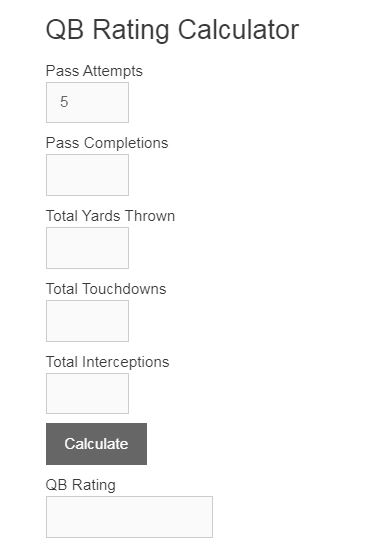
Calculate NFL and NCAA quarterback passer ratings from attempts, completions, yards, touchdowns, and interceptions, with QB comparison and what-ifs.
QB Rating Formula
The following formula is used by the NFL to determine the passer rating. Note: each component (A, B, C, D) is capped to fall between 0 and 2.375.
- Where A is the completion percentage factor: A = ((Comp/Att) − 0.3) × 5 (equivalently (Comp% − 30) × 0.05). Cap A between 0 and 2.375.
- B is the yards per attempt factor: B = ((Yards/Att) − 3) × 0.25. Cap B between 0 and 2.375.
- C is the touchdown percentage factor: C = (TD/Att) × 20 (equivalently TD% × 0.2). Cap C between 0 and 2.375.
- D is the interception percentage factor: D = 2.375 − ((INT/Att) × 25) (equivalently 2.375 − (INT% × 0.25)). Cap D between 0 and 2.375.
As you can see from the list above, there are four main factors that influence the NFL passer rating of a quarterback. It's intended that each of these factors have equal weight, but that isn't always agreed upon. Some people believe they should have equal weight, and some people believe the formula is already skewed toward certain factors.
QB Rating Definition
QB Rating, also known as passer rating, is a measure of performance for quarterbacks playing American football. The NFL passer rating has been officially used since 1973, and it is one of the most widely recognized quarterback statistics in the National Football League (NFL).
The NFL passer rating is based on four factors. These are covered in detail above, but in short, these are completion percentage, yards per attempt, passing touchdowns, and interceptions thrown.
The maximum NFL passer rating is 158.3 when rounded to one decimal place (the exact maximum is 158.333...). This maximum exists because each of the four components (A, B, C, and D) is capped at 2.375, so the overall rating cannot exceed that value even with a 100% completion percentage.
Historical QB Ratings
Historically, many of the highest career passer ratings have come from more recent eras. This is largely because rule changes and modern offensive schemes over the past several decades have tended to favor passing efficiency, and league-wide completion percentages have increased.
FAQ
QB Rating, also known as passer rating, is a measure of performance for quarterbacks playing American football. The NFL passer rating has been officially used since 1973, and it is one of the most widely recognized quarterback statistics in the National Football League (NFL).
How to improve passer rating?
You may be a young quarterback and thinking to yourself, “How do I increase my QB rating?” In the NFL formula, you improve passer rating by improving the underlying components: complete a higher percentage of passes, gain more yards per attempt, throw more passing touchdowns per attempt, and throw fewer interceptions per attempt. A higher completion percentage often helps overall efficiency, but it does not automatically increase yards per attempt or touchdown rate—those also depend on how far and how effectively your completions are gained (yards per completion) and how often drives finish in passing TDs.