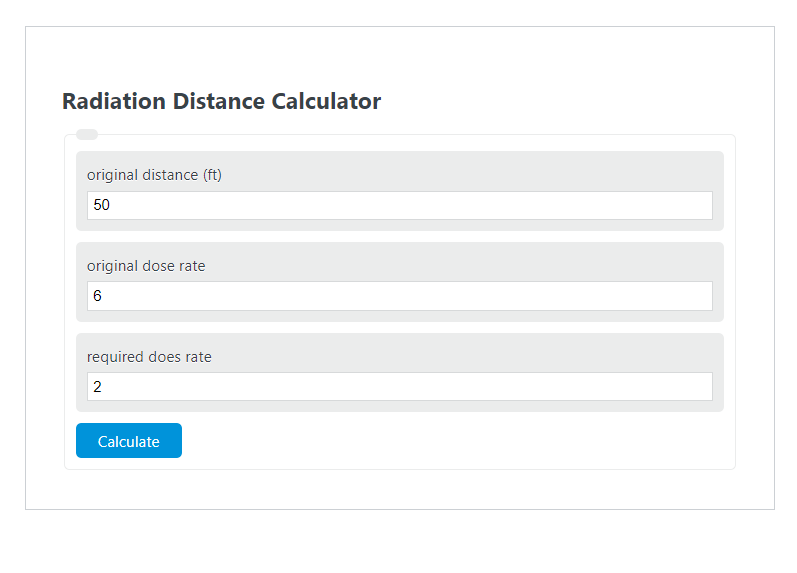
Calculate radiation distance or dose rate by inverse square law, gamma exposure from activity and distance, and required shielding thickness.
Related Calculators
- Exposure Rate Calculator
- Half-Value Layer Calculator
- Nominal Optical Hazard Distance Calculator
- Radiation View Factor Calculator
- Wavelength to Energy Calculator
- All Physics Calculators
The Inverse Square Law
Radiation from a point source spreads equally in all directions across an expanding sphere. Because the surface area of a sphere equals 4πr², the same total energy is distributed over a larger area as distance increases. Intensity therefore drops as the inverse square of distance rather than linearly. Any point source radiating uniformly in all directions obeys this law, including gamma, X-ray, and neutron sources at sufficient distance.
Key limitation: the inverse square law applies reliably when the measurement distance is at least 10 times the largest physical dimension of the source. For a 1 cm sealed source, reliable results begin at 10 cm or more. Below that threshold, source geometry matters and the law overpredicts the dose reduction achievable through added distance alone.
Radiation Distance Formula
The following formula calculates the distance required to achieve a target dose rate from a known measurement point.
- Drad = required distance to achieve the target dose rate (same unit as D1)
- D1 = original measurement distance
- R1 = dose rate measured at D1
- R2 = target (required) dose rate
Distance Multiplier and Dose Reduction Reference
The table below shows how dose rate scales relative to a baseline measurement at distance D₁. These reduction factors apply universally regardless of source type, energy, or original dose rate, provided the point-source approximation holds.
| Distance from Source | Dose Rate Factor | % of Original | Practical Context |
|---|---|---|---|
| D₁ (baseline) | 1/1 | 100% | Reference survey point |
| 2 x D₁ | 1/4 | 25% | One doubling; dose drops 75% |
| 3 x D₁ | 1/9 | 11.1% | Common ALARA move-back target |
| 4 x D₁ | 1/16 | 6.25% | Controlled area boundary design |
| 5 x D₁ | 1/25 | 4.0% | Supervised area threshold in many protocols |
| 7 x D₁ | 1/49 | 2.0% | Typical exclusion zone design target |
| 10 x D₁ | 1/100 | 1.0% | Point-source approximation fully valid; dose effectively negligible for most sources |
Radiation Protection Context
Distance is one component of the standard radiation protection framework: time, distance, and shielding (TDS). Each reduces effective dose independently, and all three can be combined. The US Nuclear Regulatory Commission (NRC) sets the occupational whole-body dose limit at 5 rem (50 mSv) per year under 10 CFR Part 20, with an ALARA investigation threshold typically at 500 to 1,500 mrem per year for routine occupational work. US average background dose is approximately 310 mrem/year, with about 200 mrem from natural sources and roughly 80 mrem from medical procedures, providing useful context for evaluating occupational exposures.
A practical benchmark: a nuclear medicine technologist standing 1 foot from a 10 mCi Tc-99m patient receives roughly 60 mR/hr. Moving back to 3 feet reduces that to about 6.7 mR/hr (a 9-fold reduction consistent with 3² = 9). For a facility performing 200 procedures per year with 6 minutes of close-proximity work each, that distance difference changes the annual dose contribution from approximately 12 mrem to 1.3 mrem per year. In industrial radiography, a 10 Ci Ir-192 source measuring 2,000 mR/hr at 1 meter requires a standoff distance of roughly 20 meters to reach the 5 mR/hr controlled area limit.
How to Calculate Radiation Distance
The following examples demonstrate how to use the radiation distance formula.
Example Problem #1
- Determine the original distance: 50 ft
- Determine the original dose rate: 6 rem/hr
- Determine the required dose rate: 2 rem/hr
- Apply the formula: Drad = SQRT(50² x 6/2) = SQRT(7,500) = 86.60 ft
To achieve a dose rate of 2 rem/hr, a worker must stand at least 86.6 ft from the source. This represents a 1.73x increase in distance, consistent with SQRT(6/2) = SQRT(3) = 1.732.
Example Problem #2: Occupational Safety Scenario
A radiation survey meter reads 120 mrem/hr at 2 feet from a sealed Cs-137 source. The controlled area dose rate limit is 5 mrem/hr. What minimum distance satisfies that limit?
Variables: D1 = 2 ft, R1 = 120 mrem/hr, R2 = 5 mrem/hr
Drad = SQRT(2² x 120/5) = SQRT(4 x 24) = SQRT(96) = 9.80 ft
The worker must remain at least 9.8 feet from the source to stay within the 5 mrem/hr controlled area limit. This is approximately a 4.9x distance increase, reducing the dose rate by a factor of 24 (120 / 5 = 24), consistent with 4.9² = 24.01.