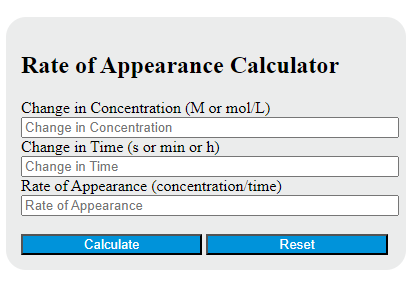
Calculate rate of appearance, change in concentration, or time from any two values with mol/L, M, s, min, and h unit conversions.
- All Chemistry Calculators
- Ionic Concentration Calculator
- Ph To Hydrogen Ion Concentration Calculator
- Hydronium Ion Concentration Calculator
Rate of Appearance Formula
The rate of appearance measures how quickly the concentration of a product increases over a measured time interval. In chemistry, it is typically reported as concentration per unit time and is most often used when analyzing reaction progress from experimental data.
If you know any two of the three values, you can solve for the third.
Variable Definitions
- RoA = rate of appearance
- ΔC = change in concentration of the substance formed
- Δt = change in time over which the concentration changes
Typical concentration units include M or mol/L. Time is commonly measured in seconds, minutes, or hours. The output unit always combines both, such as mol/L/s, mol/L/min, or mol/L/h.
How to Calculate the Rate of Appearance
- Measure the product concentration at two different times.
- Subtract the initial concentration from the final concentration to find the concentration change.
- Subtract the initial time from the final time to find the elapsed time.
- Divide the concentration change by the time change.
- Interpret the result using the correct units.
Example
If the concentration of a product increases by 0.50 mol/L over 10 s, the rate of appearance is:
This means the product concentration is increasing by 0.05 mol/L each second over that interval.
Units and Interpretation
| Input | Common Units | Meaning |
|---|---|---|
| Change in concentration | M, mol/L | How much the product concentration increases |
| Change in time | s, min, h | How long the change took |
| Rate of appearance | mol/L/s, mol/L/min, mol/L/h | Speed of product formation |
Rate of Appearance vs. Rate of Disappearance
The rate of appearance applies to products, where concentration increases with time. The rate of disappearance applies to reactants, where concentration decreases with time. In many chemistry problems, the disappearance rate of a reactant is written with a negative sign so the reported reaction rate remains positive.
For a product, a positive value is expected. If your result is negative, check that:
- you used the final concentration minus the initial concentration,
- the substance is actually being formed rather than consumed, and
- your time values were entered in the correct order.
Important Notes When Using the Calculator
- Be consistent with units. If concentration is in mol/L and time is in seconds, the rate will be in mol/L/s.
- This is usually an average rate. It describes the change over a time interval, not necessarily the exact instantaneous rate at one precise moment.
- Small measurement errors matter. Because the calculation divides by time, small inaccuracies in concentration or time can noticeably affect the result.
- Use the same substance for both concentration readings. Mixing reactant and product values will produce meaningless results.
Where This Calculation Is Used
- chemical kinetics experiments,
- tracking product formation in laboratory reactions,
- comparing how conditions affect reaction speed,
- studying catalyst performance, and
- analyzing concentration-time data in coursework and research.
Common Mistakes
- Using the wrong time units without converting them
- Entering total concentration instead of change in concentration
- Confusing product appearance with reactant disappearance
- Reporting the numerical answer without units
- Using concentration values measured at the same time point
Quick Reference
Use this calculator when you know how much a product concentration changed and how long that change took. It can also be used in reverse to determine the needed concentration change or elapsed time when a target rate is known.