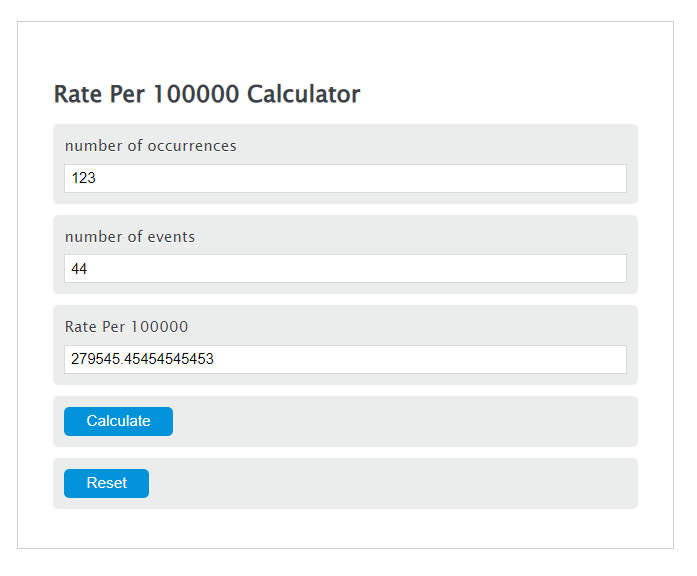
Calculate a rate per 100,000 population from event counts and population size, or solve for events or population, with a 95% confidence interval.
Related Calculators
- Homicide Rate Calculator
- Per 100,000 Population Calculator
- Incidence Rate Calculator
- Prevalence Calculator
- Crude Birth Rate Calculator
- Crude Death Rate Calculator
- All Statistics Calculators
Rate Per 100,000 Formula
Variables:
- E is the number of events (cases, deaths, crimes, incidents)
- P is the total population at risk
Dividing the event count by the population produces a tiny decimal. Multiplying by 100,000 rescales it into a whole number that is easier to read and compare. A city with 50 homicides and a population of 250,000 has a homicide rate of (50 / 250,000) x 100,000 = 20.0 per 100,000, which is immediately comparable to a city of 2 million with 400 homicides (also 20.0 per 100,000).
Why 100,000 Is the Standard Multiplier
Public health and criminal justice agencies settled on 100,000 because it sits in a useful middle range. Multiplying by 1,000 often leaves rates below 1 for rare diseases, making them hard to interpret. Multiplying by 1,000,000 inflates common conditions into numbers that are unwieldy. The 100,000 multiplier keeps most reported rates between roughly 1 and 1,000, a range that is easy to compare at a glance. The convention dates back to 19th-century vital statistics offices in Europe, where national populations were large enough that per-1,000 disease rates produced fractions too small for practical use. The WHO, CDC, FBI Uniform Crime Report, and most national statistical offices all default to this scale for mortality, morbidity, and crime reporting.
Where Rate Per 100,000 Is Used
This metric appears across several major fields, each with its own terminology but the same underlying math.
Epidemiology and Public Health
Incidence rates (new cases per year), prevalence rates (total existing cases), and mortality rates are all reported per 100,000 population. In the United States in 2024, the age-adjusted mortality rate for heart disease was 157.6 per 100,000, cancer was 139.4 per 100,000, and diabetes was 21.7 per 100,000. These figures come from CDC National Vital Statistics and allow researchers to track whether diseases are becoming more or less deadly over time, independent of population growth. The global HIV prevalence in 2021 was 486.1 per 100,000, a figure used by the WHO to allocate funding and compare burden across nations.
Criminology and Law Enforcement
The FBI Uniform Crime Report expresses both violent crime and property crime as rates per 100,000 residents. In 2024, the national U.S. violent crime rate was 359.1 per 100,000. State-level variation is dramatic: Alaska recorded 724.1 violent crimes per 100,000 while Maine recorded 100.1. Property crime followed a similar pattern, with New Mexico at 2,751.1 per 100,000 and Idaho at 736.3. Globally, the WHO estimated homicide rate was 5.61 per 100,000 in 2022, with the highest levels concentrated in the Americas and Africa.
Workplace Safety
The Bureau of Labor Statistics reports fatal occupational injuries per 100,000 full-time equivalent workers. This allows comparison between industries of vastly different sizes. Logging, fishing, and roofing consistently post rates above 40 per 100,000 workers, while office-based industries stay below 1.
Traffic and Transportation Safety
Road fatality rates are expressed per 100,000 population to compare countries or states. The U.S. road fatality rate is roughly 12 to 13 per 100,000, while many Western European countries stay below 5. Within the U.S., Mississippi tends to record rates above 20 per 100,000 while Massachusetts stays near 5, reflecting differences in road design, speed limits, seatbelt use, and rural driving distances.
Crude Rate vs. Age-Adjusted Rate
The calculator above computes a crude rate, meaning it divides total events by total population without accounting for how old or young that population is. Crude rates are straightforward but can be misleading when comparing two populations with different age distributions. A county with many retirees will naturally show a higher crude death rate than a college town, even if the underlying risk at every age is identical.
An age-adjusted rate solves this by weighting each age group’s rate against a standard population (in the U.S., the 2000 Standard Population is the reference). The steps are: calculate the age-specific rate for each group (deaths in that age bracket divided by the population of that bracket, times 100,000), multiply each age-specific rate by the proportion of the standard population in that age bracket, then sum all the weighted rates. The result is a single number that removes the distortion caused by differing age profiles.
For example, Florida’s crude death rate is higher than Utah’s largely because Florida’s median age is about 43 compared to Utah’s 31. Once both states’ rates are age-adjusted against the same standard population, the gap narrows substantially, revealing how much of the difference was demographic rather than health-related.
Reference Data: U.S. Mortality Rates per 100,000 (2024)
The following age-adjusted figures are from CDC provisional data for 2024 and provide context for what typical rate-per-100,000 values look like in practice.
| Cause of Death | Rate per 100,000 | Year-over-Year Change |
|---|---|---|
| All causes | 722.0 | -3.8% |
| Heart disease | 157.6 | -2.8% |
| Cancer | 139.4 | -1.7% |
| Unintentional injury | ~52 | Decline |
| Stroke | 38.6 | -1.0% |
| Chronic lower respiratory disease | 32.4 | -3.0% |
| Diabetes | 21.7 | -3.1% |
Source: CDC National Center for Health Statistics, Mortality in the United States: Provisional Data, 2024.
Reference Data: U.S. Violent Crime Rates per 100,000 by State (2024, Selected)
| State | Violent Crime Rate per 100,000 |
|---|---|
| Alaska | 724.1 |
| New Mexico | 717.1 |
| Tennessee | 592.3 |
| Arkansas | 579.4 |
| Louisiana | 519.8 |
| U.S. Average | 359.1 |
| Wyoming | 203.4 |
| Rhode Island | 153.6 |
| Connecticut | 136.0 |
| New Hampshire | 110.1 |
| Maine | 100.1 |
Source: FBI Crime Data Explorer / World Population Review, 2024 data.
Common Interpretation Mistakes
Comparing crude rates between populations with very different age structures is the most frequent error. A crude cancer mortality rate of 200 per 100,000 in a retirement community does not mean cancer is more dangerous there than in a city with a rate of 120; it usually means the community has more people in the age ranges where cancer is common. Always check whether published rates are crude or age-adjusted before drawing conclusions.
Another common mistake is confusing incidence with prevalence. Incidence counts only new cases during a period, while prevalence counts all existing cases at a point in time. A disease with a high prevalence rate but low incidence rate is one that people live with for a long time (such as diabetes). A disease with high incidence but low prevalence is one that resolves quickly or is rapidly fatal.
Finally, small-population distortion affects rural areas and small towns. If a county of 5,000 people experiences 1 homicide, the rate jumps to 20.0 per 100,000, the same rate as a major city with 600 homicides out of 3 million people. A single additional event in a small population can swing the rate dramatically, so analysts often use multi-year averages or confidence intervals for populations below 50,000.