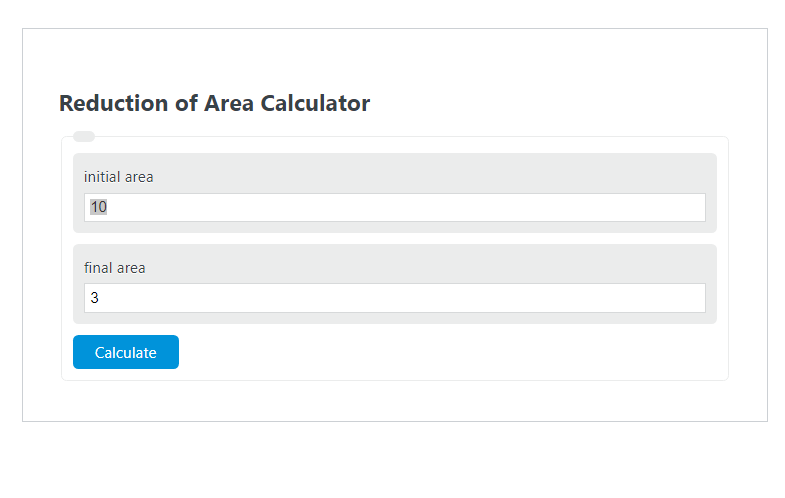
Calculate tensile reduction of area from areas, diameters, or rectangular dimensions, reverse-solve a final diameter, and report true fracture strain.
- All Math and Numbers Calculators
- All Area Calculators
- Wound Surface Area Calculator
- Open Area Percentage Calculator
Reduction of Area Formula
The reduction of area measures how much an area decreases compared to its original size. It is usually reported as a percentage, which makes it easier to compare changes across different shapes, parts, surfaces, or regions.
Where:
- ROA = reduction of area percentage
- TR = total reduction in area
- IA = initial area
- FA = final area
If you already know the percentage reduction, the same relationship can be rearranged to find the amount removed or the remaining area.
How to Calculate Reduction of Area
- Determine the initial area.
- Determine the final area after the reduction.
- Subtract the final area from the initial area to get the total reduction.
- Divide the total reduction by the initial area.
- Multiply by 100 to convert the result to a percentage.
Examples
Example 1: An area decreases from 10 m² to 3 m².
The area was reduced by 7 m², which is a 70% reduction.
Example 2: The initial area is 48 ft² and the reduction is 25%.
The total reduction is 12 ft², so the remaining area is 36 ft².
Interpreting the Result
| Reduction Result | Meaning |
|---|---|
| 0% | No change in area; the initial and final areas are the same. |
| Between 0% and 100% | A valid partial reduction in area. |
| 100% | The entire original area has been removed. |
| Negative value | The area increased rather than decreased. |
| Greater than 100% | Usually indicates incorrect inputs or inconsistent units. |
Important Notes
- Use the same units for all area values before subtracting or dividing.
- The initial area must be greater than zero to calculate a valid percentage reduction.
- The percentage reduction is unitless, but the total reduction keeps the original area unit.
- If the final area is larger than the initial area, the result represents an increase, not a reduction.
- For best accuracy, round only after the final calculation.
Common Uses for a Reduction of Area Calculation
- Comparing an original surface area to a remaining or damaged surface area
- Measuring material removal in cutting, trimming, or machining operations
- Tracking shrinkage or loss in a section, opening, or geometric region
- Evaluating how much usable area remains after a design change
Frequently Asked Questions
What is the difference between total reduction and reduction percentage?
Total reduction is the actual area removed, while reduction percentage shows that decrease relative to the starting area.
Can I calculate the final area from the reduction percentage?
Yes. Multiply the initial area by the remaining fraction.
Why do unit conversions matter?
Because subtraction and division only make sense when the areas are expressed in the same unit. For example, do not mix ft² with in² unless one is converted first.
Is reduction of area the same as percent decrease?
Yes. In this context, reduction of area is the percent decrease from the initial area to the final area.