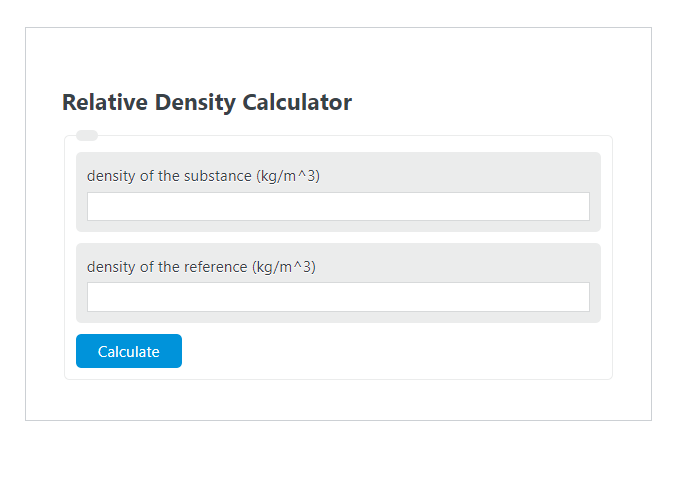
Calculate relative density (specific gravity), substance density, or reference density with water and air presets plus automatic density-unit conversion.
- All Chemistry Calculators
- All Density Calculators
- Cylinder Density Calculator
- Weight to Density Calculator
Relative Density Formula
Relative density compares the density of a substance to the density of a reference material. Because it is a ratio of two densities measured in the same units, the result is dimensionless.
| Symbol | Meaning | Units |
|---|---|---|
| RD | Relative density | None |
| ds | Density of the substance | kg/m³, g/cm³, lb/ft³ |
| dr | Density of the reference material | kg/m³, g/cm³, lb/ft³ |
If you know the relative density and one of the density values, the equation can be rearranged to solve for the missing term:
How to Use the Relative Density Calculator
- Enter the density of the substance.
- Enter the density of the reference material.
- Leave the unknown field blank if you want the calculator to solve for it.
- Make sure both density inputs use the same unit system before calculating.
You can directly compare values only when the units match. For example, kg/m³ should be paired with kg/m³, g/cm³ with g/cm³, and lb/ft³ with lb/ft³.
| Input Pair | Use Directly? | Note |
|---|---|---|
| kg/m³ and kg/m³ | Yes | No conversion needed |
| g/cm³ and g/cm³ | Yes | No conversion needed |
| lb/ft³ and lb/ft³ | Yes | No conversion needed |
| Mixed units | No | Convert first, then divide |
How to Interpret Relative Density
| Result | Interpretation |
|---|---|
| Greater than 1 | The substance is denser than the reference material. |
| Equal to 1 | The substance and reference have the same density. |
| Less than 1 | The substance is less dense than the reference material. |
When water is the reference, a value greater than 1 means the substance is denser than water, while a value less than 1 means it is less dense than water. This is why relative density is often used for quick buoyancy and comparison checks.
Reference Material Matters
A relative density value only makes sense when the reference material is clearly defined. In many practical cases, water is used as the reference for liquids and solids, while gases are often compared with air. If the reference changes, the relative density changes as well.
- Liquids and solids: often compared with water
- Gases: often compared with air
- Technical reporting: always state the reference material used
Examples
Example 1: A substance has a density of 800 kg/m³ and the reference density is 1000 kg/m³.
The result shows the substance is less dense than the reference.
Example 2: A material has a relative density of 2.5 and the reference density is 1200 kg/m³.
The density of the substance is 3000 kg/m³.
Common Uses of Relative Density
- Chemistry and laboratory testing
- Material identification and comparison
- Geology and mineral analysis
- Fluid handling and process engineering
- Quality control and product specification checks
Common Mistakes
- Using different density units without converting them first
- Forgetting to identify the reference material
- Assuming relative density has units
- Ignoring temperature effects when densities are measured under different conditions
- Rounding too early during intermediate calculations
Relative Density vs. Density
| Property | Density | Relative Density |
|---|---|---|
| Definition | Mass per unit volume | Ratio of one density to a reference density |
| Units | Has units | Unitless |
| Purpose | Measures absolute compactness of matter | Shows how dense something is compared with a standard |
FAQ
- Does relative density have units?
- No. The units cancel when both densities are expressed in the same unit system.
- Can relative density be negative?
- For ordinary physical density measurements, no. Density values are positive, so their ratio is also positive.
- Is relative density the same as specific gravity?
- In many practical situations the terms are used similarly, especially when water is the reference, but the reference material should still be stated clearly.
- Why do temperature and pressure matter?
- Density changes with conditions, especially for fluids and gases. For accurate comparison, densities should be measured under consistent conditions.