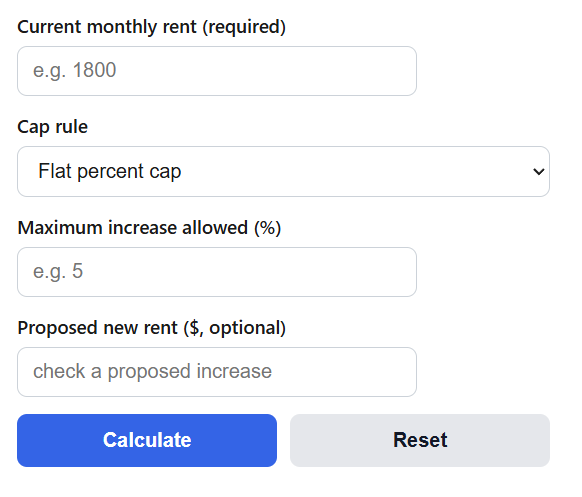
This rent increase cap calculator finds the maximum legal rent increase and new rent under a percent cap or a CPI-plus rule such as California’s 5% + CPI.
Rent Increase Cap Formula
A rent cap limits how much a landlord can raise the rent in a year. Many caps combine an inflation figure with a fixed percentage, then apply a hard ceiling:
Allowed Increase = min(CPI + Fixed, Hard Cap)
Once you know the allowed percentage, the maximum new rent and the largest legal increase follow directly:
Max New Rent = Current Rent * (1 + Allowed / 100)
 Max Increase = Max New Rent - Current Rent
Variables:
- Current Rent is the rent you pay now
- CPI is the local change in the Consumer Price Index, a measure of inflation
- Fixed is the flat percentage a law adds on top of CPI (5% under California’s statewide cap)
- Hard Cap is the absolute ceiling regardless of inflation (10% under California’s statewide cap)
Some places use a simple flat percentage cap with no CPI component, which is why the calculator also offers a plain percent mode. You can enter a proposed new rent to check whether it stays within the limit.
Examples of Rent Cap Rules
Rent-cap rules differ widely, and many units are exempt. These examples show the range of approaches; always confirm the rule that applies to your unit.
| Approach | How the cap works |
|---|---|
| California (statewide) | 5% + regional CPI, never above 10% |
| Flat percentage cap | A single fixed limit, such as 5% or 7%, per year |
| CPI-only cap | Tied to inflation alone, sometimes with a floor and ceiling |
| No cap | Increases limited only by proper notice and the lease terms |
Common exemptions include newer construction, single-family homes not owned by a corporation, and units already under local rent control with their own rules. Notice requirements also apply, often 30 to 90 days depending on the size of the increase.
Example Problems
Example 1: A flat percentage cap.
Your rent is $1,800 and the local cap is 5%. The largest legal increase is 1,800 * 0.05 = $90, so the maximum new rent is $1,890. A proposed rent of $1,950 would be over the cap by $60 a month.
Example 2: The California 5% + CPI rule.
Your rent is $2,000 and regional CPI is 3%. The formula allows 5% + 3% = 8%, which is below the 10% ceiling, so 8% applies. The maximum increase is 2,000 * 0.08 = $160, for a new rent of $2,160.
Frequently Asked Questions
How much can my landlord raise the rent?
It depends entirely on where you live and the type of unit. In areas with no rent cap, a landlord can raise the rent by any amount at lease renewal as long as they give proper notice. In capped areas, the increase is limited to a set percentage, such as California’s 5% plus regional CPI up to a 10% ceiling. This calculator applies whichever cap rule you select.
What is the most rent can go up in California?
Under the statewide Tenant Protection Act, rent on covered units can rise by no more than 5% plus the regional Consumer Price Index in a 12-month period, and never more than 10% total. Some cities have stricter local rent control that overrides the state figure, and certain newer or single-family units are exempt from the state cap.
Does a rent cap apply to every apartment?
No. Rent caps usually exempt buildings under a certain age, single-family homes not owned by corporations, and owner-occupied small properties, among others. Where a local rent-control ordinance exists, its rules take priority. Because exemptions are common, check your unit’s status and any required notice period before assuming a cap applies.