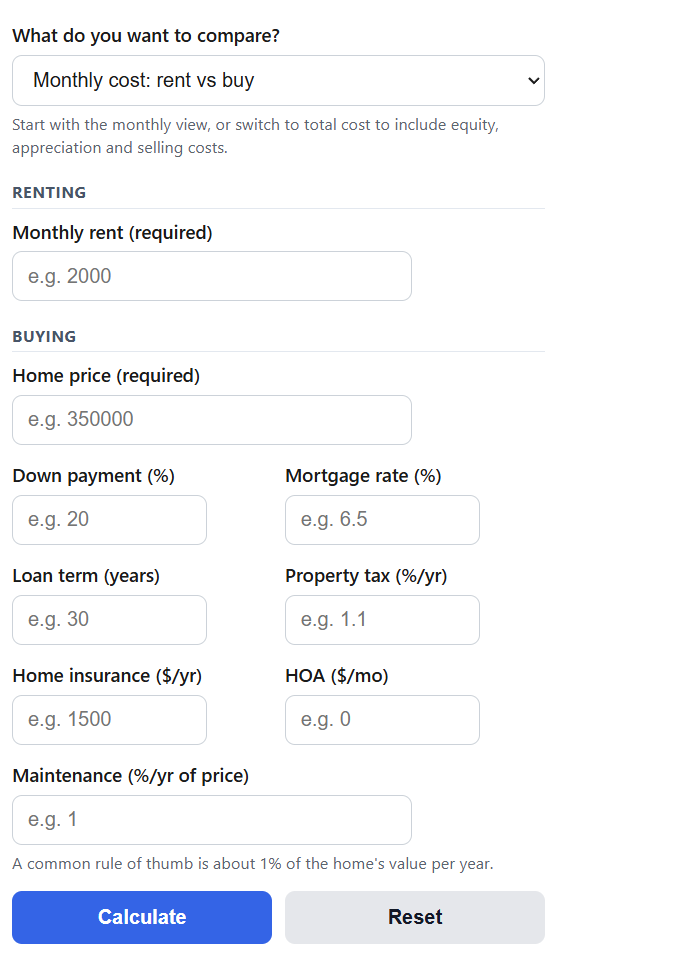
This rent vs buy calculator compares the monthly and long-term cost of renting versus buying a home, including equity, appreciation, and the break-even point.
Rent vs Buy Formula
The monthly cost of owning a home is the mortgage payment plus the ongoing costs a renter does not pay directly:
Monthly Buy Cost = M + T + I + H + R
The mortgage principal and interest payment M comes from the standard amortization formula:
M = P * i / (1 - (1 + i)^-n)
Variables:
- P is the loan amount (home price minus down payment)
- i is the monthly interest rate (annual rate divided by 12)
- n is the number of monthly payments (loan term in years times 12)
- T, I, H, and R are the monthly property tax, home insurance, HOA dues, and maintenance
Comparing monthly costs is only half the picture, because part of every mortgage payment builds equity. To compare fairly over a set number of years, the calculator totals what you spend either way and subtracts what you get back when you sell:
Net Buy Cost = Down + Closing + Payments - (Sale Value - Loan Balance - Selling Cost)
 Net Rent Cost = Total Rent Paid (grown by annual increases)
Whichever net cost is lower over your time horizon is the cheaper option for that period. The longer you stay, the more buying benefits from equity and appreciation, which is why a break-even point exists.
Rent vs Buy Rules of Thumb
Two quick screens can tell you which way to lean before running the full comparison. The price-to-rent ratio divides the home price by the annual rent for a similar place.
| Price-to-rent ratio | General signal |
|---|---|
| 1 to 15 | Buying is often the better value |
| 16 to 20 | Borderline; run the numbers carefully |
| 21 and up | Renting is often cheaper |
The other quick check is the 5% rule: multiply the home price by about 5% (roughly 1% maintenance, 1% property tax, and 3% cost of capital) and divide by 12. If the result is less than the monthly rent for a comparable home, buying tends to win; if it is more, renting does.
Example Problems
Example 1: Compare monthly costs.
Rent is $2,000. A comparable home costs $350,000 with 20% down at 6.5% over 30 years, plus 1.1% property tax, $1,500 insurance, no HOA, and 1% maintenance. The loan is $280,000, so the payment is about $1,770, and tax, insurance, and upkeep add roughly $737, for a monthly buy cost near $2,507. Renting is about $507 a month cheaper before counting equity.
Example 2: Compare over seven years.
Using the same figures with 3% annual rent increases, 3% appreciation, 3% closing costs, and 6% selling costs, total rent paid is about $184,000 while the net cost of buying is about $140,000 after equity and sale proceeds. Over seven years, buying comes out roughly $44,000 ahead even though its monthly cost is higher.
Frequently Asked Questions
Is it cheaper to rent or buy?
It depends mostly on how long you stay. In the first few years, renting is usually cheaper because buying carries large one-time costs like the down payment and closing fees. The longer you own, the more you gain from paying down the loan and from appreciation, until buying passes renting at the break-even point, commonly somewhere between three and seven years.
What costs do people forget when comparing renting and buying?
Buyers often overlook property tax, homeowners insurance, HOA dues, maintenance of around 1% of the home’s value per year, and the closing and selling costs on each end. Renters sometimes forget that their rent rises over time and that the money not spent on a down payment could be invested. This calculator includes the main ownership costs and lets you add rent increases.
How many years until buying beats renting?
The break-even period is the point where the net cost of buying drops below the net cost of renting. With typical costs it often lands around five years, but a high price-to-rent ratio, steep closing and selling costs, or slow appreciation push it later, while low mortgage rates and fast appreciation pull it earlier. Enter your own numbers to find the crossover for your situation.