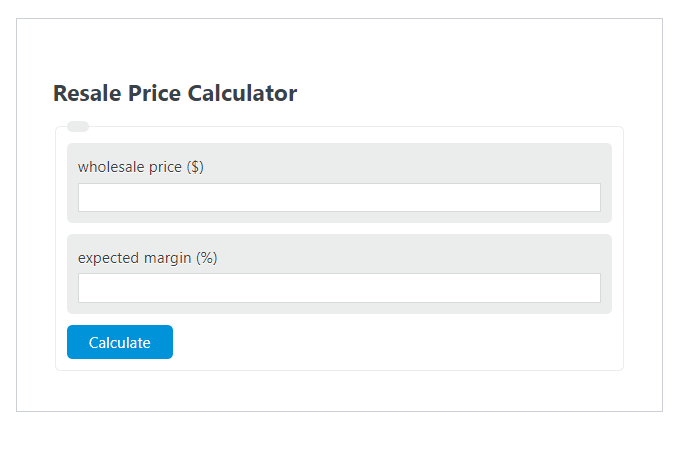
Calculate a resale price from target profit, markup, or margin, or check profit from a known price after item costs, shipping, and seller fees.
Related Calculators
- Price Multiplier Calculator
- Cost Per Item Calculator
- Absorption Cost Calculator
- Reserve Price Calculator
- All Business Calculators
Resale Price Formulas
The core resale price formula solves for any one of three variables when the other two are known:
- RP = Resale Price ($)
- WP = Wholesale Price ($)
- EM = Expected Margin (%)
Rearranging for wholesale price: WP = RP x (1 – EM/100). Rearranging for margin: EM = (1 – WP/RP) x 100.
When fees are involved (marketplace commissions, payment processing), the net margin formula becomes: Net Margin = (Price – COGS – Variable Fees – Fixed Fees) / Price x 100. The After Fees tab in the calculator above uses this expanded formula to determine the selling price needed to achieve a target net margin after all costs are deducted.
Margin vs. Markup
Margin and markup both describe the relationship between cost and selling price, but they use different denominators and produce different numbers from the same transaction. Confusing the two is one of the most common pricing errors in retail and wholesale.
Margin is calculated as a percentage of the selling price: Margin = (Price – Cost) / Price x 100. Markup is calculated as a percentage of the cost: Markup = (Price – Cost) / Cost x 100. A product that costs $60 and sells for $100 has a 40% margin but a 66.7% markup. The relationship between them is: Margin = Markup / (1 + Markup) and Markup = Margin / (1 – Margin).
At low values the two metrics are close together, but they diverge rapidly. A 50% markup equals a 33.3% margin. A 100% markup (the classic keystone doubling) equals exactly a 50% margin. A 200% markup equals a 66.7% margin. This non-linear relationship is why businesses that set pricing by markup often overestimate their actual margin and undercount the cost absorption needed to remain profitable.
Typical Resale Margins by Industry
Margins vary widely across product categories due to differences in inventory risk, spoilage, fashion cycles, and capital intensity. The following ranges reflect gross margins (before operating expenses) commonly observed across retail and e-commerce:
| Product Category | Typical Gross Margin | Typical Markup | Key Margin Driver |
|---|---|---|---|
| Grocery / Staples | 15 – 25% | 18 – 33% | High volume, low spoilage tolerance |
| Electronics | 15 – 25% | 18 – 33% | Rapid depreciation, price transparency |
| Furniture | 30 – 50% | 43 – 100% | Showroom costs, delivery logistics |
| Apparel (third-party) | 25 – 35% | 33 – 54% | Seasonal markdowns, return rates |
| Apparel (private label) | 40 – 65% | 67 – 186% | Brand control, direct sourcing |
| Beauty / Cosmetics | 50 – 70% | 100 – 233% | Low COGS, brand premium |
| Jewelry | 50 – 100% | 100%+ | Perceived value, craftsmanship |
| Footwear | 30 – 50% | 43 – 100% | Size curve inventory risk |
| Auto Parts | 20 – 35% | 25 – 54% | SKU complexity, fitment specificity |
| Luxury Goods | 60 – 68% | 150 – 213% | Scarcity, brand equity |
Net profit margins across retail are considerably tighter. The overall retail average sits near 3%, with auto parts retailers averaging around 1.6% and computer/electronics retailers closer to 17.5%. The gap between gross and net margin reflects operating costs like rent, labor, logistics, and marketing that erode the gross margin achieved at the product level.
Online Marketplace Seller Fees
For resellers operating on online platforms, marketplace fees reduce the effective margin on every sale. These fees must be factored into the resale price to avoid selling at a loss. The table below summarizes current fee structures across major platforms:
| Platform | Seller Fee Structure | Approximate Total Fee |
|---|---|---|
| eBay | ~13.25% of sale + $0.30 per order | ~13.5% |
| Mercari | 10% selling fee + 2.9% + $0.30 processing | ~13% |
| Poshmark | $2.95 flat (under $15) or 20% (over $15) | ~20% |
| Etsy | $0.20 listing + 6.5% transaction + 3% + $0.25 processing | ~10% |
| Amazon (Individual) | $0.99/item + referral fee (8-15% by category) | ~15% |
| Facebook Marketplace | 0% (local pickup) or ~5% (shipped) | 0 – 5% |
A seller listing a $50 item on Poshmark pays $10 in fees (20%), leaving $40 in gross revenue. The same item on eBay incurs roughly $6.93 in fees (~13.5%), leaving $43.07. Over hundreds of transactions, that 6.5 percentage point difference compounds significantly. The After Fees tab in the calculator above lets you model these scenarios directly.
Depreciation and Resale Value Over Time
Resale pricing for used goods requires accounting for depreciation, which is the loss of value an item experiences after purchase. Depreciation rates vary dramatically by product category and have a direct impact on what price the secondary market will bear.
Vehicles lose roughly 20% of their value in the first year and 30 to 45% over three to five years, though brands with strong reliability reputations (Toyota, Honda, Porsche) depreciate more slowly. Consumer electronics depreciate the fastest of any major category, with smartphones losing 25 to 45% of their value within the first year due to rapid product cycles. Furniture depreciates at roughly 10% per year for quality pieces, but mass-produced items can lose 50% or more of their retail price the moment they leave the store, largely because retail markups on furniture often exceed 200%. Clothing depreciates rapidly as well, with fast fashion items retaining as little as 10 to 20% of retail value on the secondary market, while designer and luxury pieces may hold 40 to 70% depending on brand and condition.
The general depreciation formula for estimating resale value is: Resale Value = Original Price x (1 – Annual Depreciation Rate) ^ Years Owned. For a $1,200 laptop depreciating at 35% per year, the estimated resale value after two years would be $1,200 x (0.65)^2 = $507.
The Resale Price Method in Transfer Pricing
In international tax and transfer pricing, the term resale price has a specific regulatory meaning. The Resale Price Method (RPM) is one of five OECD-approved methods for determining arm’s length pricing between related entities in different tax jurisdictions. It works by taking the price at which a product is resold to an independent third party and subtracting an appropriate gross margin to arrive at what the intercompany purchase price should have been.
The formula is: Arm’s Length Price = Resale Price x (1 – Gross Margin). RPM is most appropriate when the reseller adds minimal value to the product (pure distribution without manufacturing, branding, or significant processing). Tax authorities favor this method for distribution subsidiaries because the resale price to the end customer is an observable market price, making the calculation transparent and auditable. The method becomes less reliable when the reseller performs substantial value-added functions, in which case transactional net margin methods or profit split approaches are preferred.
Pricing Strategy Considerations
Setting a resale price is not purely a math exercise. The calculated price must also account for market positioning, competitive pressure, and consumer psychology. Odd pricing ($49.99 vs. $50.00) continues to influence purchase behavior in both physical and online retail. Bundling multiple lower-margin items together can achieve a higher effective margin per transaction than selling each individually. Seasonal timing matters as well: electronics resale prices drop 10 to 15% in the weeks following new model releases, and apparel markdowns at the end of a season can reach 60 to 80%.
For wholesale-to-retail resellers, the keystone pricing rule (100% markup, or a 50% margin) remains a common starting benchmark, but it fails in categories with high competition and price transparency (electronics, commodity goods) and undersells in categories where perceived value supports higher margins (luxury, beauty, artisanal goods). The optimal resale price balances the margin needed for profitability against the price ceiling the market will support for that specific product, channel, and customer segment.